Which Countries Use the Euro (and Which Don't)?
Italy, France, Ireland, Greece, Spain and Germany all use the euro, but Switzerland, Denmark and Sweden do not. Here is the full 2026 list of euro countries, the currencies they replaced, and what travelers should know before they pay.
Key points
- Italy uses the euro (EUR, €). It replaced the Italian lira at a fixed rate of 1,936.27 lire per euro, with euro cash arriving on January 1, 2002.
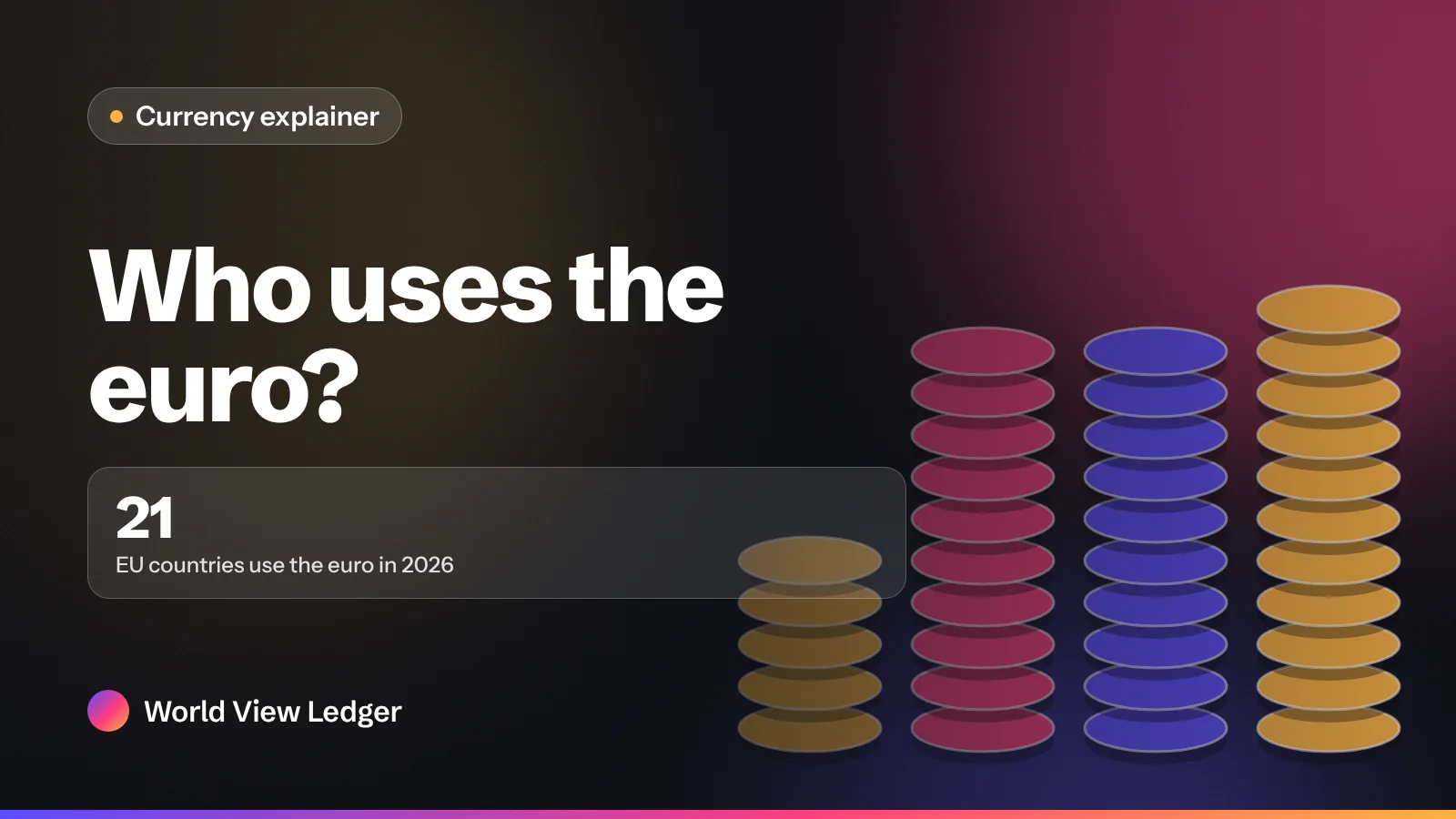
- As of November 2026, 21 of the EU's 27 countries use the euro. Bulgaria became the 21st on January 1, 2026, and the ECB says about 358 million people now use the currency.
- France, Ireland, Greece, Spain and Germany all use the euro. Switzerland does not: it uses the Swiss franc (CHF), as does Liechtenstein.
- Six EU members keep their own money: Czechia, Denmark, Hungary, Poland, Romania and Sweden. Denmark has a legal opt-out; the ECB's June 2026 Convergence Report found none of the other five ready to join.
- Outside the EU, Andorra, Monaco, San Marino and Vatican City use the euro under agreements with the EU, while Kosovo and Montenegro use it without one.
What currency does Italy use? Italy uses the euro (code EUR, symbol €), the shared currency of 21 European Union countries. The euro replaced the Italian lira at a fixed rate of 1,936.27 lire per euro, and euro banknotes and coins have been the only legal cash in Italy since early 2002.
Italy is far from alone. This guide lists every country that uses the euro as of November 2026, the national currencies they gave up, the European countries that still keep their own money (Switzerland, Denmark and Sweden among them), and the places outside the EU where you will be handed euros anyway. It ends with practical advice for travelers paying in euros from the US, UK, Australia or the UAE.
What is the currency in Italy? The euro, explained
The euro is managed by the European Central Bank (ECB) in Frankfurt together with the national central banks of the member countries, including the Banca d'Italia. The ECB is also preparing a possible digital euro, which it says could first be issued in 2029; our guide to how a cashless society affects your privacy explains what it would and would not reveal about your spending. The euro itself was launched in two stages:
- January 1, 1999: the euro became the official currency of 11 countries, including Italy, but only as "book money" for bank transfers, card payments and financial markets. Old national notes and coins stayed in people's wallets, now fixed at a permanent conversion rate.
- January 1, 2002: euro banknotes and coins went into circulation. In Italy, the lira ceased to be legal tender on February 28, 2002, according to the Bank of Italy.
Because the conversion rate was fixed, every price in Italy was simply divided by 1,936.27. A 10,000-lira pizza became about €5.16 overnight. For years afterward, many Italians mentally converted prices back into lire, and the sense that prices jumped at the changeover is still a common complaint. If you want to understand why price increases feel so personal, our guide to stagflation and deflation explains how inflation is measured.
What Italian euros look like
Euro banknotes are identical across all member countries. Coins share a common side, but each country designs its own national side, and every euro coin is legal tender everywhere in the euro area. Italy's designs are a small tour of Italian art and architecture, according to the ECB:
| Coin | Italian national side |
|---|---|
| €2 | Raphael's portrait of the poet Dante Alighieri |
| €1 | Leonardo da Vinci's drawing of ideal human proportions (the Vitruvian Man) |
| 50 cents | The equestrian statue of Emperor Marcus Aurelius |
| 20 cents | A sculpture by the Futurist artist Umberto Boccioni |
| 10 cents | Botticelli's Birth of Venus |
| 5 cents | The Colosseum (Flavian Amphitheater) in Rome |
| 2 cents | The Mole Antonelliana tower in Turin |
| 1 cent | Castel del Monte in Apulia |
So a German, Spanish or Greek coin in your change in Rome is perfectly normal and spends exactly the same.
Which countries use the euro? The full 2026 list
As of November 2026, 21 of the EU's 27 member states use the euro. Together they form the euro area, often called the eurozone. The newest member is Bulgaria, which adopted the euro on January 1, 2026, bringing the number of people using the currency to about 358 million, according to the ECB.
Each country swapped its old currency at an irrevocable rate, fixed on the day it joined. The rates below come from the Banco de España's table of irrevocable exchange rates.
| Country | Joined | Old currency | Units per €1 |
|---|---|---|---|
| Austria | 1999 | Austrian schilling | 13.7603 |
| Belgium | 1999 | Belgian franc | 40.3399 |
| Finland | 1999 | Finnish markka | 5.94573 |
| France | 1999 | French franc | 6.55957 |
| Germany | 1999 | Deutsche Mark | 1.95583 |
| Ireland | 1999 | Irish pound (punt) | 0.787564 |
| Italy | 1999 | Italian lira | 1,936.27 |
| Luxembourg | 1999 | Luxembourg franc | 40.3399 |
| Netherlands | 1999 | Dutch guilder | 2.20371 |
| Portugal | 1999 | Portuguese escudo | 200.482 |
| Spain | 1999 | Spanish peseta | 166.386 |
| Greece | 2001 | Greek drachma | 340.750 |
| Slovenia | 2007 | Slovenian tolar | 239.640 |
| Cyprus | 2008 | Cypriot pound | 0.585274 |
| Malta | 2008 | Maltese lira | 0.429300 |
| Slovakia | 2009 | Slovak koruna | 30.1260 |
| Estonia | 2011 | Estonian kroon | 15.6466 |
| Latvia | 2014 | Latvian lats | 0.702804 |
| Lithuania | 2015 | Lithuanian litas | 3.45280 |
| Croatia | 2023 | Croatian kuna | 7.53450 |
| Bulgaria | 2026 | Bulgarian lev | 1.95583 |
Two details stand out. Belgium and Luxembourg share a rate because their francs were already tied one-to-one. And Bulgaria's rate is identical to Germany's, because the lev had been pegged to the Deutsche Mark since 1997, and to the euro after that, long before Bulgaria joined.
Euro cash for the first 12 countries arrived in 2002. Slovenia, Cyprus, Malta, Slovakia, Estonia, Latvia, Lithuania, Croatia and Bulgaria switched notes and coins on the day they joined.
What currency do France, Spain, Germany, Ireland and Greece use?
All five use the euro, but each has a twist worth knowing.
France
Mainland France uses the euro, which replaced the French franc at 6.55957 francs per euro. So do France's overseas regions such as Réunion, Mayotte, French Guiana and the French Caribbean islands, which are part of the EU. France's Pacific territories (French Polynesia, New Caledonia, and Wallis and Futuna) are different: they use the CFP franc, a separate currency tied to the euro. In West and Central Africa, 14 countries use the CFA franc, which is also pegged to the euro, as the Banque de France explains, but it is not the euro itself.
Spain
Spain uses the euro, which replaced the peseta at 166.386 pesetas per euro. That includes the Canary Islands, the Balearic Islands, and the cities of Ceuta and Melilla on the North African coast.
Germany
Germany uses the euro. The Deutsche Mark, one of the world's most trusted currencies after the Second World War, was converted at 1.95583 marks per euro. The ECB's headquarters are in Frankfurt, and Germany is the largest economy in the euro area.
Ireland
The Republic of Ireland uses the euro, which replaced the Irish pound at 0.787564 pounds per euro. Northern Ireland, which is part of the United Kingdom, uses the pound sterling. If you drive from Dublin to Belfast, the currency changes at the border, so card payments are the easiest way to cover a trip to both.
Greece
Greece uses the euro. It joined in 2001, two years after the founding members, replacing the drachma at 340.750 drachmas per euro. During the debt crisis of the 2010s there was serious talk of a "Grexit", but Greece never left, and the euro remains its currency as of November 2026.
What currency does Switzerland use?
Switzerland uses the Swiss franc (CHF), not the euro. Switzerland is not a member of the EU, and its currency is issued by the Swiss National Bank. Liechtenstein also uses the Swiss franc.
Even so, Switzerland's money is closely bound to the euro, because the euro area is its biggest trading partner. Between 2011 and 2015 the Swiss National Bank capped the franc's strength at 1.20 francs per euro to protect exporters, before dramatically abandoning that minimum exchange rate on January 15, 2015, which sent the franc soaring in minutes.
Which EU countries do not use the euro?
Six EU members still use their own currencies as of November 2026:
| Country | Currency | Status |
|---|---|---|
| Czechia | Czech koruna (CZK) | Must join eventually; no date set |
| Denmark | Danish krone (DKK) | Legal opt-out; krone pegged to the euro |
| Hungary | Hungarian forint (HUF) | Must join eventually; no date set |
| Poland | Polish złoty (PLN) | Must join eventually; no date set |
| Romania | Romanian leu (RON) | Must join eventually; no date set |
| Sweden | Swedish krona (SEK) | Must join eventually; voters rejected the euro in a 2003 referendum |
Denmark's special deal
Denmark negotiated a legal opt-out from the euro in the 1990s and voters rejected joining in a 2000 referendum. But in practice the krone shadows the euro closely. Danmarks Nationalbank keeps it stable around a central rate of 7.46038 kroner per euro every day. Denmark is part of the EU's exchange rate mechanism, ERM II, with a band of plus or minus 2.25%, in place since January 1, 1999, according to the Bank of Finland.
Why the other five have not joined
Under EU treaties, Czechia, Hungary, Poland, Romania and Sweden are expected to adopt the euro once they meet the "convergence criteria" on inflation, public finances, long-term interest rates and exchange rate stability, which includes at least two years in ERM II. In practice, each country controls the timing, because it must first choose to apply to enter ERM II, and none of the five has done so.
The ECB's June 2026 Convergence Report found that none of the five was fully compatible with the requirements for adopting the euro. Hungary, Poland and Romania had inflation above the 2.7% reference value and budget deficits above 3% of GDP in 2025. Czechia and Sweden met the inflation test, but neither currency is in ERM II, so neither can qualify yet.
The trade-off is real. Keeping a national currency lets a central bank set its own interest rates and lets the exchange rate absorb shocks. Joining removes currency risk for trade and travel but hands monetary policy to the ECB. Our guide to recessions and depressions explains why that loss of control matters most when an economy turns down.
Countries outside the EU that use the euro
The euro is also used well beyond the EU's borders. The European Union's official guide lists six non-EU places that use it:
- With an agreement: Andorra, Monaco, San Marino and Vatican City have monetary agreements with the EU. They use the euro as their official currency and may issue a limited number of their own euro coins, which is why Vatican and Monaco coins are prized by collectors.
- Without an agreement: Kosovo and Montenegro adopted the euro on their own. They use euro cash but cannot issue coins or take part in ECB decisions.
Several EU territories far from mainland Europe also use the euro, including the Azores and Madeira (Portugal), the Canary Islands (Spain), and Saint Pierre and Miquelon (France), off the coast of Canada.
Beyond those, dozens of currencies are pegged to the euro or use it as an anchor, from the Danish krone and the CFA franc to the Bosnian convertible mark. The euro is also the world's second most important currency for borrowing, lending and central bank reserves after the US dollar, the EU says. Like the dollar, it is fiat money, with no link to gold.
Paying in euros: tips for travelers from the US, UK, Australia and the UAE
Whether you arrive with dollars, pounds, Australian dollars or dirhams, the same rules save money in the euro area.
Always choose to pay in euros
Card terminals and ATMs in Europe often offer to charge you in your home currency. This is called dynamic currency conversion, and the rate is set by the terminal's provider, usually with a markup. EU law, under Regulation (EU) 2019/518, requires the provider to show that markup as a percentage over the ECB's reference rate before you pay, and to tell you that you can pay in the local currency instead. Choose euros, and let your own card issuer do the conversion.
How each traveler is affected
| Traveling from | Home currency | What to check before you go |
|---|---|---|
| United States | US dollar (USD) | Whether your card charges a foreign transaction fee; many travel cards do not |
| United Kingdom | Pound sterling (GBP) | Non-sterling transaction and ATM fees on your debit card; Ireland and Northern Ireland use different currencies |
| Australia | Australian dollar (AUD) | International transaction fees and overseas ATM charges from your bank |
| UAE | UAE dirham (AED) | Your bank's foreign currency fee; the dirham is pegged to the US dollar, so its value against the euro moves with the dollar's |
Carry a little cash
Cards work almost everywhere in Italy, France, Spain and Germany's cities, but small cafés, markets, rural guesthouses and some taxis still prefer cash. Withdraw euros from a bank-run ATM rather than an independent cash machine, and again decline any offer to convert the amount into your home currency.
Watch the borders
A single trip can cross several currencies. A rail journey from Milan to Zurich takes you from euros to Swiss francs. A ferry from Italy to Croatia stays in euros, since Croatia joined in 2023, but a drive from Austria into Czechia or Hungary does not. Bulgaria now uses the euro, so leva are no longer needed there.
This is general information, not financial advice; see our disclaimer. Check fees with your own bank or card provider before you travel.
Can you still exchange old lire, francs or pesetas?
It depends on the country. Each central bank set its own deadline for swapping old notes and coins into euros. Some, including Germany's Bundesbank, still exchange old Deutsche Mark notes and coins with no time limit. Others closed the window years ago.
Italy is one of the strictest. The lira exchange window was meant to close on February 28, 2012, but a 2011 emergency decree brought the deadline forward to December 6, 2011. In 2015, Italy's Constitutional Court ruled that early cut-off unlawful, as the Bank of Italy announced. Only people who could prove they had asked to convert lire between those two dates were allowed to do so. The Bank of Italy now states that under the current legal framework, lire can no longer be exchanged, apart from that narrow group whose claims were formally kept alive. Since 2016 it has processed 268 such conversions, worth €2.7 million in total.
So if you find old lire in a drawer, they are now a souvenir or a collector's item, not money.
The bottom line
Italy uses the euro, as do France, Spain, Germany, Ireland, Greece and 15 other EU countries, 21 in all as of November 2026. Switzerland, Denmark, Sweden, Poland, Czechia, Hungary and Romania keep their own currencies, and the UK uses the pound. Six small non-EU states and territories, from Monaco to Kosovo, use the euro too. For travelers, the practical rule is simple: carry a card with low foreign fees, always pay in the local currency, and keep a few euros in cash for the places cards do not reach. For more explainers on how money and economies work, visit our economy section.
Frequently asked questions
What is the currency in Italy?
The euro. Italy was one of the 11 countries that adopted the euro on January 1, 1999, and euro banknotes and coins replaced the lira on January 1, 2002. Prices are written with the € sign, and the ISO code is EUR.
Can I still exchange old Italian lira?
In almost all cases, no. The lira stopped being legal tender on February 28, 2002, and the Bank of Italy says that under the current legal framework lire can no longer be exchanged. The narrow exception covers people who can prove they asked to convert between December 6, 2011 and February 28, 2012 and kept that claim alive.
What currency does Switzerland use?
The Swiss franc (CHF), issued by the Swiss National Bank. Switzerland is not in the EU and has never used the euro, although many shops near borders and in tourist areas accept euros, usually giving change in francs at their own rate.
What currency does Ireland use, and is it the same in Northern Ireland?
The Republic of Ireland uses the euro, which replaced the Irish pound at 0.787564 pounds per euro. Northern Ireland is part of the United Kingdom and uses the pound sterling, so the currency changes when you cross the border.
Does Greece still use the euro?
Yes. Greece joined the euro on January 1, 2001, replacing the drachma at 340.750 drachmas per euro, and it kept the euro through its debt crisis. It remains a member of the euro area as of November 2026.
Which EU countries do not use the euro?
As of November 2026: Czechia, Denmark, Hungary, Poland, Romania and Sweden. Denmark has a treaty opt-out and pegs its krone to the euro. The other five are legally expected to join once they meet the entry criteria but have no set date.
- Bulgaria introduces the euro, European Central Bank, 1 Jan 2026
- ECB reports on progress towards euro adoption (Convergence Report), European Central Bank, 24 Jun 2026
- Irrevocable exchange rates, Banco de España
- The euro outside the euro area, European Union, 12 Jan 2026
- Lira-euro conversion: useful information, Banca d'Italia
- Constitutional Court ruling on lira-euro conversion, Banca d'Italia, 6 Nov 2015
- Italy: euro coins, European Central Bank
- Exchange rates and the fixed exchange rate policy, Danmarks Nationalbank
- Exchange rate mechanism ERM II, Bank of Finland
- Swiss National Bank discontinues minimum exchange rate, Swiss National Bank, 15 Jan 2015
- Regulation (EU) 2019/518 on cross-border payments and currency conversion charges, EUR-Lex, 19 Mar 2019