Key points
- Employers pay for unemployment benefits through two payroll taxes: the federal FUTA tax and a state unemployment (SUTA) tax. Workers contribute only in Alaska, New Jersey and Pennsylvania.
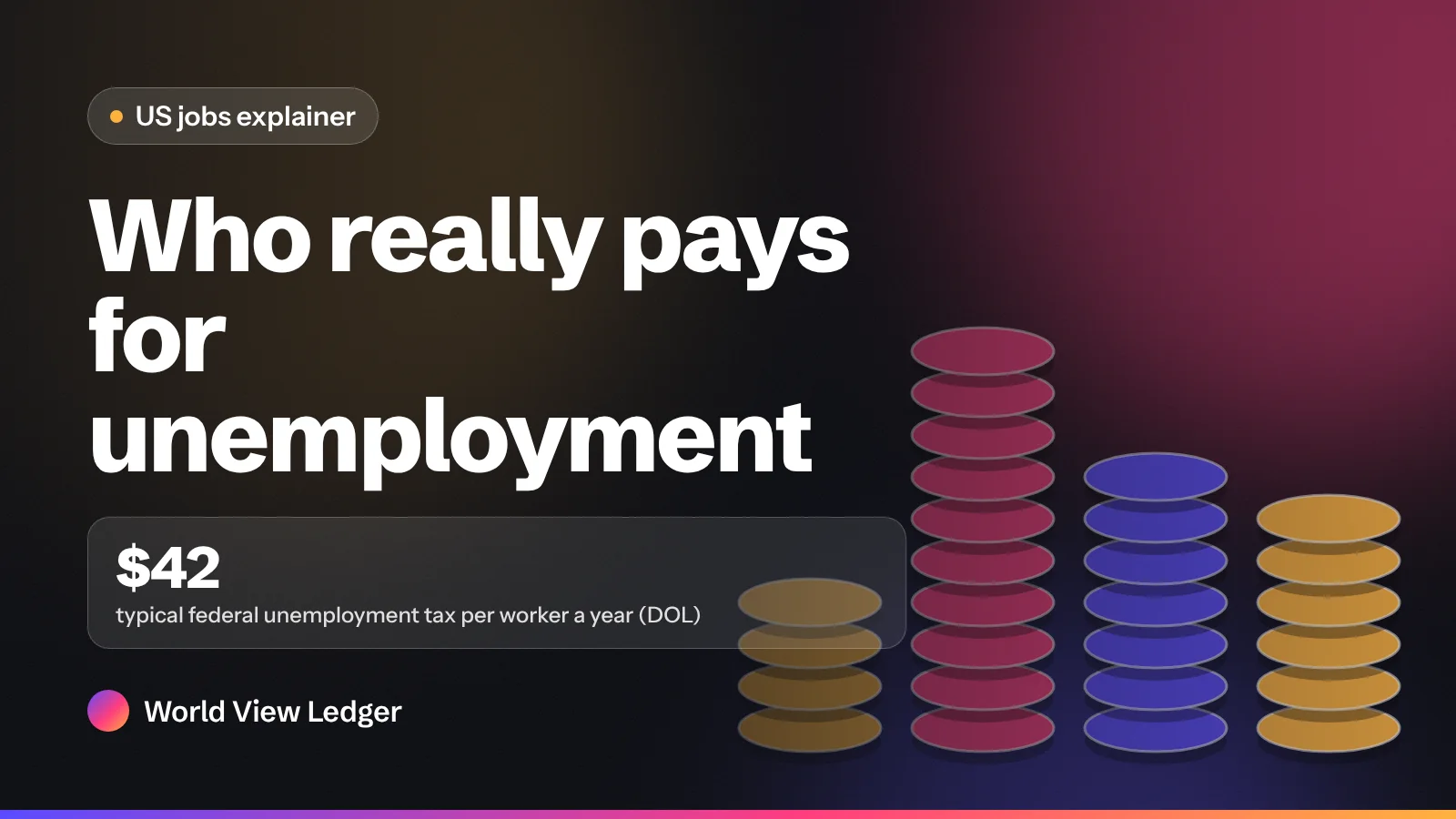
- FUTA is 6.0% of the first $7,000 of each worker's wages, but a 5.4% credit for paying state tax usually cuts it to 0.6%, or $42 per employee a year, according to the Department of Labor.
- State taxes pay the weekly benefit checks. FUTA pays to run the system, covers half of extended benefits in recessions, and lends to states whose funds run dry.
- California still owed about $21 billion in federal loans as of February 2026, so its employers face a 2.1% FUTA rate for 2026 ($147 per worker) instead of 0.6%.
- Unemployment benefits are taxable federal income, reported on Form 1099-G. You only pay benefits back if they were overpaid, and fraud overpayments can never be waived.
Who pays for unemployment? In the United States, employers do. Unemployment benefits are funded almost entirely by two payroll taxes that businesses pay on their workers' wages: a federal tax known as FUTA and a state unemployment tax, often called SUTA. In 47 states and Washington, DC, nothing is taken out of the worker's paycheck for it at all.
This guide explains where unemployment money comes from, how much it costs an employer in 2026, the three states where workers chip in, why California businesses are paying extra, and the questions people ask once they start collecting: is unemployment taxable, does it count as income, and will you have to pay it back? We also compare how the UK, Australia and the UAE fund their safety nets. Figures are as of November 2026.
Who pays for unemployment: the short answer
Unemployment insurance in the US is a joint federal and state program created by the Social Security Act of 1935. Each state runs its own program, sets its own benefit amounts and collects its own tax, while Washington sets minimum rules and collects a federal tax on top. Both taxes fall on employers.
The Department of Labor describes the split clearly. The state tax "is used solely for the payment of benefits to eligible unemployed workers." The federal tax pays for everything around those checks:
- Running the system. FUTA covers the cost of administering unemployment insurance and job services in every state, from staff to claims computers.
- Extended benefits. When unemployment rises sharply, an Extended Benefits program can add weeks of payments. FUTA pays half of the cost; the state pays the other half.
- A lender of last resort. FUTA funds a federal loan account that states can borrow from when their own benefit money runs out, as many did in the 2008 to 2009 recession and in 2020.
So when you collect a weekly unemployment check, the money comes from your state's account, filled by taxes that your former employer and every other employer in the state paid on their payrolls. Benefits are insurance, not welfare: you qualify because of your past work and wages, not because of your income or savings.
Where does unemployment money come from? Inside the trust fund
All of this money sits in one place: the Unemployment Trust Fund, held by the US Treasury. Inside it, each state has its own account, which can only be spent on that state's benefits. Alongside the state accounts sit federal accounts filled by FUTA: one pays administrative costs, one funds the federal share of extended benefits, and one lends to states.
The trust fund is designed to fill up in good times and drain in bad ones. That is why its health swings with the business cycle. According to an analysis of Labor Department data by Equifax Workforce Solutions, state trust fund balances, net of federal loans, were negative $39.46 billion in early 2011 after the Great Recession and negative $27.12 billion in early 2021 after the pandemic layoffs. By the end of 2025 they had recovered to a positive $53.83 billion.
That benchmark matters. If a recession hit tomorrow, many states would need to borrow again, and the bill for that borrowing lands on employers, as California shows below. For what a downturn would look like and the signs economists watch, see our explainer on recession vs depression.
FUTA vs SUTA: what employers pay in 2026
The federal tax (FUTA)
The Federal Unemployment Tax Act sets a 6.0% tax on the first $7,000 paid to each employee in a year, according to the IRS. Almost no employer pays the full 6.0%, though. If you pay your state unemployment tax in full and on time, you get a credit of up to 5.4%, which leaves a net rate of 0.6%.
At 0.6% of $7,000, the typical federal unemployment tax is just $42 per employee per year. That $7,000 wage base has not changed since 1983, as EY notes, so in real terms the federal tax has shrunk steadily for four decades. Employers report it once a year on Form 940, due January 31 (February 10 if all deposits were made on time), and must deposit it quarterly once the amount owed tops $500.
The state tax (SUTA)
State taxes are where most of the money is raised, and they vary enormously. Each state chooses its own taxable wage base and a range of rates. The rate a business pays usually depends on its "experience": employers whose former workers have claimed more benefits pay higher rates, while those with few layoffs pay less. New businesses get a standard new-employer rate until they build a track record.
Here is how wide the gap is in 2026:
| State | 2026 taxable wage base | Notes |
|---|---|---|
| Washington | $78,200 | Highest in the country |
| Hawaii | $64,500 | Rates up to 5.6% for negative-balance employers |
| Alaska | $54,200 | Workers also contribute |
| New Jersey | $44,800 | Workers also contribute |
| New York | $17,600 | Up from $12,800 in 2025 |
| Pennsylvania | $10,000 | Workers pay on all wages |
| Texas | $9,000 | No state income tax |
| Arizona | $8,000 | New employers pay 2.0% |
| California, Florida, Tennessee | $7,000 | The federal minimum |
Wage bases and rates as reported by state agencies and compiled by payroll providers and Equifax, as of 2026. Rates differ by employer; check your state workforce agency for your own.
A worked example
Take a small firm with 10 employees, each earning $50,000 a year.
- Federal tax: 0.6% x $7,000 x 10 workers = $420 a year in most states.
- State tax in Florida: suppose the firm's assigned rate is 2.0%. It pays 2.0% x $7,000 x 10 = $1,400.
- State tax in Washington: at the same illustrative 2.0% rate, it pays 2.0% x $50,000 x 10 = $10,000, because every dollar of each $50,000 salary is below the $78,200 wage base.
The rate is hypothetical, but the lesson is real: the wage base often matters more than the rate. A low-base state like Florida collects far less per worker, which usually means lower benefits or a thinner trust fund.
Why California employers are paying more in 2026
The 5.4% federal credit has a catch. If a state borrows from the federal loan fund and does not repay it within about two years, its employers lose part of their credit, and the reduction grows by 0.3 percentage points for each year the loan stays unpaid, the IRS explains. Employers effectively repay the state's debt through a higher federal tax.
California borrowed heavily when pandemic claims exploded in 2020 and has not repaid. In February 2026 the Department of Labor said California "currently carries $21 billion in borrowed funds" from the federal government. The state missed the November 10, 2026, repayment deadline, so for 2026 its employers face a FUTA credit reduction of 1.5 percentage points, PayrollOrg reports. The US Virgin Islands, the other jurisdiction at risk, paid off its loans in time.
For a California business with 50 employees, that is an extra $5,250 for 2026 alone. Workers do not pay it directly, but costs like this feed into hiring and wage decisions.
Do employees pay unemployment tax?
In most of the country, no. Employers are not allowed to deduct unemployment tax from workers' pay. Only three states require a worker contribution:
- Alaska: the 2026 employee rate is 0.50% on wages up to $54,200, according to the Alaska Department of Labor. The most any worker can pay is $271 for the year.
- Pennsylvania: workers pay 0.07% of their total gross wages, with no cap, according to the Pennsylvania Department of Labor and Industry. On a $50,000 salary, that is $35 a year.
- New Jersey: workers pay a small unemployment contribution on wages up to the $44,800 base for 2026, set by the New Jersey Department of Labor, which also raised the maximum weekly benefit to $905.
Economists add one caveat. Even when the employer writes the check, part of the cost of any payroll tax is usually passed on to workers over time through slightly lower wages. So the legal answer is "employers," while the economic answer is "employers and, indirectly, workers." The same debate runs through every tax, as our explainer on why we pay taxes and what they fund describes.
Is unemployment taxable, and does it count as income?
Yes. Although the benefits come from a tax-funded program, the IRS says you must generally include all unemployment compensation in your income. Here is how it works:
- Form 1099-G. Early each year, your state agency sends a Form 1099-G showing the benefits paid to you (box 1) and any federal tax withheld (box 4). You report the total on Schedule 1 of Form 1040.
- Withholding is optional. Tax is not taken out automatically. You can ask the agency to withhold a flat 10% for federal tax using Form W-4V, or make quarterly estimated payments instead.
- State tax depends on where you live. Most states with an income tax also tax benefits. According to Kiplinger's state guide, California, New Jersey, Pennsylvania and Virginia are among those that exempt them, and states with no income tax, such as Texas and Florida, do not tax them either.
Example: You collect $450 a week for 20 weeks, or $9,000. If you choose 10% withholding, $45 comes out of each check and you receive $405. At tax time, the full $9,000 counts as income. If you skip withholding, set money aside, because a surprise bill is the most common unemployment tax mistake.
Does unemployment count as income for other purposes? It counts toward your adjusted gross income, and it generally counts when the marketplace calculates Affordable Care Act premium subsidies. But it is not earned income, so it does not count as wages for Social Security credits or the earned income tax credit. The one-time federal exclusion of up to $10,200 of benefits applied only to 2020 and has not been renewed.
Do you have to pay back unemployment?
Not if you were eligible and reported everything accurately. Unemployment is insurance you have already been covered for, not a loan. You only owe money back if the state decides you were overpaid. That can happen because of an agency mistake, earnings you did not report while claiming, a separation reason that later turns out to disqualify you, or a successful appeal by your former employer.
What happens next depends on whether the state finds fraud:
- Non-fraud overpayments. Many states let you request a waiver if you were not at fault and repayment would be unfair. New Jersey, for example, considers waivers only if you did not misrepresent or withhold facts, according to its overpayment FAQ. A few states have no permanent waiver rule at all.
- Fraud overpayments. Federal law bars waivers, and states must add a penalty of at least 15%, the National Employment Law Project notes.
- How states collect. They can deduct the debt from future unemployment benefits, set up repayment plans, go to court, or have federal tax refunds intercepted through the Treasury Offset Program.
Two practical points: you owe the gross amount, including any tax that was withheld, and you usually have a short window (21 days in New Jersey) to appeal an overpayment decision. If you think the decision is wrong, appeal quickly and keep copies of everything you reported.
How the US compares with the UK, Australia and the UAE
Few countries fund unemployment support the American way, with a dedicated employer tax held in state accounts. Our other editions show three different models.
| Country | Main program | Who pays | Benefit (as of 2026) |
|---|---|---|---|
| US | State unemployment insurance | Employers (workers too in 3 states) | Set by each state; New Jersey's maximum is $905 a week |
| UK | New Style Jobseeker's Allowance | Workers and employers, through National Insurance | Up to £95.55 a week (25 or over) for up to 182 days |
| Australia | JobSeeker Payment | General federal tax revenue | A$833.70 a fortnight for a single person without children |
| UAE | Involuntary Loss of Employment (ILOE) scheme | Workers, through insurance premiums | 60% of basic salary, capped, for up to 3 months |
UK. New Style JSA is a contributory benefit: you qualify through Class 1 National Insurance contributions paid as an employee, usually in the previous two tax years, and it lasts up to 182 days, according to GOV.UK. The 2026/27 rates are £75.65 a week for under-25s and £95.55 for those 25 or over, under the DWP's rate tables. Those who do not qualify, or need more, turn to means-tested Universal Credit. The same contributions mostly fund the State Pension, as our guide to what National Insurance pays for explains.
Australia. There is no unemployment insurance at all. JobSeeker Payment is a means-tested benefit paid from general government revenue, so every taxpayer funds it rather than employers specifically. From September 20, 2026, a single person without children can receive up to A$833.70 a fortnight, according to the Department of Social Services. Australia instead requires employers to fund retirement accounts, as our guide to how superannuation works explains.
UAE. The Emirates flipped the US model: under the ILOE scheme, set up by Federal Decree Law No. 13 of 2022, it is the employee who pays. Workers with a basic salary of AED 16,000 or less pay AED 5 a month plus VAT, and those above pay AED 10, according to the ILOE scheme. After at least 12 months of premiums, a worker who loses their job involuntarily can claim 60% of basic salary, capped at AED 10,000 or AED 20,000 a month, for up to three months. More than AED 620 million has been paid out since payments began in 2024, including more than AED 250 million to about 28,000 workers in the first nine months of 2026, Gulf Today reported, citing the Ministry of Human Resources and Emiratisation.
What it means for you
- If you are a worker: unless you work in Alaska, New Jersey or Pennsylvania, nothing is deducted from your pay for unemployment, and an employer that deducts it elsewhere is breaking the rules. If you lose your job through no fault of your own, file a claim promptly; your employer's taxes have already paid for the coverage.
- If you are collecting: treat benefits as taxable income. Choose 10% withholding or set money aside, report any work you do while claiming, and keep records in case of an overpayment notice.
- If you run a business: budget for both taxes. Your state rate is the bigger cost and the one you can influence, because fewer layoffs and accurate responses to claims lower your experience rating over time. In California, plan for the extra $105 per worker on your 2026 Form 940.
- If you watch the economy: trust fund balances are an early warning. States that enter a downturn with thin reserves borrow, and their employers pay higher taxes for years afterward. Our analysis of whether a US recession is coming tracks the risks.
For more on how taxes and the labor market shape the economy, see our economy coverage.
This is general information, not tax, legal or financial advice; see our disclaimer and check with your state unemployment agency or a qualified tax professional about your own situation.
Frequently asked questions
Who pays for unemployment benefits?
Employers do, in almost every state. They pay a federal unemployment tax (FUTA) and a state unemployment tax (SUTA) on each worker's wages. The state tax funds the weekly benefit checks, and the federal tax pays to administer the program, covers half of extended benefits and funds loans to states. Only Alaska, New Jersey and Pennsylvania also take a small contribution from workers' pay.
Where does unemployment money come from?
From employer payroll taxes held in the Unemployment Trust Fund at the US Treasury. Each state has its own account in the fund, filled by its employers' state unemployment taxes and used only to pay benefits. Federal accounts in the same fund, filled by FUTA, pay for administration and lend money to states when their accounts run out.
Do you have to pay back unemployment?
Not if you were eligible and reported everything correctly. You only repay benefits that were overpaid, for example because of an agency error, unreported earnings or a later ruling that you were not eligible. Many states let you ask for a waiver if the overpayment was not your fault, but federal law bars waivers for fraud, and states must add a penalty of at least 15% to fraud overpayments.
Is unemployment taxable?
Yes, at the federal level. The IRS says you must generally include all unemployment compensation in income. The paying agency sends you Form 1099-G, and you can ask it to withhold a flat 10% for federal tax using Form W-4V. Most states with an income tax also tax benefits, but some, including California, New Jersey, Pennsylvania and Virginia, exempt them.
Does unemployment count as income?
Yes for federal income tax, and it generally also counts toward the household income used to set Affordable Care Act marketplace subsidies. It is not earned income, though, so it does not count as wages for Social Security or for the earned income tax credit.
Do employees pay unemployment tax?
In 47 states and Washington, DC, no: unemployment taxes are paid by the employer and must not be deducted from your pay. Workers do contribute in Alaska (0.50% of wages up to $54,200 in 2026), Pennsylvania (0.07% of all wages) and New Jersey, where a worker rate applies up to a $44,800 wage base in 2026.
- Unemployment Insurance Tax Topic, US Department of Labor, Employment and Training Administration, Sep 2026
- Topic no. 759, Form 940, Employer's Annual Federal Unemployment (FUTA) Tax Return, IRS, Nov 2026
- Topic no. 418, Unemployment compensation, IRS, Nov 2026
- FUTA credit reduction, IRS
- US Department of Labor to probe California's Unemployment Insurance program, US Department of Labor, 18 Feb 2026
- California Faces FUTA Credit Reduction for 2026, PayrollOrg, 13 Nov 2026
- State unemployment insurance wage bases and tax rates for 2026, EY Tax News, 29 Jul 2026
- Outlook for federal and state unemployment insurance tax rates in 2026 and beyond, Equifax Workforce Solutions, Apr 2026
- 2026 Unemployment Insurance Tax Rates, Alaska Department of Labor and Workforce Development, Nov 2026
- Employee Withholding (UC tax), Pennsylvania Department of Labor and Industry
- NJDOL Announces New Benefit Rates for 2026, New Jersey Department of Labor and Workforce Development, 29 Dec 2025
- Overpayments FAQ, New Jersey Department of Labor and Workforce Development
- Unemployment Insurance Overpayments and Waivers, National Employment Law Project
- Is Unemployment Taxable? A State-by-State Guide, Kiplinger, Jan 2026
- New Style Jobseeker's Allowance, GOV.UK, Oct 2026
- Benefit and pension rates 2026 to 2027, Department for Work and Pensions, Feb 2026
- Social Security Payment Parameters, 20 September 2026 indexation, Department of Social Services (Australia), Sep 2026
- About the Involuntary Loss of Employment Scheme, ILOE (UAE)
- Dhs620 million paid out in unemployment insurance benefits since 2024, Gulf Today, 17 Nov 2026