What Is a Cashless Society and What Does It Mean for Privacy?
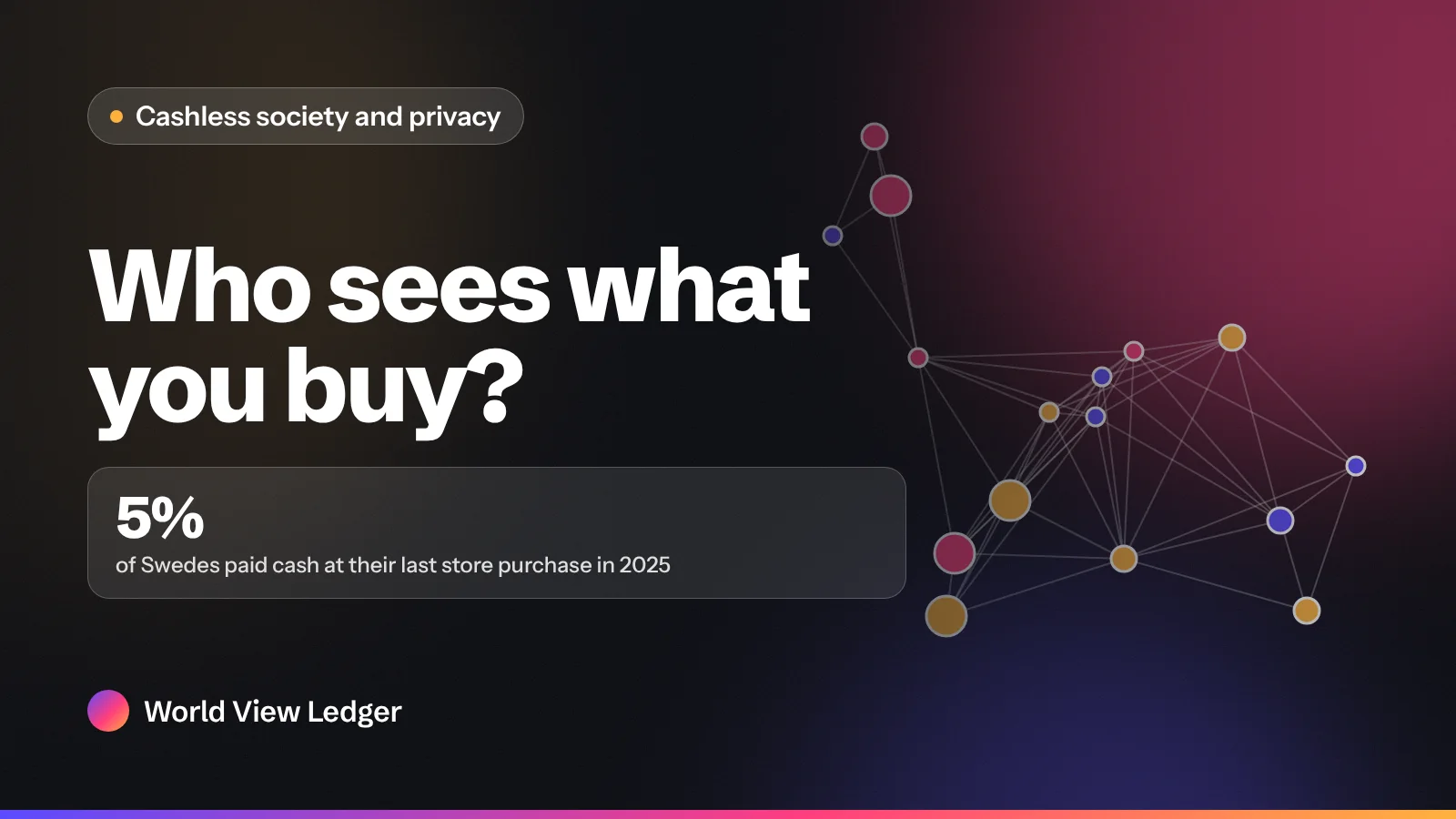
Cash is fading fast: just 5% of Swedes paid cash at their last shop visit. Every digital payment leaves a record. Here is who can read that record, what the law allows them to do with it, and how different countries are protecting the right to pay in cash.
Key points
- In a cashless society almost every purchase is digital, so each one creates a record held by banks, card networks, payment apps and merchants. Cash is the only common payment that leaves no such trail.
- Cash is now a minority habit in rich economies: 5% of Swedes paid cash for their last in-store purchase in 2025, cash was 8% of UK payments in 2025, 14% of US payments in 2024, and about 15% of Australian payments in 2025.
- In the US, bank records generally have no Fourth Amendment protection under United States v. Miller (1976), and banks filed about 4.7 million suspicious activity reports in fiscal 2024.
- Central bank digital currencies raise the stakes. The US has banned a Federal Reserve CBDC through 2030, while the EU is still negotiating a digital euro that the ECB says it could first issue in 2029.
- Several governments now legally protect cash: the UK has access-to-cash rules, Australia requires supermarkets and fuel retailers to accept cash from 2026, and New Jersey, New York City and Philadelphia ban cashless stores.
How does a cashless society affect your privacy? It turns almost every purchase into a permanent record. Cash changes hands without anyone writing down who paid, for what, where or when. Cards, phones and payment apps log all four, and that log is held by banks, card networks, payment processors, retailers and app companies, and can be shared with marketers or handed to governments. A cashless society, in short, is one where the default is to be recorded.
This guide explains how close the world really is to going cashless, exactly who can see your payment data, what the law lets them do with it, why digital currencies issued by central banks have become a political fight, and how the US, UK, Australia and UAE are each trying to keep cash alive. It ends with practical steps to protect your own financial privacy.
What is a cashless society, and how close are we?
A cashless society is one where notes and coins have all but disappeared from everyday spending and people pay digitally instead: by debit or credit card, phone wallet, bank transfer, instant payment app or, in future, central bank digital currency. No country has abolished cash. But in several, it has become a minority habit.
| Country | How much people still use cash | As of |
|---|---|---|
| Norway | 2% paid cash for their last in-store purchase | 2025 |
| Sweden | 5% paid cash for their last in-store purchase (40% about 15 years earlier) | September 2025 |
| Denmark | 8% paid cash for their last in-store purchase | 2025 |
| United Kingdom | 8% of all payments, down from 45% in 2015 | 2025 |
| United States | 14% of consumer payments by number | 2024 |
| Australia | About 15% of all payments by number, 19% of in-person payments | 2025 |
Sources: Riksbank Payments Report 2026 (Nordic figures), UK Finance, the Federal Reserve and the Reserve Bank of Australia. Survey methods differ, so compare the direction of travel rather than the exact numbers.
Sweden is the case everyone watches. In the Riksbank's latest survey, only 56% of people said they ever withdraw cash, down from 71% in 2023, and about one in three people who wanted to pay cash in a shop found it was not accepted. In the UK, UK Finance reports that 19 million adults, a third of the population, now use cash once a month or less, and it forecasts cash will fall to around 4% of payments by 2035.
The decline is not uniform, though. Australia's cash share actually ticked up between the 2022 and 2025 surveys, from about 13% to 15% of payments by number, and roughly 1.5 million Australian adults still rely mainly on cash, according to the RBA. In the US, consumers still made an average of seven cash payments a month in 2024, a figure unchanged since 2020.
Why cash is different: the privacy gap
When you hand over a $20 note, the shop learns what you bought but usually not who you are. Nothing links that sale to your name, your other purchases or your location history. When you tap a card for the same item, at least four parties typically record it:
- Your bank or card issuer, which sees the merchant, amount, date, time and often the location.
- The card network (such as Visa or Mastercard), which routes the payment between banks.
- The merchant and its payment processor, which can tie the card to a loyalty account, receipt email or online profile, and sometimes to the exact items in your basket.
- A wallet or app provider, if you paid by phone or through a payment app.
Each record alone looks harmless. Put together over months, they form a remarkably detailed picture of a life: your commute, your gym, your pharmacy, your political donations, the bar you visit on Fridays, the clinic you went to once.
"Anonymous" payment data is easy to unmask
Companies often say they share only anonymized or aggregated data. Research suggests that protection is thinner than it sounds. In a widely cited 2015 study in Science, researchers at MIT analyzed three months of credit card records for 1.1 million people, with names and card numbers removed. Just four data points (a shop and a day for each of four purchases) were enough to uniquely identify about 90% of individuals. Knowing the approximate price of each purchase raised the risk further.
That matters because the commercial market for payment insights is large and lightly regulated in many countries. In 2023, a consumer group alleged that Mastercard sells aggregated and anonymized transaction data to third parties, CBS News reported; Mastercard said it does not sell personal cardholder data for marketing, location tracking or targeted advertising. In the US, the Consumer Financial Protection Bureau proposed a rule in December 2024 to bring more data brokers under credit reporting law, then withdrew it in May 2025.
Who can see your payment data? The government question
Commercial use is only half the story. The bigger privacy question for most people is what governments can obtain, and how easily.
In the US, bank records have little constitutional protection
In United States v. Miller (1976), the Supreme Court held that a bank customer has no Fourth Amendment interest in his bank records, because the Fourth Amendment does not prohibit "the obtaining of information revealed to a third party." This became known as the third-party doctrine: data you hand to a bank, phone company or other business is generally not treated as private from the government.
The Court carved out an exception in Carpenter v. United States (2018), ruling that police generally need a warrant to obtain historical cell phone location records. But Chief Justice Roberts stressed: "Our decision today is a narrow one." Financial records were not part of the ruling, so Miller still largely governs them.
On top of that, the Bank Secrecy Act requires banks to report cash transactions of more than $10,000 and to flag suspicious activity. The numbers are large. According to FinCEN, financial institutions filed about 4.7 million suspicious activity reports and 20.5 million currency transaction reports in fiscal 2024. These reports exist to fight money laundering, fraud and terrorism financing, and they help catch real criminals. They also mean the government already receives millions of reports on ordinary financial activity every year without a warrant.
From watching to switching off: Canada's 2022 account freezes
The sharpest example of what digital-only money can enable came from Canada. In February 2022, the federal government invoked the Emergencies Act during the trucker convoy protests in Ottawa and ordered banks to freeze funds belonging to people linked to the blockades. An RCMP official told the House of Commons finance committee that at least 257 accounts were frozen by financial institutions.
The courts have since pushed back. In January 2024, the Federal Court found the invocation unreasonable. On January 16, 2026, the Federal Court of Appeal dismissed the government's appeal, finding that requiring banks to search for and disclose customers' property without a warrant breached the Charter's protection against unreasonable search. The Supreme Court of Canada agreed in October 2026 to hear a further appeal.
Whatever you think of the protests, the episode showed a practical point. Cash in a wallet cannot be frozen with an order sent to a bank. A balance held entirely in accounts can.
CBDCs: why central bank digital money is so contested
Central bank digital currencies (CBDCs) are digital versions of a country's own money, issued by the central bank rather than a commercial bank. Like today's notes and coins, they would be fiat currency, backed by the state rather than by gold. Supporters say they offer a public, free, always-accepted alternative to private payment giants. Critics worry they could give the state a direct view of, or even control over, every transaction. Here is where the major ones stand as of November 2026.
| Jurisdiction | Status | Privacy approach |
|---|---|---|
| Euro area (digital euro) | Law still in negotiation; ECB says first issuance could come in 2029 | ECB says it could not identify users of online payments; offline payments private between payer and payee |
| China (e-CNY) | Live; wallet balances held with banks earn interest from 1 January 2026 | "Controllable anonymity": small payments anonymous, large ones traceable by the authorities |
| United States | Banned: Federal Reserve may not issue a CBDC through 2030 | Not applicable |
| United Kingdom (digital pound) | Design phase; no decision to launch | Bank of England has said it would not see users' personal data |
| UAE (Digital Dirham) | Phased rollout planned; retail pilot ran in January 2024 | Details of public rollout not yet confirmed |
The digital euro
The European Central Bank has worked hardest to answer privacy fears. In its official FAQ, it says the Eurosystem would not be able to identify the people making or receiving online payments, although banks and payment providers would, to run anti-money laundering checks. For offline payments made device to device, the ECB says "only the payer and the payee would know the personal transaction details," much like cash. To protect bank deposits, holdings would be capped; the ECB has modeled hypothetical limits of up to €3,000 per person, but no limit has been set.
Politics is the bottleneck. EU governments agreed their position in December 2025 and the European Parliament voted in July 2026 to open negotiations, but talks between the institutions on November 18 and 19, 2026 ended without a deal, with more sessions planned for December. The ECB said in October 2025 that, if the law is adopted in 2026, it could be ready for a first issuance during 2029. Readers who use the euro can see our guide to which countries use the euro.
China's e-CNY and "controllable anonymity"
China's digital yuan takes a different path. The People's Bank of China describes its approach as controllable, or managed, anonymity: small payments can be made with limited identity checks, while larger ones are traceable. As analysts at Stanford's DigiChina point out, the "control" belongs to the central authority, not the user.
The US ban
The US has moved firmly the other way. Executive Order 14178, signed on January 23, 2025, prohibits federal agencies from any action to establish, issue or promote a CBDC. The House passed the Anti-CBDC Surveillance State Act by 219 votes to 210 in July 2025, and a ban was finally written into law through the 21st Century ROAD to Housing Act, which became law without the President's signature on July 11, 2026. It bars the Federal Reserve from issuing a CBDC through December 31, 2030.
Note the irony: Americans are protected from a government digital dollar, but their existing bank and card data remains governed by the weak protections of the third-party doctrine described above.
How the US, UK, Australia and UAE protect cash
Because privacy and inclusion concerns are real, governments are increasingly stepping in to stop cash disappearing by accident. The approaches differ sharply.
| Country | Can shops refuse cash? | Key protection |
|---|---|---|
| United States | Generally yes; no federal rule | State and city laws: New Jersey (2019), Philadelphia and New York City require most in-person retailers to accept cash |
| United Kingdom | Generally yes | Access-to-cash rules in force since 18 September 2024 require designated banks to fill local gaps in withdrawal and deposit services |
| Australia | Not at covered supermarkets and fuel retailers | Mandatory cash acceptance codes from 1 January 2026 for in-person purchases up to $500, 7am to 9pm |
| UAE | Generally yes | Central bank is planning a phased Digital Dirham alongside existing cash |
| Sweden | Generally yes, for now | Banks must keep cash services within 25 km of 99.7% of people; December 2025 proposals would make grocery stores and pharmacies accept cash |
United States
There is no federal law forcing private businesses to take cash. Instead, local governments have acted. New Jersey's 2019 law requires in-person retailers to accept cash, with fines of up to $2,500 for a first violation. New York City requires most businesses to accept cash in store and bars them from charging cash customers more. Philadelphia has a similar rule.
United Kingdom
The UK protects access to cash rather than its acceptance. Under the Financial Services and Markets Act 2023, the Financial Conduct Authority must seek to ensure reasonable provision of cash withdrawal and deposit services. Since September 2024, designated banks and building societies must assess the impact before closing branches or ATMs, respond to local requests, and keep existing services open until any replacement is in place.
Australia
Australia has gone furthest on acceptance. Two mandatory industry codes, overseen by the ACCC, started on 1 January 2026, with penalties applying from 1 July 2026. Supermarkets and fuel retailers must accept cash for in-person transactions of $500 or less between 7am and 9pm. Businesses with turnover under $10 million are exempt, unless they trade under a larger retailer's brand. For more Australian coverage, see our Australia edition.
United Arab Emirates
The UAE is building digital money rather than protecting cash by law. The Central Bank of the UAE said in its July 2025 policy paper that it would soon launch the Digital Dirham in phases, ahead of a full rollout to the public, after a retail pilot in January 2024. Cash remains legal tender in the meantime.
Europe's limit on large cash payments
Rules can cut the other way too. Under the EU's new Anti-Money Laundering Regulation, businesses will not be allowed to accept or make cash payments above €10,000 from 10 July 2027. Everyday spending is unaffected, but it shows how cash privacy is being trimmed at the top end even as governments defend it at the bottom.
The case for going cashless
None of this means a cashless society is simply bad. The benefits are real, which is why so many people choose cards and phones even when cash is available.
- Safety and security. Businesses that hold no cash are less attractive to robbers. In the Riksbank's surveys, security risks are the main reason Swedish retailers give for refusing cash.
- Convenience and speed. Contactless payments are quick, receipts are automatic and budgeting apps can categorize spending instantly.
- Fighting crime and tax evasion. Digital trails make money laundering, bribery and undeclared cash work harder to hide. That is one reason governments collect payment reports, and why we pay the taxes that fund public services more fully when income is visible.
- Financial inclusion, in some countries. India shows how fast digital payments can spread. After the government withdrew the legal tender status of notes making up nearly 86% of currency in circulation by value in November 2016, according to the RBI, digital payments surged. The UPI instant payment system handled a record 25.47 billion transactions in October 2026, according to NPCI data reported by Entrepreneur India.
The trade-off is that the costs fall unevenly. People who are older, poorer, living in rural areas, or escaping financial abuse are more likely to rely on cash. In Australia, one in three people told the RBA they would face hardship or major inconvenience if cash became hard to access.
What it means for you: how to protect your financial privacy
You do not have to choose between going fully cashless and stuffing a mattress. A few habits keep more of your spending private without much effort.
- Keep using some cash. For small, personal purchases you would rather not have on a statement, cash is still the most private option. Regular use also helps keep it accepted locally.
- Read and act on privacy notices. US banks must tell you how they share data, and you can opt out of some sharing with unaffiliated companies. In the UK and EU, data protection law gives you the right to see what data a company holds about you.
- Limit loyalty programs. Loyalty cards and receipt emails link your card payments to an identity and a basket of goods. Decide whether the discount is worth it.
- Check payment app settings. Some apps show transactions to friends or the public by default, and many collect location data. Review who can see your activity.
- Separate sensitive spending. Using a different card or account for health, political or personal payments reduces how much any one provider can piece together.
- Follow the policy debates. Rules on CBDCs, cash acceptance and data brokers are being written now, in Brussels, London, Canberra and Washington. Our economy coverage tracks the changes.
This is general information, not personal financial or legal advice; see our disclaimer.
The bottom line
A cashless society does not have to be a surveillance society, but it becomes one by default unless laws say otherwise. The technology records everything; what matters is who may read the record, for what purpose, and with what oversight. Right now those answers vary enormously: from China's traceable digital yuan to the EU's privacy-focused digital euro design, from America's ban on a CBDC alongside weak protection for bank records, to Australia's new rule that your local supermarket must still take your $20 note. As cash keeps shrinking, those rules, more than the payment technology itself, will decide how private your spending stays.
Frequently asked questions
How does a cashless society affect your privacy?
It removes the one everyday way to pay without leaving a record. Digital payments are logged by your bank, the card network, the payment processor and often the merchant and an app. Those records can show where you were, what you bought and who you paid. Depending on the country, they can be shared with marketers in aggregated form and obtained by governments, often without a warrant.
Is Sweden a cashless society?
Nearly, but not legally. Only 5% of Swedes paid cash for their most recent in-store purchase in 2025, according to the Riksbank, and about one in three people who tried to pay cash found the store would not take it. Cash is still legal tender, banks must keep cash services within reach of almost everyone, and in December 2025 the government proposed requiring grocery stores and pharmacies to accept it.
Can a store refuse to accept cash?
In most places, yes, unless a specific law says otherwise. In the US there is no federal rule forcing private businesses to take cash, but New Jersey, New York City and Philadelphia require most in-person retailers to accept it. In Australia, larger supermarkets and fuel retailers must accept cash for in-person purchases of $500 or less between 7am and 9pm from 1 January 2026.
Will the digital euro let the ECB track my spending?
The ECB says no. Under its design, the Eurosystem would not be able to identify the people making or receiving online payments, although your bank or payment provider would, for anti-money laundering checks. For offline payments, the ECB says only the payer and payee would know the details. The law creating the digital euro was still being negotiated as of November 2026.
Does the United States have a central bank digital currency?
No. An executive order signed on January 23, 2025 bars federal agencies from creating or promoting one, and the 21st Century ROAD to Housing Act, which became law on July 11, 2026, prohibits the Federal Reserve from issuing a CBDC through December 31, 2030.
Can a government freeze your bank account?
It can happen. In February 2022, Canada used the Emergencies Act to require banks to freeze accounts linked to the trucker convoy protests; the RCMP told Parliament at least 257 accounts were frozen. Canadian courts later ruled the invocation unreasonable, and the Supreme Court of Canada agreed in October 2026 to hear the government's appeal.
- Payments Report 2026: Payment habits in Sweden, Sveriges Riksbank, 12 Mar 2026
- Payments Report 2026: Continued challenges for cash, Sveriges Riksbank, 12 Mar 2026
- Digital payments continue to grow as mobile wallets become more popular (UK Payment Markets 2026), UK Finance, 19 Aug 2026
- Findings from the 2025 Diary of Consumer Payment Choice, Federal Reserve Financial Services, 13 May 2025
- Cash Use in Australia: What the 2025 Consumer Payments Survey Tells Us, Reserve Bank of Australia, 20 Apr 2026
- Cash acceptance industry codes, ACCC, 29 Jun 2026
- Helping people access cash, Financial Conduct Authority, 19 Nov 2026
- United States v. Miller, 425 U.S. 435 (1976), Justia
- Carpenter v. United States, No. 16-402 (2018), Cornell Legal Information Institute, 22 Jun 2018
- FinCEN Year in Review FY2024, FinCEN
- Unique in the shopping mall: On the reidentifiability of credit card metadata, Science (via MIT DSpace), Jan 2015
- Protecting Americans From Harmful Data Broker Practices (Regulation V); Withdrawal, Federal Register, 15 May 2025
- 2026 FCA 6: plain-language decision summary, Federal Court of Appeal (Canada), 16 Jan 2026
- Finance Committee evidence, 7 March 2022, House of Commons of Canada, 7 Mar 2022
- FAQs on the digital euro, European Central Bank, 17 Aug 2026
- Eurosystem moving to next phase of digital euro project, European Central Bank, 30 Oct 2025
- Executive Order 14178: Strengthening American Leadership in Digital Financial Technology, Federal Register, 31 Jan 2025
- 21st Century ROAD to Housing bill becomes law without President's signature, Orrick InfoBytes, 17 Jul 2026
- Lexicon: 'Controllable Anonymity' and China's Digital Yuan, DigiChina, Stanford University, 8 Mar 2022
- Progress update: Digital Pound Design Phase, Bank of England, 21 Sep 2026
- Policy Paper No. 1/2025: Central Bank Digital Currency, Central Bank of the UAE, Jul 2025
- Regulation (EU) 2024/1624 (Anti-Money Laundering Regulation), EUR-Lex, 2024
- P.L.2019, c.50 (cash acceptance by retail establishments), New Jersey Legislature, 18 Mar 2019
- Prohibition of Cashless Establishments, NYC Department of Consumer and Worker Protection