Key points
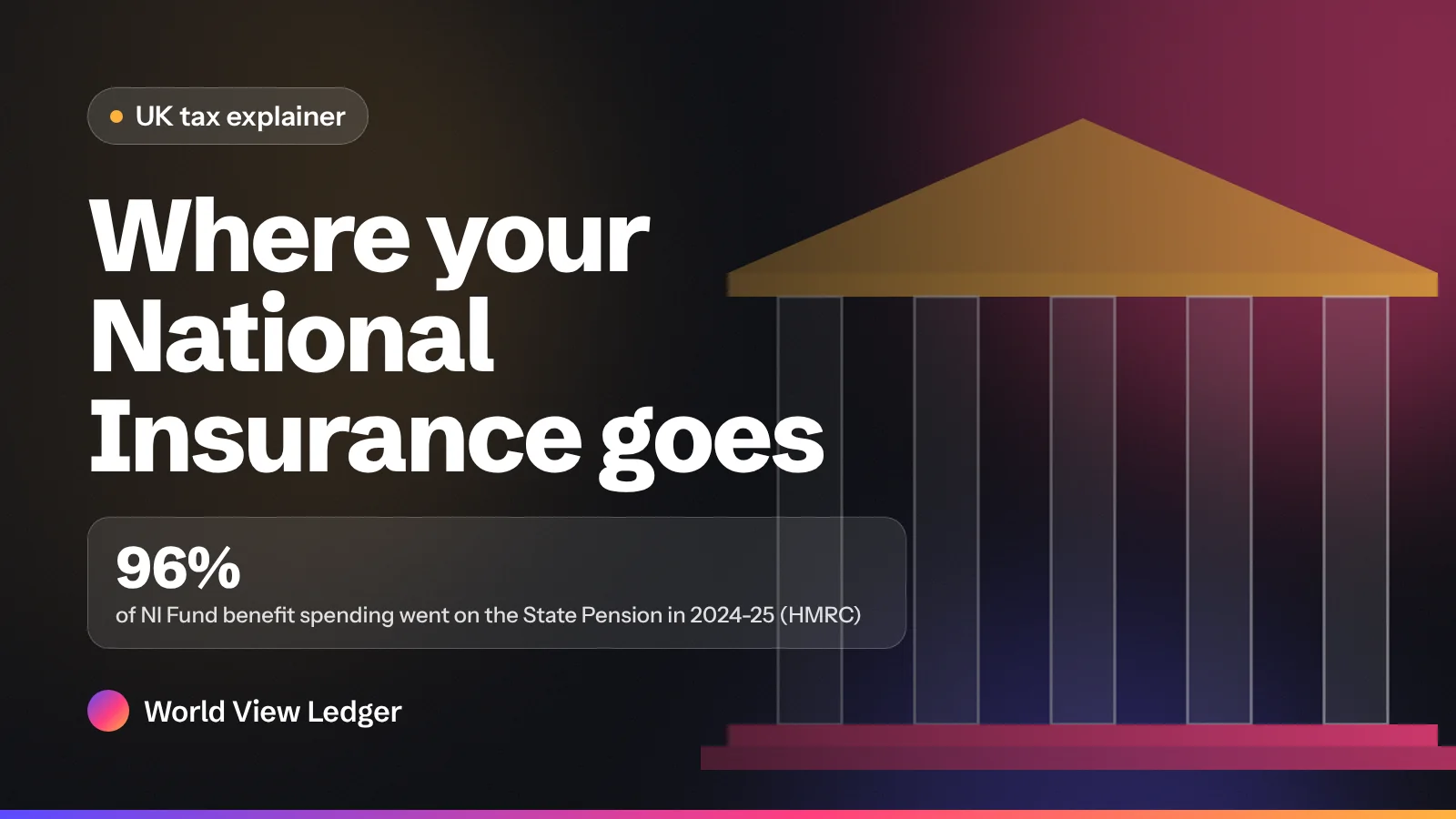
- National Insurance mainly pays for the State Pension. In 2024-25 the State Pension took about £136.9 billion of the £143.2 billion in benefits paid from the National Insurance Fund, roughly 96%.
- The rest funds contribution-based benefits (New Style JSA and ESA, Maternity Allowance, Bereavement Support Payment), and a separate slice of contributions, about £34.8 billion in 2024-25, is allocated to the NHS.
- In 2026/27 employees pay 8% on earnings between £12,570 and £50,270 and 2% above that. Employers pay 15% above £5,000, and thresholds are frozen until April 2031.
- You need 35 qualifying years for the full new State Pension (£241.30 a week from April 2026) and at least 10 to get any. Your NI number tracks every year for life.
- You stop paying employee National Insurance when you reach State Pension age, which began rising from 66 towards 67 in April 2026, even if you keep working.
What does National Insurance pay for? Mainly the State Pension. National Insurance contributions are paid into the National Insurance Fund, which pays the State Pension and a handful of contribution-based benefits, such as New Style Jobseeker's Allowance and Maternity Allowance. A separate slice of the money raised is allocated to the NHS. In 2024-25, about 96p of every pound of benefits paid from the fund went on the State Pension.
This guide follows the money: what National Insurance funds and what it does not, the 2026/27 rates for employees, employers and the self-employed, what your National Insurance number is for, how many years you need for a full State Pension, and when you stop paying. We also compare the UK system with the US, Australia and the UAE. Figures are as of November 2026.
What National Insurance pays for: the short answer
National Insurance began as a contributory insurance scheme: workers pay in while they earn, and in return they build up entitlement to a pension and to support if they cannot work. That link still exists, which is what makes National Insurance different from Income Tax. Your contributions are recorded against your name, and they decide whether you qualify for certain benefits.
According to GOV.UK, contributions count towards these benefits:
| Benefit | Class 1 (employees) | Class 2 (self-employed) | Class 3 (voluntary) |
|---|---|---|---|
| New State Pension | Yes | Yes | Yes |
| Basic State Pension (reached pension age before 6 April 2016) | Yes | Yes | Yes |
| Additional State Pension | Yes | No | No |
| New Style Jobseeker's Allowance | Yes | No | No |
| Contribution-based Employment and Support Allowance | Yes | Yes | No |
| Maternity Allowance | Yes | Yes | No |
| Bereavement Support Payment | Yes | Yes | No |
Class 4 contributions, which the self-employed pay on profits, do not count towards any benefit at all. They are, in effect, a tax on profits that helps fund the system.
What National Insurance does not pay for
Many of the benefits people associate with "the welfare system" are not funded from National Insurance. Universal Credit, Child Benefit, Personal Independence Payment and Pension Credit are paid from general taxation and do not depend on your contribution record. That is why you can receive Universal Credit with no work history, but you cannot get New Style JSA without enough recent contributions.
Inside the National Insurance Fund: where the money goes
Contributions from workers and employers in Great Britain are collected by HMRC. Part of the money is allocated to the NHS, and the rest is paid into the National Insurance Fund. (Northern Ireland has its own, smaller fund.) The Government Actuary's Department, which reports on the fund each year, puts it simply: contributions "are split between the NHS and the NIF", and contribution income and benefit payments each run to over £100 billion a year, GAD says.
The most recent audited accounts, for the year to 31 March 2025, published by HMRC in November 2025, show how lopsided the spending is:
| Paid from the National Insurance Fund, 2024-25 | Amount |
|---|---|
| State Pension | £136.9 billion |
| Contribution-based Employment and Support Allowance | £5.2 billion |
| Maternity Allowance | £402 million |
| Bereavement benefits | £361 million |
| Contribution-based Jobseeker's Allowance | £223 million |
| Christmas Bonus (paid to pensioners) | £130 million |
| Total benefits | £143.2 billion |
Figures rounded from the Great Britain National Insurance Fund Account 2024 to 2025.
In the same year, contributions credited to the fund came to about £130.9 billion, after an NHS allocation of about £34.8 billion. Because benefit spending was higher than contribution income, the fund's balance fell by £7.1 billion to £79.3 billion. Part of the reason is policy: the employee main rate was cut from 12% to 10% in January 2024 and to 8% in April 2024, while the rise in employer contributions only took effect in April 2025, after the year these accounts cover.
Is there a pot with your name on it?
No. National Insurance works on a pay-as-you-go basis: today's workers pay for today's pensioners, and your State Pension will be paid by the workers of the future. Your contributions buy you an entitlement, recorded year by year, not a personal investment fund. The fund keeps only a working balance, and money above what it needs is invested short term. A Full Fact analysis noted that, in practice, surplus money has been used to reduce government borrowing. If contributions ever fall short, the Treasury can top up the fund with a grant. None was needed in 2024-25.
National Insurance rates for 2026/27
The tax year runs from 6 April 2026 to 5 April 2027. These are the main rates and thresholds, from HMRC's employer guidance and its rates and allowances tables:
| Who pays | Class | 2026/27 rate |
|---|---|---|
| Employees | Class 1 (primary) | 8% on earnings from £12,570 to £50,270 a year (£242 to £967 a week); 2% above £50,270 |
| Employers | Class 1 (secondary) | 15% on earnings above £5,000 a year (£96 a week). 0% up to £50,270 for under-21s, apprentices under 25 and eligible veterans |
| Employers | Class 1A and 1B | 15% on taxable benefits in kind and PAYE Settlement Agreements |
| Self-employed | Class 4 | 6% on profits from £12,570 to £50,270; 2% above |
| Self-employed (voluntary) | Class 2 | £3.65 a week, for those with profits under £7,105 who want to protect their record |
| Anyone with gaps | Class 3 (voluntary) | £18.40 a week |
Small employers can claim the Employment Allowance, which knocks up to £10,500 a year off their employer contributions in 2026/27.
The thresholds are frozen, so as wages rise, more of each pay packet is caught. The November 2025 Budget extended the freeze on Income Tax and National Insurance thresholds to April 2031. The Autumn Budget on 28 October 2026 left the headline rates unchanged and kept the employer rate at 15% and the £5,000 threshold for 2027/28, according to a summary by THP Chartered Accountants. A further change, announced in the November 2025 Budget, means that from April 2029 only the first £2,000 a year of pension contributions made through salary sacrifice will be free of National Insurance.
A worked example
Here is what National Insurance costs on two salaries in 2026/27, using the annual thresholds (payroll actually works it out each pay period, so the real figures can differ slightly):
| Salary £35,000 | Salary £60,000 | |
|---|---|---|
| Employee pays 8% band | 8% x £22,430 = £1,794.40 | 8% x £37,700 = £3,016.00 |
| Employee pays 2% band | £0 | 2% x £9,730 = £194.60 |
| Employee total | £1,794.40 | £3,210.60 |
| Employer pays 15% | 15% x £30,000 = £4,500.00 | 15% x £55,000 = £8,250.00 |
The surprise for most people is the bottom row. On a £35,000 salary, the employer's contribution is roughly two and a half times the employee's, and it never appears on your payslip. Economists generally expect much of the cost of employer National Insurance to be passed back to workers over time through lower pay rises. A self-employed person with £35,000 of profit pays 6% x £22,430 = £1,345.80 in Class 4, and no employer contribution at all.
What is a National Insurance number?
Your National Insurance number is the reference that ties every contribution and credit to you. It is "made up of 2 letters, 6 numbers and a final letter", for example QQ123456B, and it stays the same for life, according to GOV.UK.
- When you get it: most people born in the UK are sent a letter confirming their number shortly before their 16th birthday.
- If you never had one: for example because you moved to the UK, you can apply on GOV.UK. You need the right to work in the UK, and you can usually start work before the number arrives if you can prove that right.
- If you have lost it: you can find it online through your personal tax account or the HMRC app. It is also printed on payslips and P60s.
- Who needs it: employers, HMRC, the DWP, pension schemes and student loan providers. Keep it private, as it is useful to identity thieves.
The number is not proof of identity or of the right to work on its own. Its job is record-keeping, which matters because your record decides your State Pension.
How National Insurance builds your State Pension
The full new State Pension is £241.30 a week from April 2026, up 4.8% under the triple lock, the Department for Work and Pensions confirmed. That is about £12,548 a year. The older basic State Pension, for people who reached pension age before 6 April 2016, is £184.90 a week.
To get the full new State Pension you usually need 35 qualifying years on your National Insurance record, and you need at least 10 qualifying years to get anything. You build a qualifying year in one of four ways:
- Paying contributions as an employee or through self-employment.
- Being treated as paid. If you earn between the lower earnings limit (£6,708 a year in 2026/27) and £12,570, you pay nothing but the year still counts. Self-employed people with profits above £7,105 get their Class 2 contributions treated as paid.
- National Insurance credits. These fill years when you are not working, for example while claiming Child Benefit for a child under 12, caring for someone, or receiving certain benefits because you are ill or unemployed.
- Voluntary contributions to fill gaps.
Is filling a gap worth it? Each qualifying year adds about 1/35 of the full new State Pension: £241.30 divided by 35 is roughly £6.89 a week, or about £358 a year. A full year of Class 3 contributions costs £18.40 x 52 = £956.80. If that year raises your pension, you get the money back in under three years of retirement, and the extra keeps rising with the triple lock. It only pays off if the year actually increases your entitlement, so check your forecast first.
You can usually pay voluntary contributions for the past six tax years, with a deadline of 5 April each year, according to GOV.UK's voluntary contributions guide. Rules tightened for people abroad from 6 April 2026: you can no longer pay voluntary Class 2 for time abroad, and to pay Class 3 for time abroad after that date you need either 10 continuous years of UK residence or 10 years of qualifying contributions, up from 3.
Check your record and forecast in your personal tax account or the HMRC app before you pay anything. People with years before 2016 can have a starting amount above or below the standard figure, which changes the maths.
When do you stop paying National Insurance?
You stop when you reach State Pension age, not when you reach 35 qualifying years. Many people complete their record in their 50s and keep paying for another decade, because National Insurance is also a tax on work, not only a pension subscription.
State Pension age is changing. According to the Institute for Fiscal Studies, it started rising from 66 in April 2026 and reaches 67 in early 2028, a change legislated in 2014. Anyone born from 6 April 1960 onwards is affected, with the exact date depending on your birthday, so check yours with the GOV.UK State Pension age calculator.
- Employees: "when you reach State Pension age you usually stop paying National Insurance contributions", even if you keep working, GOV.UK says. Show your employer a passport or birth certificate. Your employer still pays its 15% on your wages.
- Self-employed: you stop paying Class 4 from the 6 April after you reach State Pension age. If you reach it on 6 September 2026, your last Class 4 bill covers 2026/27 and is due by 31 January 2028.
- Income Tax does not stop. You still pay Income Tax on earnings and on your pensions above your Personal Allowance. Pension income itself never attracts National Insurance.
Does National Insurance pay for the NHS?
Partly, and less than many people assume. A fixed share of National Insurance receipts goes straight to the NHS: about £34.8 billion in 2024-25, according to the fund's accounts. That is real money, but most NHS funding comes from general taxation, and the amount the government spends on health is decided in spending reviews, not by how much National Insurance raises. Your contribution record has no effect on your right to NHS treatment, which depends on where you live, not on what you have paid.
That is why fact-checkers caution against treating National Insurance as a dedicated health tax. When governments raise it and say the money is "for the NHS", the cash still enters the same overall budget as every other tax. For more on how taxes fund public services, see our explainer on why we pay taxes and what they pay for.
How the UK compares with the US, Australia and the UAE
Most rich countries fund pensions through something like National Insurance, but the details vary a lot:
| Country | How the state pension is funded | What workers pay |
|---|---|---|
| UK | National Insurance contributions, pay-as-you-go | 8% of earnings from £12,570 to £50,270, then 2%; employers 15% above £5,000 |
| United States | Social Security payroll tax, pay-as-you-go, held in trust funds | 6.2% up to $184,500 in 2026, matched by employers, plus 1.45% each for Medicare |
| Australia | The Age Pension is paid from general tax revenue and is means-tested | No social insurance contribution; employers pay compulsory superannuation of 12% of earnings into the worker's own fund |
| UAE | Emirati nationals contribute to a federal or emirate pension scheme | No income tax; expatriates are not in the state pension scheme and receive an end-of-service gratuity instead |
The US is closest to the UK, with one key difference: its Social Security tax stops above a wage cap set by the Social Security Administration, while UK employee contributions continue at 2% on all earnings above £50,270 and employer contributions have no cap. Australia takes the opposite approach: there is no contribution record, the state pension depends on your income and assets, and the main retirement saving happens in private superannuation accounts that belong to each worker. The US funds its unemployment insurance separately, through employer payroll taxes, as our guide to who pays for unemployment explains, whereas in the UK contribution-based JSA comes from the same fund as the pension.
What it means for you
- If you are an employee: about 8% of your pay between £12,570 and £50,270 goes on National Insurance, and your employer pays more on top. In return you are mainly buying a State Pension worth about £12,548 a year at today's rates, plus access to contribution-based sickness, unemployment and maternity support.
- If you are self-employed: your Class 4 contributions do not count towards benefits, but profits above £7,105 still earn you a qualifying year. If your profits are lower, voluntary Class 2 at £3.65 a week is the cheapest way to protect your record.
- If you have gaps: check your record now. You can usually only fill the last six years, and a year of Class 3 can repay itself in under three years of retirement.
- If you are near State Pension age: check your exact date, because it is moving towards 67. Once you reach it, tell your employer so your National Insurance deductions stop.
For more UK coverage, visit our UK edition or browse our economy explainers.
This is general information, not tax, financial or legal advice; see our disclaimer and check your own record with HMRC or speak to a qualified adviser about your situation.
Frequently asked questions
What does National Insurance pay for?
Mainly the State Pension. National Insurance contributions go into the National Insurance Fund, which pays the State Pension and contribution-based benefits such as New Style Jobseeker's Allowance, New Style Employment and Support Allowance, Maternity Allowance and Bereavement Support Payment. In 2024-25 the State Pension made up about 96% of the fund's benefit spending. Part of the money raised is also allocated to the NHS before the rest reaches the fund.
What is a National Insurance number?
It is your personal reference number for the National Insurance and tax system, made up of two letters, six numbers and a final letter, for example QQ123456B. It makes sure your contributions and tax are recorded against your name only, and it stays the same for life. Most people receive a letter confirming it shortly before their 16th birthday. If you have never had one, you can apply on GOV.UK.
When do you stop paying National Insurance?
Employees usually stop paying when they reach State Pension age, even if they carry on working. Show your employer proof of your age, such as a passport or birth certificate. Self-employed people stop paying Class 4 contributions from the 6 April after they reach State Pension age. Your employer still pays employer contributions on your wages.
Does National Insurance pay for the NHS?
Partly. A share of National Insurance receipts is allocated to the NHS before the remainder is paid into the National Insurance Fund. That allocation was about £34.8 billion in 2024-25, according to the fund's accounts. It covers only a small part of total health spending, most of which is paid for from general taxation.
How many years of National Insurance do you need for a full State Pension?
Usually 35 qualifying years for the full new State Pension, and at least 10 to get any at all. Years can come from paid contributions, contributions treated as paid on low earnings, National Insurance credits or voluntary contributions. Check your own record and forecast on GOV.UK, because people with years before 2016 can have a different starting amount.
Do you pay National Insurance on pension income?
No. National Insurance is charged on earnings from work and self-employment, not on pension income, savings interest, dividends or rent. You may still pay Income Tax on a pension if your total income is above your Personal Allowance.
- National Insurance: what National Insurance is for, GOV.UK, 27 Oct 2026
- Rates and thresholds for employers 2026 to 2027, HMRC, 1 Sep 2026
- Rates and allowances: National Insurance contributions, HMRC, 6 Apr 2026
- Great Britain National Insurance Fund Account for the year ended 31 March 2025, HMRC (HC 1360), 27 Nov 2025
- National Insurance Fund: up-rating report, Government Actuary's Department, 23 Oct 2026
- Over 12 million pensioners to receive £575 State Pension boost, Department for Work and Pensions, 4 Apr 2026
- National Insurance and tax after State Pension age, GOV.UK, 27 Oct 2026
- Your National Insurance number, GOV.UK, 27 Oct 2026
- Voluntary National Insurance, GOV.UK, 27 Oct 2026
- State pension age of 67 is coming: what to watch as it rolls out, Institute for Fiscal Studies, 10 Mar 2026
- What happens to the money from National Insurance Contributions?, Full Fact, 1 Mar 2019
- Autumn Budget 2026, THP Chartered Accountants, 28 Oct 2026
- Contribution and benefit base, US Social Security Administration