Recession vs Depression: How to Tell the Difference and Spot One Coming
Every downturn sparks the same questions: is this a recession, could it become a depression, and how would anyone know? Here is how economists actually draw the line, the indicators that flash first, and where the US, UK, Australia and UAE stand in November 2026.
Key points
- A recession is a significant, widespread fall in economic activity lasting more than a few months. A depression is a far deeper and longer version, with no official threshold separating the two.
- In the US, the NBER dates recessions using jobs, income, spending and output, not the popular two-quarters-of-falling-GDP rule. It does not separately identify depressions.
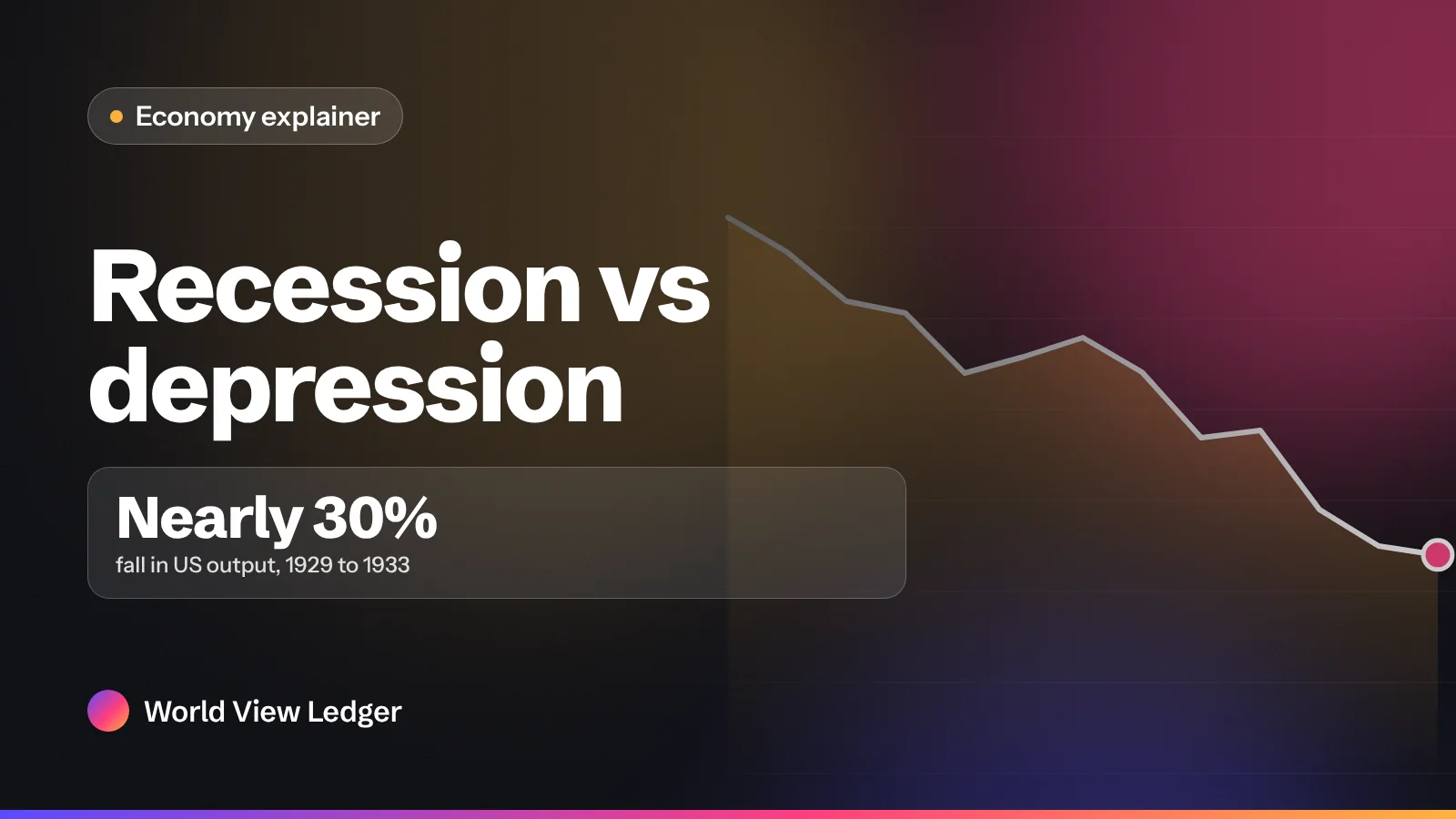
- Scale is the real difference: US output fell about 4.3% in the 2007–09 Great Recession, but nearly 30% from 1929 to 1933, when unemployment approached 25%.
- As of November 2026, none of the US, UK, Australia or UAE is in recession. Australia is closest to the edge, with unemployment at 4.9% and five interest rate rises this year.
- The best-known warning signs are a rising unemployment rate (the Sahm rule) and an inverted yield curve. Neither is flashing red for the US right now.
Recession vs depression: a recession is a significant, widespread decline in economic activity that lasts more than a few months, while a depression is a far deeper and longer one, measured in years and in double-digit falls in output. There is no official line between them. The difference is one of scale: most recessions shave a few percent off output and are over within about a year or two; a depression wipes out a large share of the economy and leaves mass unemployment behind for years.
This guide explains how economists actually define each one, why the popular "two quarters of negative GDP" rule is only a rule of thumb, what history tells us about how bad each can get, the warning signs that tend to flash first, and whether the US, UK, Australia or UAE is in a recession as of November 2026.
What is a recession?
In the United States, recessions are dated by a private, nonpartisan group of economists: the Business Cycle Dating Committee of the National Bureau of Economic Research (NBER). Its traditional definition describes a significant decline in economic activity that is spread across the economy and lasts more than a few months. It judges every downturn on three criteria, often called the three Ds:
- Depth: how far activity falls.
- Diffusion: how widely the decline spreads across industries and regions.
- Duration: how long it lasts.
The criteria can offset each other. The COVID-19 downturn was so deep and so widespread that it counted as a recession even though it lasted only two months.
The two-quarter rule, and why the NBER doesn't use it
The definition you hear most often in the news is a technical recession: two consecutive quarters of falling real GDP, meaning output adjusted for inflation. It is simple and easy to check, and it is the standard media test in the UK and Australia.
The NBER does not use it. Most US recessions do include two or more quarters of falling GDP, but not all of them: the 2001 recession is the committee's own example of one that did not. It looks at monthly data rather than quarterly, gives equal weight to income-based measures of output, and also considers how deep a decline is. The indicators it watches most closely include:
- Nonfarm payroll employment and household-survey employment
- Real personal income, excluding government transfers
- Real consumer spending
- Real manufacturing and trade sales
- Industrial production
The Reserve Bank of Australia makes a similar point in its explainer on recessions: there is no single definition, but a recession generally involves reduced output and a significant rise in unemployment. GDP can keep growing weakly while joblessness climbs, and GDP figures are often revised, so the two-quarter rule can miss a real downturn or flag a false one.
Why recessions are only confirmed after they start
Because the NBER waits for enough data to be confident, it announces turning points well after the fact. According to its FAQ, the shortest lag on record was four months, when it confirmed in June 2020 that a peak had occurred in February. It took 12 months to confirm the December 2007 peak that began the Great Recession, and 21 months to confirm the trough of the early 1990s downturn. By the time a recession is official, many people have already felt it.
What is a depression?
There is no formal definition of a depression. The NBER says it does not separately identify depressions in its chronology; the word is simply used for a particularly severe period of economic weakness. The Federal Reserve Bank of San Francisco's economists describe it as a more severe version of a recession, and note there is no standard threshold. The figure you may see online, that a depression means a 10% fall in GDP, is a rule of thumb, not an official test.
The most recent US episode generally regarded as a depression is the 1930s. The NBER dates it in two legs: a contraction from August 1929 to March 1933, then a partial recovery, then a second sharp downturn from May 1937 to June 1938. Citing Ben Bernanke, the San Francisco Fed notes that real output fell nearly 30% between 1929 and 1933, unemployment rose from about 3% to nearly 25%, and prices fell at close to 10% a year in the early 1930s.
Australia's experience was similar. The RBA counts two depressions: the 1890s, which began with runs on banks and saw a deeper fall in production than the 1930s, and the 1930s, when trade union records put unemployment at around 30%, with other estimates closer to 20%.
Recession vs depression: the key differences
The clearest way to see the gap is to put the worst modern recession next to the Great Depression.
| Recession | Depression | |
|---|---|---|
| Definition | Significant, widespread decline lasting more than a few months | Severe, prolonged recession; no official definition |
| Fall in output | Usually a few percent | Double digits; nearly 30% in the US in 1929–33 |
| Typical length | Months, sometimes up to about a year and a half | Years |
| Unemployment | Rises by a few percentage points | Mass unemployment, around a quarter of the workforce in the 1930s |
| Prices | Inflation usually slows | Often outright deflation |
| Who declares it | NBER in the US; GDP data elsewhere | Nobody officially; historians and economists, after the fact |
| How often | Several times a generation | Rare; the 1930s is the classic case |
An old economists' joke, repeated by the San Francisco Fed, captures the popular version: a recession is when your neighbor loses their job, and a depression is when you lose yours. It is a reminder that "mild" recessions are not mild for the people who lose work in them.
Recessions in history: how bad do they get?
| Downturn | Dates | What happened |
|---|---|---|
| Great Depression (US) | Aug 1929 – Mar 1933; May 1937 – Jun 1938 | Output fell nearly 30%; unemployment rose to nearly 25%; prices fell sharply. |
| Oil shock recession (US) | 1973–1975 | Real output fell 3.4%; unemployment rose from about 4% to about 9%. |
| Early 1990s (Australia) | Early 1990s | Unemployment peaked at just over 11%, according to the RBA. |
| Great Recession (US) | Dec 2007 – Jun 2009 | Real GDP fell 4.3%; unemployment peaked at 10% in October 2009; home prices fell about 30%. |
| COVID-19 (US) | Feb 2020 – Apr 2020 | The shortest US recession on record, at two months, but one of the steepest. |
| COVID-19 (Australia) | 2020 | GDP fell 7% in the June quarter, the largest quarterly fall on record; unemployment peaked near 7.5%. |
The Great Recession: the closest call
The 2007–09 downturn is the nearest the modern world has come to a depression. According to Federal Reserve History, it was the longest US recession since World War II, at 18 months. The S&P 500 fell 57% from its October 2007 peak to its March 2009 low, and household net worth dropped from about $69 trillion to $55 trillion. The Bureau of Labor Statistics recorded payroll employment falling from a peak of 138 million in January 2008 to 129 million by February 2010. It did not become a depression partly because central banks cut rates to near zero, governments supported banks and spending, and the financial system was stabilized, lessons learned directly from the policy mistakes of the 1930s.
COVID-19: short and violent
The NBER's July 2021 announcement dated the pandemic recession from a February 2020 peak to an April 2020 trough. The committee was careful to say that ending the recession did not mean the economy was back to normal, only that it had stopped shrinking. It shows why duration alone cannot separate a recession from a depression: the drop was depression-like in speed, but the recovery began within weeks.
What causes a recession, and what turns one into a depression?
Recessions rarely have a single cause, but most begin with one of a few triggers:
- Interest rate rises to fight inflation. Central banks deliberately slow demand when prices rise too fast. Ending the inflation of the 1970s took two US recessions in the early 1980s, a story told in our explainer on stagflation and deflation.
- Financial crises and credit busts. When asset prices collapse and banks stop lending, spending and investment fall together. This was the core of 2008.
- Supply shocks. A sudden jump in the cost of something the whole economy needs, such as oil in 1973, raises costs and cuts output at the same time.
- External shocks. A pandemic, war or natural disaster can shut down activity almost overnight.
Once a downturn starts, it can feed itself. Workers who lose jobs spend less, firms that sell less hire less, and lenders become cautious. A recession turns into a depression when that spiral is allowed to run: in the 1930s, thousands of bank failures, falling prices that made debts heavier, tight monetary policy and collapsing world trade all reinforced each other. Today's central banks and governments are built to interrupt that spiral early, which is the main reason depressions have become so rare.
How to spot a recession coming: the warning signs
No indicator predicts recessions perfectly, but a few have strong track records. Here are the ones economists watch most, and what they show as of November 2026.
The Sahm rule
Created by economist Claudia Sahm, the rule signals the start of a recession when the three-month average of the unemployment rate rises at least 0.5 percentage points above its lowest three-month average of the previous 12 months. It works because unemployment tends to rise slowly at first, then quickly once a downturn takes hold.
A worked example
The figures below are illustrative. Suppose the lowest three-month average of unemployment in the past year was 4.0%. Over the latest three months, unemployment reads 4.4%, 4.5% and 4.6%.
| Step | Calculation | Result |
|---|---|---|
| Latest three-month average | (4.4 + 4.5 + 4.6) ÷ 3 | 4.5% |
| Lowest three-month average in past 12 months | Given | 4.0% |
| Sahm rule reading | 4.5 − 4.0 | 0.5 points: the rule is triggered |
The real US reading is nowhere near that. The St. Louis Fed's real-time Sahm rule series stood at 0.00 for October 2026, with unemployment at 4.1%. The rule is not infallible: it rose to 0.57 in mid-2024, and no recession followed.
The yield curve
Normally, long-term interest rates are higher than short-term ones. When the curve inverts, with short-term rates above long-term rates, it has often preceded US recessions, because it signals that investors expect the central bank to cut rates as the economy weakens. The New York Fed's model, based on the gap between 10-year and 3-month Treasury yields, puts the probability of a US recession by September 2027 at about 13%, using data through September 2026, when the 10-year yield was about 0.96 percentage points above the 3-month rate. That spread is positive, not inverted. Like the Sahm rule, the curve has had a recent false alarm: it inverted from late 2022 without a recession following.
Other signals worth watching
- Weekly jobless claims, a timely sign of rising layoffs.
- Purchasing managers' surveys, which show whether manufacturers and service firms are expanding or shrinking.
- Consumer spending and confidence, since household spending is the largest part of most rich economies.
- Credit conditions, including whether banks are tightening lending standards.
Are we in a recession? The US, UK, Australia and UAE compared
As of November 2026, the short answer for all four economies is no. But the margin varies a lot, and the energy shock from disruption around the Strait of Hormuz is pushing central banks to raise rates, which is a classic recession risk.
| Country | Latest growth | Unemployment | In recession? |
|---|---|---|---|
| United States | +3.4% annualized, Q3 2026 | 4.1% (Oct 2026) | No; Sahm rule at 0.00 |
| United Kingdom | +0.7% q/q, Q3 2026 (+1.9% on a year earlier) | 4.6% (Jul–Sep 2026) | No |
| Australia | +0.4% q/q, June quarter 2026 (+2.1% on a year earlier) | 4.9% (Oct 2026) | No, but risk is rising |
| UAE | 1.6% forecast for 2026 | Not a headline indicator | No; a slowdown, with a rebound forecast |
Is the US in a recession?
No. The Bureau of Economic Analysis estimated that real GDP grew at a 3.4% annualized rate in the third quarter, and unemployment was 4.1% in October. The NBER has not identified any recession since the April 2020 trough. The bigger US problem is inflation, at 3.7% in the year to September, which led the Fed to raise rates in September. Higher rates are how recessions are sometimes made, so this is the risk to watch in 2027.
Is the UK in a recession?
No. The Office for National Statistics estimates GDP grew 0.7% in the third quarter of 2026, after 0.5% in the second, and GDP per head also rose 0.7%. Unemployment fell to 4.6% in the three months to September. The Bank of England, which raised Bank Rate to 4% on 5 November, expects that recent strength to fade somewhat as inflation heads toward 5% in mid-2027.
Is Australia in a recession?
Not technically, but it is the closest of the four. GDP grew 0.4% in the June quarter and 2.1% over the year, according to the ABS. Since then, the picture has darkened. The ABS reported on 19 November that unemployment rose to 4.9% in October from 4.7% in September, as employment fell by 43,500. The Reserve Bank lifted the cash rate to 4.85% on 3 November, its fifth increase of 2026, while acknowledging the economy is slowing. Rising unemployment with weak growth is exactly the pattern the RBA's own definition of recession describes, which is why September quarter GDP, due in early December, will be closely watched. Read more in our Australia edition.
Is the UAE in a recession?
No. The Central Bank of the UAE reported that oil output fell to an average of 2.0 million barrels a day from March to May 2026, from 2.9 million a year earlier, before recovering to near-record levels in June and July. It forecasts real GDP growth of 1.6% in 2026 and a sharp rebound in 2027. For an oil exporter, an energy shock that disrupts shipping can hit output directly, but higher prices also lift revenue, so the UAE's cycle often moves differently from importers like the UK and Australia.
Is a recession coming?
Nobody can say with confidence, and forecasters have a poor record of calling recessions in advance. What can be said, as of November 2026, is where the pressure points are:
- Rising interest rates. The Fed, the Bank of England and the RBA have all raised rates in recent months to contain energy-driven inflation. Higher borrowing costs work by slowing the economy, and they work with a lag.
- The energy shock. Fuel prices are squeezing household budgets in importing countries. A longer or wider disruption would raise the odds of a downturn.
- Labor markets. In the US and UK, jobs data are still holding up. In Australia, unemployment jumped from 4.7% to 4.9% in a single month, and a few more readings like that would move it closer to recession territory.
On the US side, the standard indicators are calm: the Sahm rule is at zero and the New York Fed's yield-curve model puts recession odds around 13% for the coming year. A depression, by contrast, is not a realistic near-term risk for any of these economies; it would require a financial collapse on the scale of the 1930s and a failure of policy to respond.
How to prepare for a recession: what it means for you
You cannot control the economy, but you can make a downturn less painful if one arrives.
- Build an emergency fund. The Consumer Financial Protection Bureau says the right amount depends on your situation and that even a small reserve helps. Practical steps include automatic transfers to savings, splitting your pay between two accounts, and banking windfalls such as a tax refund.
- Tackle expensive debt. Credit card balances and variable-rate loans get costlier when central banks raise rates, and harder to manage if your income drops.
- Protect your income. Recessions hit some industries harder than others, such as construction and manufacturing in 2008. Keeping skills and contacts current is the best insurance against job loss.
- Avoid panic decisions. Markets often fall sharply in recessions and recover before the economy does. Selling long-term investments at the bottom locks in losses.
- Know your safety net. Find out what unemployment support, hardship arrangements from your lender, or other help you would be entitled to before you need it.
This article is general information, not financial advice. See our disclaimer.
The bottom line
A recession is a significant, broad-based decline in activity that lasts more than a few months; a depression is the same thing on a far larger scale, with output falling by double digits and unemployment staying high for years. The US has had many recessions since the 1930s but no depression, largely because modern policy is designed to stop downturns from spiraling. As of November 2026, the US, UK and UAE are growing, and Australia is the one to watch, with unemployment rising and interest rates still going up. For more on the forces shaping growth, prices and jobs, browse our economy coverage.
Frequently asked questions
Is a depression worse than a recession?
Yes. A depression is generally described as a severe, prolonged recession. The Great Depression saw US output fall nearly 30% and unemployment approach 25%, while a typical recession sees output fall by a few percent and unemployment rise by a few percentage points before recovering.
Are we in a recession right now?
Not in the US, UK, Australia or UAE as of November 2026. US real GDP grew at a 3.4% annualized rate in the third quarter and unemployment was 4.1% in October. UK GDP grew 0.7% in the third quarter. Australia grew 0.4% in the June quarter, though its unemployment rate has risen to 4.9%.
What is a technical recession?
A technical recession is the media shorthand for two consecutive quarters of falling real GDP. It is widely used in the UK and Australia. In the US, the official arbiter, the NBER, uses a broader judgment based on several monthly indicators instead.
How long do recessions last?
It varies. The COVID-19 recession lasted two months in the US, from February to April 2020, the shortest on record. The Great Recession lasted 18 months, from December 2007 to June 2009. The first leg of the Great Depression lasted 43 months.
What causes a recession?
Common triggers include interest rate rises to fight inflation, financial crises and credit busts, sudden supply shocks such as an oil price spike, and external shocks such as a pandemic. Falling confidence can then make the downturn worse as households and firms cut spending at the same time.
How can I prepare for a recession?
Build an emergency fund in an insured bank or credit union account, pay down high-interest and variable-rate debt, keep your skills and network current, and avoid making long-term investment decisions in a panic. Check what unemployment support you would be entitled to before you need it.
- Business Cycle Dating Procedure: Frequently Asked Questions, National Bureau of Economic Research, 7 Oct 2025
- Business Cycle Dating Committee Announcement, July 19, 2021, National Bureau of Economic Research, 19 Jul 2021
- What is the difference between a recession and a depression?, Federal Reserve Bank of San Francisco, Feb 2007
- The Great Recession, Federal Reserve History, 22 Nov 2013
- The Recession of 2007–2009, U.S. Bureau of Labor Statistics, Feb 2012
- Recession (explainer), Reserve Bank of Australia
- Real-time Sahm Rule Recession Indicator (SAHMREALTIME), Federal Reserve Bank of St. Louis (FRED), 6 Nov 2026
- Probability of US Recession Predicted by Treasury Spread, Federal Reserve Bank of New York, 4 Oct 2026
- GDP (Advance Estimate), 3rd Quarter 2026, U.S. Bureau of Economic Analysis, 29 Oct 2026
- The Employment Situation – October 2026, U.S. Bureau of Labor Statistics, 6 Nov 2026
- GDP first quarterly estimate, UK: July to September 2026, Office for National Statistics, 12 Nov 2026
- Employment in the UK: November 2026, Office for National Statistics, 17 Nov 2026
- Australian economy grew 0.4% in the June quarter, Australian Bureau of Statistics, 2 Sep 2026
- Labour Force, Australia, October 2026, Australian Bureau of Statistics, 19 Nov 2026
- Statement by the Monetary Policy Board: Monetary Policy Decision, Reserve Bank of Australia, 3 Nov 2026
- Quarterly Economic Review, September 2026, Central Bank of the UAE, Sep 2026
- An essential guide to building an emergency fund, Consumer Financial Protection Bureau, 29 Oct 2025