Fiat Money vs Gold: What Gives Money Its Value?
Almost every currency on Earth is now fiat money, backed by no metal at all. Yet gold hit a record above $5,500 an ounce this year and central banks bought 42% more of it in the third quarter than a year earlier. Here is what gives each its value, and what that means for your money.
Key points
- Fiat currency is money that has value because a government declares it legal tender and people trust it, not because it can be swapped for gold or silver. The dollar, pound, euro and Australian dollar are all fiat.
- US dollars have not been redeemable in gold for Americans since 1934, and the last link for foreign governments ended on August 15, 1971, when President Nixon closed the gold window.
- Gold is valuable because it is scarce, almost indestructible and no one's liability: all the gold ever mined, about 224,200 tonnes, would fit in a cube roughly 23 meters on each side.
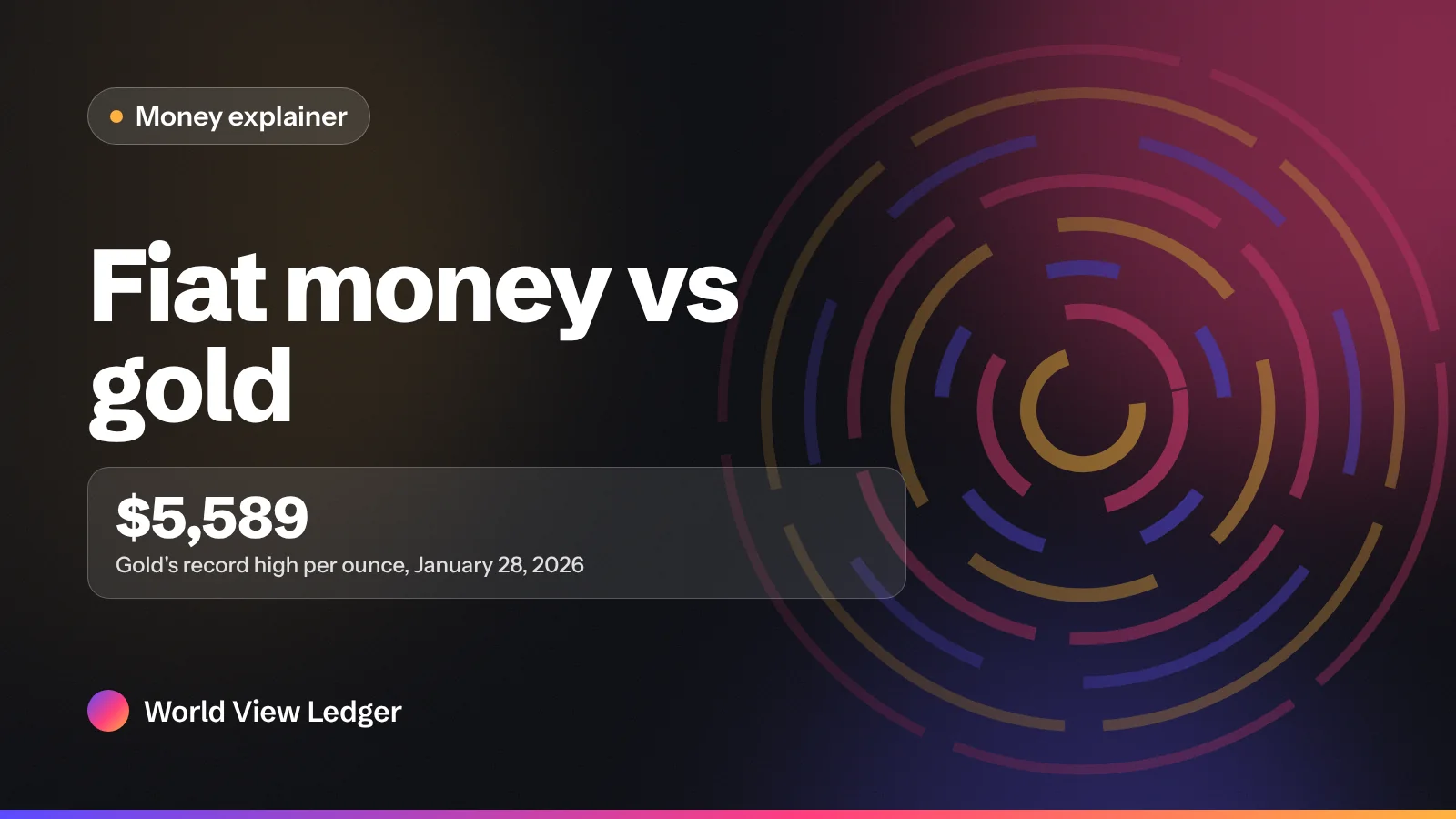
- Gold is not a stable store of value in the short run. It hit a record $5,589.38 an ounce on January 28, 2026, then fell about a third to below $3,600 by November 20.
- Central banks still back their fiat systems with gold reserves: they bought 321 tonnes in the third quarter of 2026, 42% more than a year earlier, according to the World Gold Council.
What is fiat currency? Fiat currency is money that has value because a government declares it legal tender and people trust it, not because it can be exchanged for gold, silver or anything else. The US dollar, the British pound, the euro and nearly every other currency in use today are fiat money.
That can sound unsettling: if a $100 bill is just paper, why is it worth anything? And if gold is "real" money, why did its price fall by about a third in 2026? This guide explains what gives money its value, why gold is valuable, how the world moved off the gold standard, how fiat money and gold compare, and what it all means for your savings. Figures are the latest available as of November 25, 2026.
What is fiat money, and where does the name come from?
Fiat is Latin for "let it be done". Fiat money exists because an authority decrees it. A fiat currency has three defining features:
- No intrinsic value. The paper, polymer or digital entry is worth almost nothing in itself.
- No promise of conversion. You cannot take it to the central bank and demand a fixed amount of gold or silver.
- Legal tender status. The law says it must be accepted to settle debts, and the government accepts it, and usually only it, for taxes.
Economists contrast fiat money with commodity money, such as gold or silver coins, which are valuable as materials, and representative money, such as old gold certificates, which were paper claims on metal held in a vault. For most of history, money was one of those two. Fiat money is not entirely new (China's Song dynasty issued government paper money in the 11th century), but a world where every major currency is fiat only dates from the early 1970s.
Today most fiat money is not even physical. The bulk of it exists as bank deposits and digital balances, which is why the debate over a cashless society and central bank digital currencies is really a debate about the future form of fiat money.
What gives fiat money its value?
If nothing physical backs a dollar, its value rests on a few reinforcing pillars.
1. Taxes and legal tender laws
Governments demand taxes in their own currency. Every household and business that owes tax needs that currency, which creates permanent demand for it. Legal tender laws add to this by making it the default way to settle debts in court.
2. Trust and network effects
You accept dollars because you are confident that your landlord, supermarket and employer will accept them too. Money is a shared convention, and the more people use it, the more useful it becomes. That is also why it can collapse quickly when trust breaks.
3. Scarcity managed by a central bank
Fiat money is only valuable if it stays relatively scarce. Central banks such as the Federal Reserve, the Bank of England and the Reserve Bank of Australia control the supply of money and set interest rates, typically aiming for inflation of about 2% a year. When they get that wrong, prices rise quickly, as our explainer on why everything is so expensive shows.
4. The strength of the economy behind it
A currency is ultimately a claim on the goods, services and assets of the economy that issues it. A large, productive economy with stable institutions and courts gives people more reasons to hold its money.
Why is gold valuable?
Gold has been treated as valuable for thousands of years, across cultures that had no contact with each other. That is not an accident. It has an unusual combination of physical and economic properties.
- It is scarce, and supply grows slowly. All the gold ever mined that still exists above ground came to about 224,200 tonnes at the end of September 2026, according to the World Gold Council. Because gold weighs 19.3 tonnes per cubic meter, that would fit in a cube roughly 23 meters (about 75 feet) on each side. Mines produced a record 3,672 tonnes in 2025, which added less than 2% to the stock.
- It practically never wears out. Gold does not rust, tarnish or corrode, so almost all the gold ever mined is still around, in rings, bars, coins and vaults.
- It is easy to use as money. It is dense, divisible, easy to recognize and assay, and holds a lot of value in a small space.
- It is no one's liability. A dollar bill or a government bond is a promise by someone else. A gold bar is not. It cannot default and cannot be printed, which is why central banks hold it as insurance.
- It has real demand. Jewellery, investment bars and coins, central bank reserves and electronics all compete for the same metal.
| Who holds the world's gold | Tonnes (approx.) | Share |
|---|---|---|
| Jewellery | 98,700 | 44% |
| Bars and coins | 48,100 | 21% |
| Central banks | 39,300 | 18% |
| Over-the-counter investment | 10,000 | 4% |
| Gold ETFs | 4,300 | 2% |
| Other (including industry) | 23,800 | 11% |
| Total | 224,200 | 100% |
Source: World Gold Council, above-ground stocks at end of Q3 2026. Figures are rounded.
Notice what gold does not have: a yield. A bond pays interest and a share pays dividends, but a gold bar pays nothing. Its value rests entirely on what the next buyer will pay, which is why its price can swing sharply.
From gold standard to fiat: a short history
For much of the 19th and early 20th centuries, major currencies were tied to gold at a fixed price. The system broke down in stages.
- September 20, 1931: Britain suspended the gold standard. A Treasury notice said more than £200 million had been withdrawn from London since mid-July and the Bank of England's gold could not safely be reduced further, according to The National Archives.
- 1933 to 1934: in the depths of the Great Depression, President Franklin Roosevelt ordered Americans to hand in monetary gold, paying $20.67 an ounce. The Gold Reserve Act, passed on January 30, 1934, then raised the official price to $35, an increase of about 69%, Kitco reports. From then on, Americans could not redeem dollars for gold.
- 1944 to 1971, Bretton Woods: after World War II, other currencies were pegged to the dollar, and foreign governments could convert dollars into gold at $35 an ounce.
- August 15, 1971: with far more dollars held abroad than the US had gold to cover them, President Nixon "closed the gold window", ending conversion for foreign governments, as Federal Reserve History explains. He paired it with a 90-day wage and price freeze.
- 1971 to 1973: the December 1971 Smithsonian agreement tried to save fixed rates with a $38 gold price, and a second devaluation in February 1973 set the official price at $42.22, where it still sits on the Treasury's books. By 1973, major currencies were floating against each other.
- December 31, 1974: Americans were again allowed to own gold privately.
The decade that followed was rough. Without the discipline of gold, and hit by oil shocks, the US and UK suffered high inflation alongside weak growth, a mix explained in our guide to stagflation. Critics of fiat money still point to the 1970s. Supporters point out that central banks eventually brought inflation down and have kept it far more stable since than it was in the gold standard era, when deflation and banking panics were common.
Fiat money vs gold: the key differences
Fiat money
- Value comes from law, taxes and trust
- Supply set by a central bank, can expand in a crisis
- Steady, low inflation is the goal, about 2% a year
- Earns interest when held in a bank account or bond
- Risk: loses value fast if a government prints to pay its bills
Gold
- Value comes from scarcity, durability and demand
- Supply grows less than 2% a year and cannot be printed
- Price can rise or fall by a third in a single year
- Pays no interest and costs money to store and insure
- Risk: hard to spend, and a poor fit for running an economy
Most economists favor fiat systems because they let central banks respond to recessions and financial crises, for example by cutting interest rates or lending to banks in a panic. Under a strict gold standard, the money supply depends on how much gold a country holds and how much is dug up, not on what the economy needs. The cost of the flexibility is that fiat money depends entirely on the competence and independence of whoever controls it.
When fiat money fails
The worst failures come when a government prints money to pay for its spending and people stop trusting the currency. In Zimbabwe, monthly inflation peaked at 79.6 billion percent in November 2008, and in the former Yugoslavia at 313 million percent in January 1994, according to economist Steve Hanke's measurements. In both cases, people fled to foreign currencies and goods. These are extreme cases, but they show that a fiat currency is only as good as the institutions behind it.
Gold in 2026: a record, then a sharp fall
This year has been a live lesson in both sides of the argument. Gold reached an all-time high of $5,589.38 an ounce on January 28, 2026, CBS News reported, as traders bet on a more dovish chair at the Federal Reserve, according to Bloomberg. Gold had started 2025 at about $2,624. It then reversed. By Friday, November 20, it had dropped below $3,576, a fall of about 36% from the peak, according to Emirates 24|7, which pointed to higher bond yields and shifting expectations for US interest rates.
The fall shows gold's main weakness. When interest rates on cash and bonds rise, holding a metal that pays nothing becomes less attractive, and its price tends to suffer. For anyone who bought near the top, gold has been anything but a safe store of value this year.
Yet the biggest buyers have not stopped. Central banks bought 321 tonnes of gold in the third quarter of 2026, 42% more than a year earlier and well above the five-year quarterly average of 227 tonnes, according to the World Gold Council. China's central bank reported adding 63 tonnes and Poland's 40 tonnes. Year to date, central banks have bought 675 tonnes. In other words, the institutions that run fiat currencies are among the most committed holders of gold, as a reserve that no other country can freeze or default on.
Worked example: gold and the dollar since 1971
When Nixon closed the gold window, an ounce of gold officially cost $35. Using the US consumer price index (an average of 40.5 in 1971 and 337.511 in October 2026), $35 in 1971 is worth about $292 in today's money. At around $3,576, gold now costs roughly 12 times more than that in real terms. That sounds like a clear win for gold, but the timing matters enormously: someone who bought at the January 2026 peak is sitting on a loss of more than a third, and gold has had long losing stretches before. Meanwhile, cash kept in an interest-bearing account has earned a return that the metal never pays.
How the US, UK, Australia and UAE compare
Every one of these countries runs a fiat currency, but they relate to gold in different ways.
| Country | Currency | Left gold | Official gold today |
|---|---|---|---|
| United States | US dollar (free floating) | 1934 for citizens; 1971 for foreign governments | About 8,133 tonnes held by the Treasury |
| United Kingdom | Pound sterling (free floating) | September 1931 | Held in the UK's official reserves; London is the world's main gold trading hub |
| Australia | Australian dollar (free floating) | During the Great Depression | 80 tonnes, unchanged since 1997 |
| UAE | Dirham (pegged to the dollar) | Dirham created in 1973 as a fiat currency | Peg of 3.6725 dirhams per dollar since 1997 |
United States: the Treasury reports 261,498,926 fine troy ounces of gold, about 8,133 tonnes, much of it at Fort Knox. On its books it is still valued at the 1973 price of $42.22 an ounce, about $11 billion. At around $3,600 an ounce, it would be worth roughly $940 billion.
United Kingdom: Britain was the anchor of the classical gold standard and one of the first major economies to abandon it, in 1931. London remains the center of the global gold market, which is why many central banks store their gold at the Bank of England.
Australia: the Reserve Bank of Australia holds 80 tonnes, unchanged since 1997, as part of Australia's official reserves. Almost all of it (99.9%) is stored at the Bank of England in London, according to the RBA.
UAE: the dirham is fiat money too, but rather than floating freely it is fixed at 3.6725 per US dollar, a peg in place since November 1997, The National reports. The UAE in effect borrows the dollar's credibility, which suits an economy whose main export, oil, is priced in dollars. A peg is one of several ways countries anchor a fiat currency; the euro, explained in our guide to the currency Italy uses, is another, shared by 21 countries.
What it means for you
- Your money is a promise, not a metal. The value of your salary and savings depends on central banks keeping inflation low. Watching real interest rates (the rate you earn minus inflation) tells you whether your cash is gaining or losing ground.
- Gold is insurance, not a guaranteed winner. It can protect against currency crises and extreme events, but it can also fall by a third in a year and pays no income. Many investors who hold it keep it to a small part of a diversified portfolio.
- Beware "gold-backed" sales pitches. Coins and bars carry dealer markups, storage and insurance costs. Compare the price you pay with the spot price before buying.
- Fiat failures are about governments, not paper. Hyperinflation happens where central banks lose independence and fund government spending. Strong institutions are the real backing of any currency.
This article is general information, not financial advice; see our disclaimer. For more on money, prices and markets, follow our economy coverage.
Frequently asked questions
What is fiat currency in simple terms?
Fiat currency is money that is valuable because a government says it must be accepted for debts and taxes, and because people trust that others will accept it. It is not backed by gold, silver or any other commodity. The word fiat is Latin for 'let it be done'. US dollars, British pounds, euros, Australian dollars and UAE dirhams are all fiat currencies.
Is the US dollar backed by gold?
No. The Federal Reserve states that Federal Reserve notes are not redeemable in gold, silver or any other commodity, and they have not been redeemable in gold since January 30, 1934. Instead, the Fed must hold collateral equal to the notes it issues, chiefly US Treasury and agency securities. The US Treasury does still own about 8,133 tonnes of gold, but it does not back the currency.
Why is gold valuable?
Gold is valuable because it is rare, does not rust or corrode, is easy to divide and recognize, and cannot be created by a government or bank. New mining adds less than 2% a year to the existing supply. It is also no one else's debt, which is why central banks hold it as a reserve. Demand for jewellery, investment and electronics adds to that value.
When did the US leave the gold standard?
In stages. Americans lost the right to exchange dollars for gold in 1933 and 1934, when the Gold Reserve Act raised the official price from $20.67 to $35 an ounce. Foreign governments could still swap dollars for gold until August 15, 1971, when President Nixon closed the gold window. By 1973 the major currencies were floating, with no gold link at all.
Is fiat money better than gold?
Each does a different job. Fiat money lets a central bank adjust the money supply to fight recessions and banking panics, which a gold standard makes very hard, but it can lose value through inflation if it is mismanaged. Gold cannot be printed, but its price swings sharply, as its fall of about a third from its January 2026 record shows, and it pays no interest.
What happens if a fiat currency fails?
When people stop trusting a fiat currency, usually because a government prints money to cover its spending, prices can spiral out of control. In Zimbabwe, monthly inflation peaked at 79.6 billion percent in November 2008, according to economist Steve Hanke. People then switch to foreign currencies such as the US dollar, as Zimbabweans did.
- Nixon Ends Convertibility of U.S. Dollars to Gold and Announces Wage/Price Controls, Federal Reserve History, 22 Nov 2013
- Is U.S. currency still backed by gold?, Board of Governors of the Federal Reserve System, 2 Aug 2013
- Above-ground stocks, World Gold Council, 3 Nov 2026
- Gold Demand Trends: Q3 2026, World Gold Council, 3 Nov 2026
- Gold Demand Trends Q3 2026: Central Banks, World Gold Council, 3 Nov 2026
- You asked, we answered: Are we running out of gold?, World Gold Council, 12 Mar 2026
- Gold revaluation would pay Washington, not private holders, historian says, Kitco News, 3 Aug 2026
- Fort Knox Bullion Depository, United States Mint
- What is the highest gold price in history?, CBS News, 24 Feb 2026
- Gold Climbs to Record Above $5,500 on Bets for Dovish Fed Chair, Bloomberg, 28 Jan 2026
- Gold drops by a third from record peak: What happens next?, Emirates 24|7, 22 Nov 2026
- Going off gold (Treasury notice, 20 September 1931), The National Archives (UK)
- Questions and Answers About Our Gold Holdings, Reserve Bank of Australia
- UAE dirham-dollar peg explained, The National, 28 Aug 2025
- The Three Ms: Milosevic, Mugabe and Maduro, Cato Institute (Steve H. Hanke), 13 May 2019