How Superannuation Works in Australia
Almost every working Australian has it, yet few could explain how it works. Here is a plain-English guide to super in 2026: what goes in, how it is taxed, when you can touch it, and how it compares with retirement savings in the US, UK and UAE.
Key points
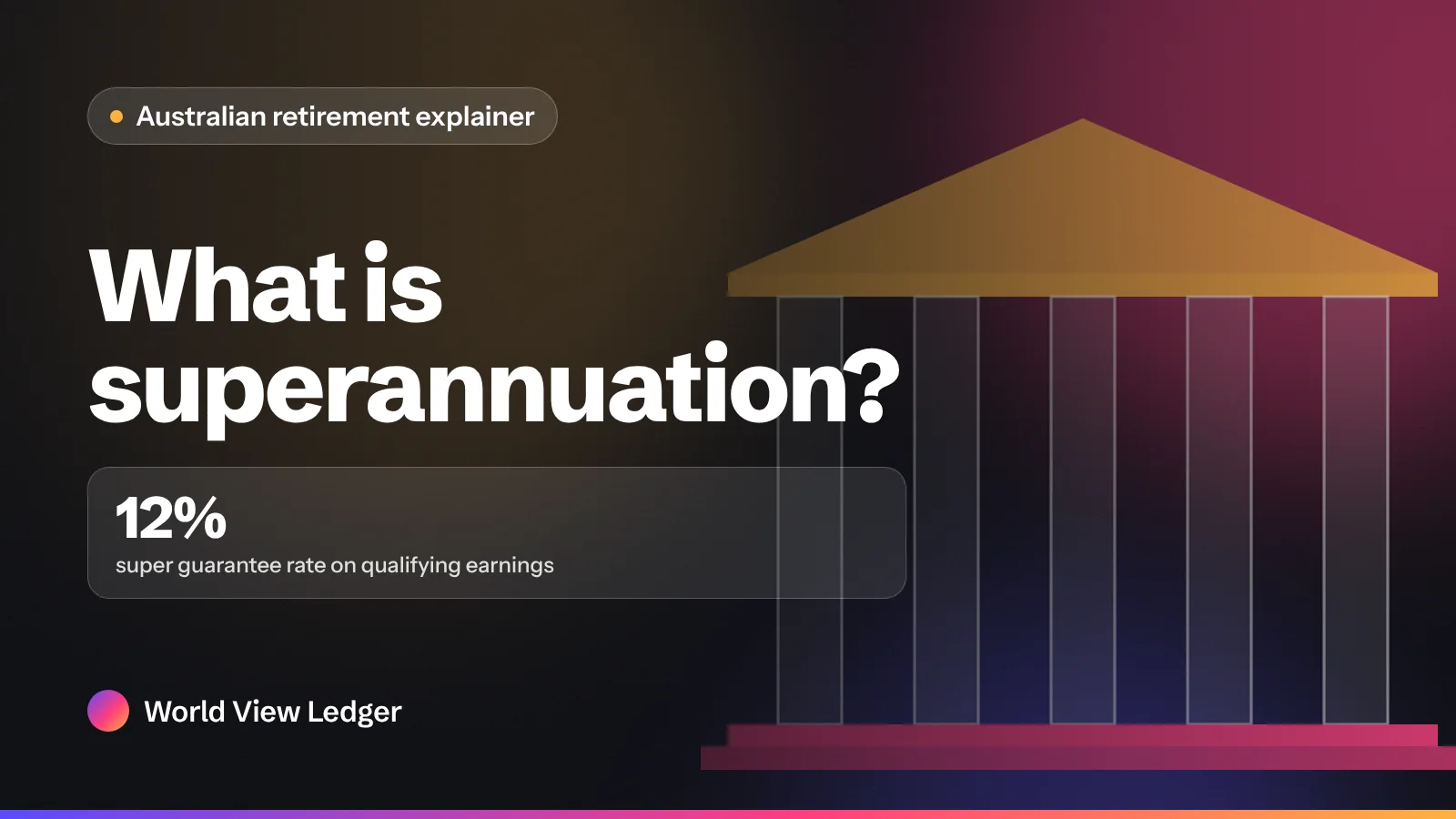
- Superannuation is Australia's compulsory workplace retirement savings system: employers must pay 12% of an employee's qualifying earnings into a super fund, where it is invested until retirement.
- Since 1 July 2026, Payday Super requires employers to pay super with each pay run, and contributions must reach the fund within 7 business days.
- Super is taxed lightly: generally 15% on employer and salary sacrifice contributions and up to 15% on fund earnings, with withdrawals usually tax-free from age 60.
- You generally cannot touch your super until you reach preservation age (60 for anyone born on or after 1 July 1964) and retire, or turn 65.
- Australians held about $4.77 trillion in super at 30 June 2026, according to APRA, making it one of the largest pension pools in the world.
What is superannuation? Superannuation, usually called "super", is Australia's compulsory workplace retirement savings system. Your employer must pay a set share of your earnings (12% as of 2026–27) into a super fund, which invests the money on your behalf until you are allowed to access it, normally when you retire after age 60 or turn 65.
Super is light-touch for most people: money goes in automatically and grows quietly for forty years. But the rules decide how much you end up with, and several of them changed in 2026. This guide explains how super works, how it is taxed, when you can use it, how it began, and how it compares with retirement saving in the US, the UK and the UAE.
Superannuation explained in plain English
Think of super as a long-term investment account with your name on it that you mostly cannot open until later life. Three things go into it:
- Employer contributions. The super guarantee (SG) is the minimum your employer must pay on top of your wages. It applies to employees, including most part-time and casual workers.
- Your own contributions. You can add money before tax through salary sacrifice, or after tax from your bank account.
- Investment returns. Your fund invests in shares, property, bonds, infrastructure and cash. Over decades, returns often make up the majority of a final balance.
The trade-off is simple: the government taxes super lightly to encourage you to save, and in return you agree to leave the money alone until retirement. The aim is to reduce reliance on the Age Pension, which super complements rather than replaces.
How does superannuation work? The 2026 rules
The super guarantee rate is now 12%
According to the Australian Taxation Office, the SG rate reached 12% on 1 July 2025 and remains 12% for 2026–27 and beyond. It has climbed in steps: 9% from 2002–03, 9.5% from 2014, then half a percentage point a year from 2021 until it reached the legislated target.
The SG is paid on earnings up to a ceiling called the maximum contribution base, which is $270,830 a year for 2026–27. Above that, employers are not required to pay more, although many senior contracts do.
Payday Super: the biggest change for employers in decades
Until mid-2026, employers only had to pay super quarterly, and unpaid super was a persistent problem. From 1 July 2026, Payday Super requires employers to pay super for each payday, and the money must reach your fund within 7 business days of payday, with limited exceptions such as for new employees. At the same time:
- super is now calculated on "qualifying earnings", a broader measure that includes ordinary time earnings, commissions and salary sacrificed amounts;
- funds must allocate or return contributions within 3 business days, down from 20;
- the Small Business Superannuation Clearing House has closed;
- late payers face a super guarantee charge with interest compounding daily, plus penalties of 25% or 50% of the unpaid charge.
Choosing a fund and stapling
Most employees can choose their own fund. If you do not, your employer must pay into your existing "stapled" fund, the one that follows you from job to job, so you do not end up with a new account and a new set of fees each time you move. If you have no fund at all, the employer uses its default fund, which must offer a basic, low-cost MySuper product.
A worked example: how 12% adds up
The numbers below are illustrative only, to show the mechanics. They assume a constant salary in today's dollars and a 4% a year return after fees and inflation, which is an assumption, not a forecast.
Sam earns $80,000 a year. His employer pays 12%, or $9,600 a year. After 15% contributions tax, $8,160 lands in his fund.
| Scenario over 40 years | Yearly amount into fund (after 15% tax) | Approximate balance in today's dollars |
|---|---|---|
| Employer super guarantee only | $8,160 | about $775,000 |
| Plus $50 a week salary sacrifice ($2,600 a year) | extra $2,210 | extra about $210,000 |
The salary sacrifice line shows why people top up. On the 30% tax rate plus the 2% Medicare levy, sacrificing $2,600 reduces Sam's take-home pay by only about $1,768, yet $2,210 reaches his super. Most of the extra balance comes from compounding over four decades, not from the contributions themselves. Real results will vary with returns, fees, career breaks and pay rises.
Is superannuation taxed?
Yes, but at concessional rates designed to reward saving. The government's Moneysmart guide sets out the basic structure:
| Stage | How it is taxed |
|---|---|
| Employer and salary sacrifice (concessional) contributions | Generally 15% when received by the fund |
| After-tax (non-concessional) contributions | Not taxed on the way in, because you have already paid income tax |
| Fund earnings while you are saving | Up to 15%, with an effective 10% on capital gains for assets held over 12 months |
| Earnings in a retirement phase pension account | Tax-free, up to the transfer balance cap |
| Withdrawals from a taxed fund at age 60 or over | Generally tax-free |
Give your fund your tax file number, otherwise contributions can be taxed at a higher rate. Low earners also get help: the Low Income Super Tax Offset refunds the 15% contributions tax, up to $500 a year, for people earning $37,000 or less. Legislation passed in March 2026 lifts that to a maximum of $810 for incomes up to $45,000 from 1 July 2027, according to law firm Hall & Wilcox's summary of the new law.
Extra tax for high earners and large balances
- Division 293 tax. If your income plus concessional contributions exceed $250,000, the ATO charges an extra 15% on the lesser of the excess or your concessional contributions, so those contributions are effectively taxed at 30%.
- Division 296 tax. From 1 July 2026, earnings on the share of a total super balance above $3 million are taxed at 30%, and above $10 million at 40%. Both thresholds are indexed to inflation, and the tax applies only to realised earnings, not paper gains. Parliament passed the law on 10 March 2026. It affects a small minority of members.
This is general information, not personal financial or tax advice; see our disclaimer and speak to a licensed adviser or registered tax agent about your situation.
How much can you put in? Contribution caps for 2026–27
Because super is taxed so lightly, there are annual limits on how much you can add. From 1 July 2026 they rose with wage indexation, according to the ATO's contributions caps page:
| Limit | 2025–26 | 2026–27 |
|---|---|---|
| Concessional (before-tax) cap, including employer SG | $30,000 | $32,500 |
| Non-concessional (after-tax) cap | $120,000 | $130,000 |
| General transfer balance cap (limit on moving super into tax-free retirement phase) | $2 million | $2.1 million |
Two features help people with uneven careers. If your total super balance was under $500,000 on the previous 30 June, you can carry forward unused concessional cap amounts from up to five earlier years. And if you are under 75, you can bring forward up to three years of non-concessional contributions at once, subject to balance tests. Note that a non-concessional cap of nil applies once your total balance reaches the general transfer balance cap.
When can you access your super?
Super is "preserved", meaning it stays locked until you meet a condition of release. The ATO lists the main ones:
- you turn 65, even if you are still working;
- you reach your preservation age and retire;
- you reach preservation age and start a transition to retirement income stream while still working.
Preservation age is 60 for anyone born on or after 1 July 1964, which now covers almost everyone still in the workforce. Early access is allowed only in narrow cases, such as severe financial hardship, specified compassionate or medical grounds, permanent incapacity, the First Home Super Saver scheme (for voluntary contributions only), or temporary residents leaving Australia.
At retirement you can take a lump sum, start an account-based pension that pays you regular income, or combine both. Money moved into a retirement phase pension earns tax-free returns, up to your personal transfer balance cap, which is a lifetime limit.
When did superannuation start in Australia?
Super is older than most people think, but universal super is relatively new. Drawing on APRA's timeline, Treasury's history of the retirement income system and the Parliamentary Library's chronology:
| Year | Milestone |
|---|---|
| Mid-1800s | Employer super schemes appear, mainly for salaried public servants and finance sector staff |
| 1909 | The Commonwealth Age Pension begins paying, at age 65 |
| 1915 | Super is taxed for the first time |
| 1986 | Under the Prices and Incomes Accord, a 3% employer super contribution is added to industrial awards in place of part of a wage rise |
| 1 July 1992 | The Superannuation Guarantee makes employer super compulsory: 3%, or 4% for employers with payrolls above $1 million |
| 1993 | The Superannuation Industry (Supervision) Act sets the modern regulatory framework |
| 2002 | The SG reaches 9% |
| 2013 | MySuper low-cost default products introduced through the Stronger Super reforms |
| 1 July 2025 | The SG reaches 12% |
| 1 July 2026 | Payday Super and the Division 296 tax on large balances begin |
The impact was dramatic. Treasury notes that coverage grew from around 40% of employees to 79% in the four years after award super arrived, and Parliamentary Library figures show more than 90% of employees had super by the late 1990s.
The pool has grown into one of the largest in the world. APRA's June 2026 statistics put total super assets at $4,767.2 billion at 30 June 2026, up 9.5% in a year, with a 12-month return of 8.6% for larger funds.
How super compares with the US, UK and UAE
Most rich countries encourage retirement saving through the workplace, but few force employers to pay as much as Australia does.
| Country | Main workplace scheme | Is the employer forced to pay? |
|---|---|---|
| Australia | Superannuation | Yes: 12% of qualifying earnings, on top of wages |
| United States | 401(k) plans | No: employers choose whether to offer a plan or match. Employees could defer up to $24,500 in 2026 (IRS) |
| United Kingdom | Auto-enrolment workplace pensions | Yes, but less: a minimum of 8% of qualifying earnings in total, of which the employer pays at least 3% (GOV.UK) |
| UAE | End-of-service gratuity for expatriate private sector workers | A lump sum at the end of employment: 21 days' basic salary per year for the first five years, 30 days after that, capped at two years' wages. A voluntary savings scheme lets employers invest 5.83% to 8.33% of basic salary monthly instead (u.ae) |
Two differences stand out. Australia's contribution comes entirely from the employer, while the UK model splits it between worker and employer. And Australian super is locked away until retirement, whereas a UAE gratuity is paid when a job ends. That preservation rule is what makes super a genuine retirement system rather than a severance payment.
What it means for you
- Check your fund's fees and performance. Small differences in fees compound over decades. The ATO's YourSuper comparison tool ranks MySuper products.
- Consolidate if you have several accounts. Multiple accounts mean multiple fees and insurance premiums. Make sure you are not losing insurance you need before you merge.
- Watch for missing payments. With Payday Super, contributions should appear within about a week of each pay.
- Consider topping up if you can. Salary sacrifice within the $32,500 cap can cut tax and lift your balance, especially for people with career breaks.
- Check your investment option. Younger members often sit in growth options suited to a long horizon; closer to retirement, the right mix depends on your plans.
Super is one piece of the wider tax system. If you have ever wondered what the rest of your tax pays for, our explainer on why we pay taxes covers the basics. Property investors will also want to read how the 2026 Budget changed negative gearing and capital gains tax. For more Australian coverage, visit our Australia edition.
Frequently asked questions
What is superannuation in simple terms?
Superannuation, or super, is money your employer is required to put aside for your retirement, on top of your wages. It goes into a super fund that invests it for decades. You can add your own money too, and you generally cannot withdraw it until you retire after reaching preservation age or turn 65.
How much super does my employer have to pay?
As of 2026–27, the super guarantee rate is 12% of your qualifying earnings, which include ordinary time earnings plus items such as commissions and salary sacrificed amounts. The rate is legislated to stay at 12%. From 1 July 2026 employers must pay it with each payday rather than quarterly.
Is superannuation taxed?
Yes, but at concessional rates. Employer and salary sacrifice contributions are generally taxed at 15% when they enter the fund, and fund earnings are taxed at up to 15%. Earnings on money in a retirement phase pension account are tax-free, and withdrawals from a taxed fund are generally tax-free once you are 60 or older.
When did superannuation start in Australia?
Employer super schemes existed from the mid-1800s, mainly for public servants and finance workers. Mass coverage began with award superannuation in 1986, when a 3% employer contribution was added to industrial awards, and compulsory super for almost all employees started with the Superannuation Guarantee on 1 July 1992.
Can I access my super early?
Only in limited circumstances, such as severe financial hardship, specified compassionate or medical grounds, permanent incapacity, the First Home Super Saver scheme for voluntary contributions, or leaving Australia as a temporary resident. Illegal early release schemes are a common scam and can lead to heavy penalties.
What happens to my super if I change jobs?
Your fund usually follows you. Under 'stapling' rules, if you do not choose a fund, a new employer must pay into your existing stapled fund rather than open a new account. That helps avoid paying multiple sets of fees on several small accounts.
- Super guarantee, Australian Taxation Office, 17 Apr 2026
- How Payday Super works, Australian Taxation Office, 10 Aug 2026
- Contributions caps, Australian Taxation Office, 11 Sep 2026
- Division 293 tax on concessional contributions by high income earners, Australian Taxation Office, 24 Aug 2026
- When you can withdraw your super, Australian Taxation Office, 10 Jul 2026
- Calculating your personal transfer balance cap, Australian Taxation Office, 31 Mar 2026
- Tax and super, Moneysmart (ASIC)
- Quarterly superannuation performance statistics highlights, June 2026, APRA, 31 Aug 2026
- Superannuation in Australia: a timeline, APRA
- Towards higher retirement incomes for Australians: a history of the Australian retirement income system since Federation, Treasury, 2001
- Superannuation: a chronology, Parliamentary Library, 11 Mar 2014
- Higher taxes on large super balances: key changes now legislated, Hall & Wilcox, 18 Mar 2026
- Key changes to 2026/27 super thresholds, Morningstar Australia, 9 Apr 2026
- 401(k) limit increases to $24,500 for 2026, IRA limit increases to $7,500, IRS, 13 Nov 2025
- Workplace pensions: what you, your employer and the government pay, GOV.UK, 27 Oct 2026
- End of service benefits for employees in the private sector, UAE Government (u.ae), 15 Oct 2026