Key points
- We pay taxes because governments sell almost nothing: taxes are how they fund shared services such as defense, roads, courts, schools and retirement and health programs.
- Congress's power to tax comes from Article I, Section 8 of the Constitution; the 16th Amendment, ratified on February 3, 1913, allowed a federal income tax without dividing it among the states by population.
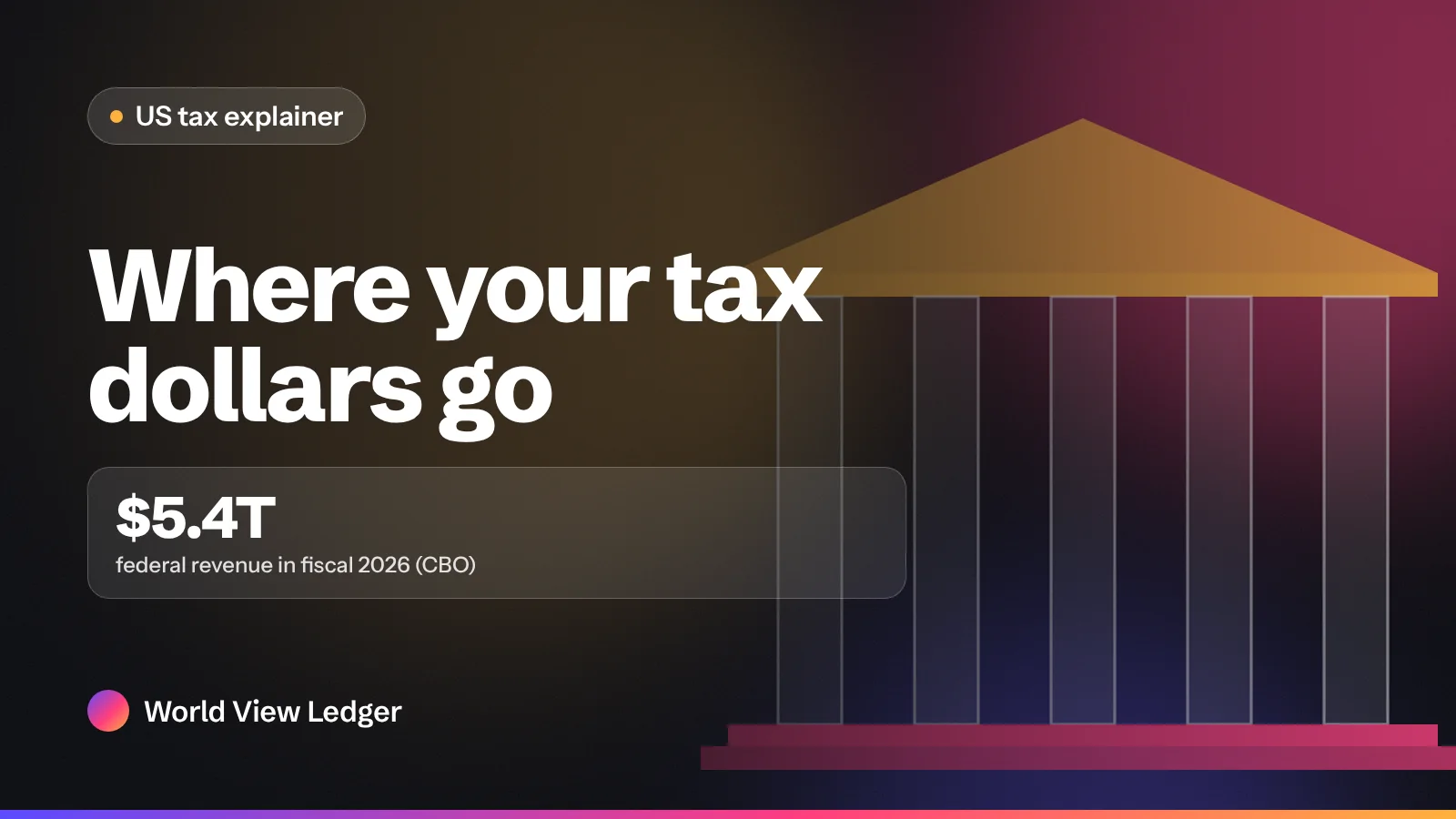
- In fiscal 2026 the federal government took in $5.40 trillion and spent $7.40 trillion, leaving a $2.0 trillion deficit, according to the Congressional Budget Office.
- Social Security was the largest single expense at $1.65 trillion, and interest on the national debt ($1.14 trillion) cost more than Medicare or the military.
- Individual income taxes supplied about 53% of federal revenue and payroll taxes about 34%; corporate taxes brought in about 7%.
Why do we pay taxes? Because governments sell almost nothing, taxes are how they pay for the things a society shares: an army, courts and police, highways, public schools, and the retirement and health programs that tens of millions of people rely on. In fiscal 2026 the federal government collected $5.40 trillion in taxes and other receipts, and spent $7.40 trillion.
This guide explains how taxes work in the United States, where the power to tax comes from, what the 16th Amendment changed, and exactly what your tax dollars paid for last year, line by line. We also compare how the US, UK, Australia and the UAE raise and spend money. Figures are as of November 2026.
Why do we pay taxes? The short answer
The Tax Foundation defines a tax as a mandatory payment collected by local, state and national governments to cover the cost of general government services. The key word is mandatory. A fee buys you a specific service, such as a passport or a park entry, and a fine punishes you for breaking a rule. A tax is neither: it is your share of the cost of things everybody uses, whether or not you personally use them that year.
Economists give three main reasons governments tax:
- To fund public goods. Some things are hard to sell one customer at a time. You cannot buy national defense, clean air rules or a flood barrier just for your own house, and nobody can easily be kept from benefiting. If these were left to voluntary payment, most people would let their neighbors pay. Taxes solve that problem. As the IRS's own classroom material puts it, the government provides public goods and services for the community as a whole, and taxes pay most of the bill.
- To share risk and support people. Social Security, Medicare, Medicaid, unemployment insurance and food assistance pool money across the whole population, so that old age, illness or a lost job does not mean destitution.
- To shape behavior. Excise taxes on cigarettes, alcohol and fuel raise money but also discourage use. Tax credits for children, retirement saving or home energy upgrades do the opposite, encouraging activities lawmakers want more of.
How much of the economy should run through taxes is one of the oldest arguments in politics. Our guide to socialism, communism and capitalism explains the competing views on the size of government. But every modern economy, from the most market-oriented to the most state-led, taxes its citizens.
What gives the US government the power to collect taxes?
The Constitution does. Article I, Section 8 opens the list of Congress's powers with the power to "lay and collect Taxes, Duties, Imposts and Excises," in order to pay the nation's debts and "provide for the common Defence and general Welfare," according to the National Archives transcription. The same clause says duties, imposts and excises must be uniform across the country.
The power to tax was a deliberate fix. Under the Articles of Confederation, which governed the country from 1781 until 1789, Congress could ask states for money but could not tax anyone directly, and states often failed to pay. The framers gave the new federal government its own taxing power so it could pay war debts and fund an army without begging.
They also added a limit. Article I says any "direct" tax must be apportioned among the states by population. That rule, written partly with head taxes and land taxes in mind, would become the central obstacle to a federal income tax for more than a century.
Taxes on income, property and sales at the state and local level rest on a different foundation: state constitutions. That is why tax rules differ so much from one state to the next.
What did the 16th Amendment do?
The 16th Amendment made the modern federal income tax possible. Its text is a single sentence: Congress "shall have power to lay and collect taxes on incomes, from whatever source derived," without apportionment among the states and without regard to any census. It was passed by Congress on July 2, 1909, and ratified on February 3, 1913, according to the National Archives.
The road to 1913
| Year | What happened |
|---|---|
| 1861–1862 | To pay for the Civil War, Congress passes the first federal income tax. The 1862 law, signed by President Lincoln, creates a Commissioner of Internal Revenue and taxes incomes at 3% and 5%. |
| 1872 | Congress repeals the Civil War income tax. |
| 1881 | In Springer v. United States, the Supreme Court unanimously upholds the Civil War tax. |
| 1894 | Congress enacts a 2% tax on incomes above $4,000, a threshold fewer than 1% of households met. |
| 1895 | In Pollock v. Farmers' Loan and Trust Co., a 5–4 Court strikes the 1894 tax down as an unapportioned direct tax, because it reached income from property such as rent, interest and dividends. |
| 1909 | Backed by President Taft, Congress sends the 16th Amendment to the states. |
| 1913 | The amendment is ratified and the first Form 1040 is introduced. |
| 1943 | The Current Tax Payment Act requires employers to withhold income tax from wages. |
| 1953 | The Bureau of Internal Revenue is renamed the Internal Revenue Service. |
The Pollock ruling is the reason an amendment was needed. Apportioning an income tax by population would have meant that residents of poorer, less populous states paid far higher rates than residents of richer ones, which was politically impossible. As the Constitution Annotated explains, the amendment's purpose was to remove that apportionment requirement for taxes on income, whatever its source.
The first modern income tax was tiny by today's standards. In 1913, generous exemptions meant less than 1% of the population paid income tax, at a rate of 1% of net income, the National Archives notes. The National Constitution Center adds that the first Form 1040 was three pages long. The income tax became a mass tax only during World War II, when the 1943 Current Tax Payment Act (see the Senate Finance Committee's report on the bill) introduced the paycheck withholding that most workers still see today.
How do taxes work in the US?
Americans pay three layers of tax, each funding a different level of government.
| Level | Main taxes | What they mostly fund |
|---|---|---|
| Federal | Individual income tax, payroll (Social Security and Medicare) tax, corporate income tax, tariffs, excise taxes | Social Security, Medicare, Medicaid (shared with states), defense, veterans, interest on the debt |
| State | Income tax (in most states), sales tax, excise taxes, plus federal grants | Medicaid and welfare, universities, highways, prisons, aid to school districts |
| Local | Property tax, local sales taxes, fees | Public schools, police, fire, sanitation, parks, local roads |
Progressive, flat and regressive taxes
The federal income tax is progressive: income is split into brackets, and each slice is taxed at a higher rate than the one below it. A raise never reduces your take-home pay, because the higher rate applies only to the extra dollars. Payroll tax is roughly flat up to a cap, after which Social Security tax stops. Sales taxes are often described as regressive, because lower-income households spend a larger share of what they earn.
That mix is why many households that owe no federal income tax still pay plenty of tax overall. Our explainer on who doesn't pay taxes shows how roughly 40% of households owe no federal income tax but still pay payroll, sales and property taxes.
Where does federal tax money come from?
The Congressional Budget Office reported on November 9, 2026, that federal receipts totaled $5,403 billion in fiscal 2026, which ran from October 1, 2025, to September 30, 2026. That was up 3.2% from the year before, though receipts fell slightly as a share of the economy, from 17.2% to 16.8% of GDP.
| Source | FY2026 (billions) | Share of revenue | Change vs FY2025 |
|---|---|---|---|
| Individual income taxes | $2,846 | 52.7% | +7.1% |
| Payroll taxes | $1,812 | 33.5% | +3.6% |
| Corporate income taxes | $381 | 7.1% | −15.6% |
| Customs duties (including tariffs) | $173 | 3.2% | −11.1% |
| Other receipts | $191 | 3.5% | +4.4% |
| Total | $5,403 | 100% | +3.2% |
Source: CBO. Shares calculated by World View Ledger.
The takeaway is that taxes on individual incomes and wages fund most of the federal government: together, income and payroll taxes supplied more than 86% of revenue. Corporate income tax, often the focus of political debate, contributed about 7 cents of every dollar.
What do taxes pay for? Every federal dollar in 2026
Federal outlays were $7,396 billion in fiscal 2026, up 5.5%, according to the CBO. Here is how that broke down.
| Spending category | FY2026 (billions) | Share of outlays |
|---|---|---|
| Social Security benefits | $1,654 | 22.4% |
| Net interest on the public debt | $1,142 | 15.4% |
| Medicare (net of premiums and other offsetting receipts) | $1,069 | 14.5% |
| Department of Defense, military | $917 | 12.4% |
| Medicaid | $723 | 9.8% |
| Veterans Affairs | $416 | 5.6% |
| Everything else (food assistance, education, housing, transportation, science, federal law enforcement, foreign aid and more) | $1,475 | 19.9% |
| Total | $7,396 | 100% |
Source: CBO. Shares calculated by World View Ledger.
Worked example: where $10,000 of your federal tax went
Suppose you paid $10,000 in federal income and payroll taxes in fiscal 2026. Spread across federal spending in proportion to the table above, it would have paid for roughly:
This is a simplification. Payroll taxes are legally earmarked for the Social Security and Medicare trust funds, while income taxes go into the general fund. But it gives a fair picture of the federal budget's priorities: more than half of all spending goes to Social Security, Medicare, Medicaid and veterans, mostly as payments to individuals.
The fastest-growing bill: interest
The government did not pay for all of that with taxes. Spending exceeded revenue by $1,992 billion, a deficit of 6.2% of GDP and $217 billion larger than the year before. In other words, about 27 cents of every federal dollar spent in 2026 was borrowed.
Borrowing has a price. Net interest on the public debt equaled about 21% of all federal revenue, and debt held by the public reached roughly 100% of GDP, the CBO says. Every dollar spent on interest is a dollar not available for anything else, which is why the deficit has become central to arguments over both tax rates and spending. When Congress cannot agree on how to fund the government at all, the result can be a shutdown, as our government shutdown explainer describes.
What do state and local taxes pay for?
The federal budget is only part of the picture. State and local governments spent $3.7 trillion on direct general expenditures in fiscal 2021, the latest detailed year available, according to the Urban Institute, or about $11,087 per person. Part of that money comes from federal grants, especially for Medicaid.
- Public welfare, including most of Medicaid: 23%
- Elementary and secondary schools: 21%
- Health and hospitals: 10%
- Higher education: 8%
- Highways and roads: 6%
- Police: 4%, with corrections at 2% and fire protection at 2%
So when people ask what their taxes pay for day to day, the honest answer depends on the tax. Your property tax bill mostly funds the local public school and police department. Your federal income tax mostly funds retirement and health programs, the military and interest.
How the US compares with the UK, Australia and the UAE
By international standards, Americans pay relatively little tax. Total US taxes at all levels of government equaled 25.2% of GDP in 2023, compared with an OECD average of 33.9%, ranking the US 32nd of 38 member countries, according to the OECD. Across the OECD, ratios ranged from 18.3% in Mexico to 45.2% in Denmark in 2024, with an average of 34.1%, the organization reported in December 2025. The OECD also notes the US is unusual in having no national value-added tax.
| United States | United Kingdom | Australia | UAE | |
|---|---|---|---|---|
| Main national taxes | Income tax, payroll tax, corporate tax, tariffs | Income tax, National Insurance, VAT, corporation tax | Income tax, company tax, GST (passed to the states) | Corporate tax, VAT, excise taxes; no personal income tax |
| National sales tax or VAT | None (states set sales taxes) | VAT | GST | VAT at 5% since January 1, 2018 |
| Biggest spending area | Social Security (22% of federal outlays, FY2026) | Welfare excluding state pensions (21% of spending, 2024–25) | Social security and welfare (36% of planned expenses, 2026–27 to 2029–30) | Not published on a comparable basis |
United Kingdom. HM Treasury's breakdown for the Annual Tax Summary that taxpayers receive shows that in 2024–25 welfare took 21.3% of spending, health 20.9%, state pensions 11.9%, debt interest 10.8%, education 10.3% and defense 5.5%. The big difference from the US is the National Health Service: Britons fund universal health care mainly through general taxation. National Insurance is different again: our explainer on what National Insurance pays for shows that it mostly funds the State Pension.
Australia. Social security and welfare is the largest category by far, at A$1,284 billion of A$3,527 billion in total expenses planned over the four years from 2026–27, according to the Parliamentary Budget Office's May 2026 snapshot. Health is next, at about 16%. Australia collects its goods and services tax nationally but hands it to the states, and the PBO notes those payments remain the largest single expense. Retirement saving is organized differently too: alongside the means-tested Age Pension, employers must pay 12% of wages into each worker's own retirement account, as our guide to how superannuation works in Australia explains.
UAE. The Emirates show that a modern state can run with very different taxes. There is no personal income tax. VAT was introduced at 5% on January 1, 2018, according to the UAE Ministry of Finance, and a federal corporate tax of 9% on taxable profits above AED 375,000 applies to financial years starting on or after June 1, 2023, PwC's tax summary notes.
What it means for you
- Your taxes buy specific things. Federal taxes go mostly to retirement and health programs, defense and interest. Local property taxes go mostly to schools and public safety. Knowing which is which makes political debates much easier to follow.
- Look at your total tax, not just income tax. Payroll, sales and property taxes can add up to more than your federal income tax, especially for middle- and lower-income households.
- Deficits are deferred taxes. With 27% of federal spending borrowed and interest costs rising fast, future taxpayers will carry the bill unless spending falls or revenue rises.
- You have a say. Tax rates, exemptions and spending priorities are set by elected officials at every level, from the school board to Congress.
For more on how tax and spending decisions shape the economy, see our economy coverage and the latest from our US edition.
This is general information, not tax or financial advice; see our disclaimer and speak to a qualified tax professional about your own situation.
Frequently asked questions
Why do we pay taxes?
We pay taxes to fund things that individuals cannot easily buy for themselves or that everyone shares: national defense, courts and police, roads, public schools, and safety-net programs such as Social Security, Medicare and Medicaid. Governments do not sell products for profit, so taxes on income, purchases and property are their main source of money.
What gives the US government the power to collect taxes?
Article I, Section 8 of the Constitution gives Congress the power to lay and collect taxes, duties, imposts and excises to pay the debts and provide for the common defense and general welfare. The 16th Amendment, ratified in 1913, added the specific power to tax incomes without apportioning the tax among the states by population.
What did the 16th Amendment do?
It overturned the effect of Pollock v. Farmers' Loan and Trust Co. (1895), in which the Supreme Court struck down the 1894 income tax as an unapportioned direct tax. By letting Congress tax incomes from whatever source derived, without apportionment, it made the modern federal income tax possible.
What are taxes used for?
At the federal level, the biggest items in fiscal 2026 were Social Security ($1.65 trillion), net interest on the debt ($1.14 trillion), Medicare ($1.07 trillion), the military ($917 billion) and Medicaid ($723 billion). State and local taxes mostly fund public schools, Medicaid and other welfare programs, hospitals, highways and police.
How do taxes work in the US?
Americans pay three layers of tax. The federal government relies mainly on income and payroll taxes, usually withheld from paychecks. States add income and sales taxes, and local governments rely mostly on property taxes. Income tax is progressive, with higher rates on higher slices of income, while payroll and sales taxes take a flatter share.
What happens if the government spends more than it collects in taxes?
It borrows by selling Treasury securities, and the borrowing adds to the national debt. In fiscal 2026 the gap was $2.0 trillion, or 6.2% of GDP, and debt held by the public reached about 100% of GDP, according to the Congressional Budget Office. Interest on that debt is now one of the largest items in the budget.
- Monthly Budget Review: Summary for Fiscal Year 2026, Congressional Budget Office, Nov 2026
- 16th Amendment to the U.S. Constitution: Federal Income Tax (1913), National Archives
- Historical Background on Sixteenth Amendment, Constitution Annotated (Cornell LII)
- How we wound up with a national income tax, National Constitution Center
- The Constitution of the United States: A Transcription, National Archives
- Current Tax Payment Act of 1943 (Senate Report No. 78-221), U.S. Senate Committee on Finance, 10 May 1943
- Understanding Taxes: Why Pay Taxes?, IRS
- Tax (TaxEDU glossary), Tax Foundation
- State and Local Expenditures, Urban Institute, Apr 2024
- Labour taxes drive OECD tax revenues to record high in 2024, OECD, Dec 2025
- Revenue Statistics 2024: the United States, OECD
- How public spending was calculated in your tax summary, HM Treasury, Mar 2026
- 2026-27 Budget Snapshot, Parliamentary Budget Office (Australia), May 2026
- Value Added Tax (VAT), UAE Ministry of Finance
- United Arab Emirates: Corporate - Taxes on corporate income, PwC Worldwide Tax Summaries, Sep 2026