Will the Stock Market Crash? The Warning Signs to Watch
Wall Street just had its worst week since 2020, as doubts about AI spending, Nvidia's leadership crisis and a hawkish Fed pushed the S&P 500 and Dow into a correction. Then stocks staged their best day in more than a year and a half. Here is what happened, how it compares with real crashes, and what to watch next.
Key points
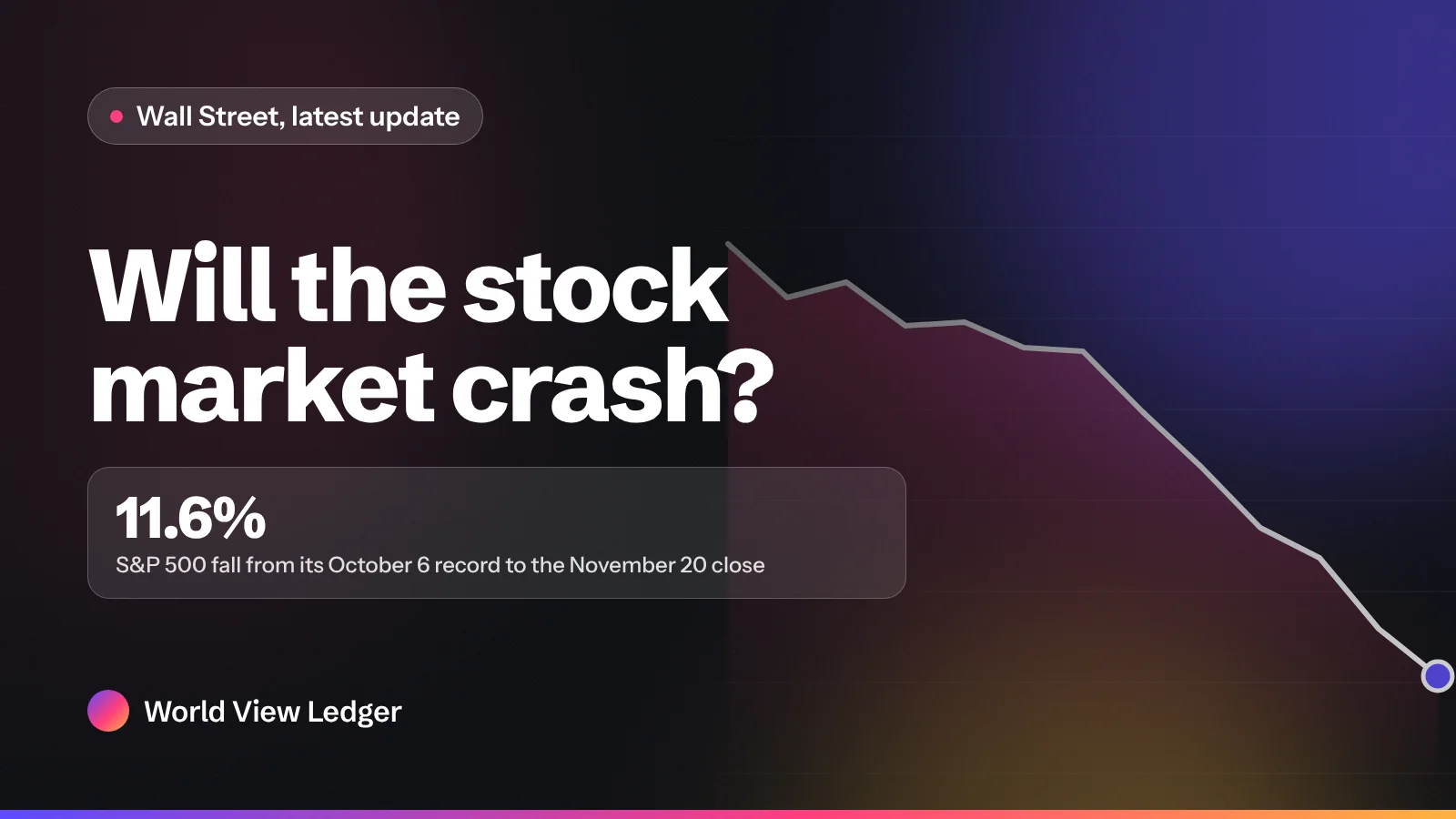
- The S&P 500 fell 8.6% in the week to November 20 and closed 11.6% below its October 6 record, a correction rather than a crash. The Dow also closed in correction territory.
- The selloff was led by AI and chip stocks: Nvidia fell 23% in the week after CEO Jensen Huang's November 12 resignation, and Anthropic's record IPO did not calm doubts about AI spending.
- On November 23 Nvidia reinstated Huang and stocks had their best day since April 2025: the S&P 500 rose 4.7% to 7,237.17 and the Nasdaq jumped 6.5%.
- The S&P 500 is still about 7% below its peak, and the Fed is widely expected to raise rates on December 9, so volatility is unlikely to disappear quickly.
- Warning signs to watch: whether the rebound holds, the VIX fear gauge, Treasury yields, the Fed's decision and AI companies' spending plans.
US stocks staged their best day since April 2025 on Monday, November 23, after Nvidia's board reinstated Jensen Huang as chief executive. The S&P 500 rose 4.7% to 7,237.17, ending a seven-day losing streak, and Nvidia shares jumped about 31%. The index is still about 7% below its October record. Next up: GDP and inflation data on November 25 and the Fed's decision on December 9.
Will the stock market crash? Nobody can say for certain, but what happened in November 2026 was a sharp correction, not a crash. The S&P 500 fell 11.6% from its record in about six weeks and had its worst week since 2020, then bounced hard on November 23. The risks that caused the selloff have not gone away.
Below: what drove the AI selloff, how it compares with real market crashes, the warning signs to watch and what it means for your money.
What happened: Wall Street's worst week since 2020
In the week ending Friday, November 20, the S&P 500 fell 8.6%, the Dow Jones Industrial Average lost 8.0% and the Nasdaq Composite dropped 10.0%, according to closing data compiled by STL.News. Friday alone was brutal: the S&P 500 lost 3.7% to close at 6,910.39, the Nasdaq fell 5.3% and the Dow shed 950 points.
That left the S&P 500 11.6% below its record close of 7,818.93 on October 6, and the Dow more than 11% below its August record, putting both in correction territory, Yahoo Finance reported. The Nasdaq ended the day below where it started 2026. The S&P 500 fell for seven straight sessions, its longest losing streak since February 2020.
Fear spiked. The Cboe Volatility Index (VIX), Wall Street's "fear gauge," briefly touched 40 on Friday, its highest level since April 2025. By Fortune's estimate, the S&P 500 had lost roughly $8 trillion in market value from its peak.
Why is the stock market down? Three causes
1. Doubts about AI spending
The biggest driver was a loss of confidence in the artificial intelligence trade that powered stocks to records. Investors are questioning whether the hundreds of billions being spent on AI chips and data centers will earn an adequate return. Chip stocks fell hardest: Micron lost nearly a quarter of its value over the week, and AMD and Broadcom fell by double digits, according to Fortune. By Friday, 71 of the 101 stocks in the Nasdaq-100 were in a bear market, including every semiconductor and memory chip name in the index.
The timing was awkward. Anthropic, the maker of the Claude AI models, priced its IPO at $83 a share on November 18, raising about $81.3 billion, the largest offering on record. Its shares opened at $111.50 on November 19 and closed up 17%, CBS News reported, but fell about 9% the next day as the wider selloff deepened.
2. Nvidia's leadership crisis
Nvidia, the world's most important AI chipmaker, announced on November 12 that Jensen Huang had resigned as CEO with immediate effect, naming CFO Colette Kress interim chief. The company gave no reason. CBS News reported that the resignation followed concerns raised by US intelligence agencies about a personal relationship; China has denied any involvement. Nvidia shares fell 14% on November 20 and 23% for the week, their worst week since October 2008. For the full story of Huang's exit, return and Nvidia's record quarter, see our Nvidia AI news tracker.
3. A Fed that is still raising rates
Unlike most past selloffs, investors cannot count on the Federal Reserve riding to the rescue. The Fed signaled it still plans to raise rates in December, and futures markets put the odds of a quarter-point hike at around 90%. Higher rates make borrowing more expensive and reduce what investors will pay for future profits, which hits fast-growing tech stocks hardest. For the economic backdrop, see our analysis of whether there will be a recession.
The rebound: Huang returns and stocks surge
On November 23, Nvidia's board reinstated Huang as president, CEO and director, saying it had received input from senior levels of the US government and was confident his return posed no national security risk. President Trump had publicly pushed for the move and told CNBC he spoke directly to the board.
Markets roared back. According to closing figures from the Associated Press:
| Index | Close, Nov 20 | Close, Nov 23 | Monday change | Below record (Nov 23) |
|---|---|---|---|---|
| S&P 500 | 6,910.39 | 7,237.17 | +4.7% | About 7.4% |
| Dow Jones | 48,147.33 | 49,595.31 | +3.0% | About 8.7% |
| Nasdaq Composite | 22,617.74 | 24,089.56 | +6.5% | n/a |
| Russell 2000 | 2,581.79 | 2,669.66 | +3.4% | n/a |
Nvidia closed up about 31%. It was Wall Street's best day since April 2025, Yahoo Finance reported. Not everyone was convinced: Nomura strategist Charlie McElligott attributed much of the move to forced, mechanical buying and short covering, warning the bounce "guarantees us nothing." Even after the rally, the S&P 500 remained about $5 trillion below its peak value, Fortune calculated.
Is this a crash? How it compares
There is no official definition of a crash, but the term usually means a sudden, very large fall over days or weeks. Analysts use two standard thresholds: a correction is a fall of at least 10% from a recent high, and a bear market is a fall of at least 20%.
| Episode | Approximate S&P 500 fall | How fast |
|---|---|---|
| Black Monday, October 1987 | About 20% in one day | One session |
| Global financial crisis, 2007 to 2009 | About 57% | 17 months |
| Covid crash, 2020 | About 34% | About five weeks |
| Rate-hike bear market, 2022 | About 25% | About nine months |
| Tariff selloff, spring 2025 | About 19% | About seven weeks |
| AI selloff, Oct to Nov 2026 | 11.6% (to Nov 20 close) | About six weeks |
By that yardstick, November 2026 was a fast, painful correction, steeper in the tech sector than in the broad market. Corrections are common; the S&P 500 has historically had one every year or two on average, and most do not turn into bear markets.
Warning signs to watch
Signs the worst may be over
- The rebound holds through the Thanksgiving week
- The VIX falls back toward its 2026 average of about 18
- Chip stocks stabilize as AI spending plans hold up
- Economic data stays solid: 165,000 jobs added in October
Signs of more trouble
- Stocks fall back to or below the November 20 lows
- The VIX returns to 40 or higher
- Big tech firms cut AI investment plans
- The Fed signals several more rate hikes into 2027
Other gauges matter too. The 10-year Treasury yield, around 4.9% last week, sets the cost of money across the economy. Inflation is the other key input: hotter prices mean more hikes. Our inflation news tracker follows the latest readings.
What it means for you
- Long-term investors: history shows that selling after a sharp drop often locks in losses, and some of the biggest up days, like November 23, come in the middle of turbulent stretches.
- Check your concentration: AI and chip stocks make up a large share of major US indexes, so index funds were hit too. Know how much of your portfolio rides on a handful of companies.
- Outside the US: retirement savers in the UK, Australia and the UAE often hold large US stakes through global funds. Australian superannuation balances, for example, typically include significant international shares.
- Cash needs: money you need within a year or two generally should not depend on the stock market.
This article is general information, not financial advice. See our disclaimer.
What to watch next
- November 25: second estimate of third-quarter GDP and October PCE inflation.
- November 26 to 27: US markets closed for Thanksgiving, with an early 1 p.m. Eastern close on Friday.
- December 4: the November jobs report.
- December 9: Federal Reserve rate decision, with a hike widely expected.
- December 10: November consumer price index.
We will update this page as markets move. Follow our business coverage for more.
Frequently asked questions
Is the stock market crashing right now?
Not on the usual definitions. The S&P 500 fell 11.6% from its October 6 record by November 20, which is a correction (a drop of 10% or more). A bear market is a fall of 20% or more. On November 23 the index rebounded 4.7% and closed about 7% below its peak.
Why did the stock market drop in November 2026?
Mainly because investors grew more doubtful that huge spending on artificial intelligence will pay off. Chip and AI stocks fell hardest, Nvidia was hit by the sudden resignation of its CEO, and the Federal Reserve signaled it still plans to raise interest rates in December.
When will the stock market crash?
Nobody can reliably predict the timing of a crash. Sharp falls usually follow a shock, such as a financial crisis, a pandemic or a sudden change in interest rates, combined with high valuations. The signals worth watching are market volatility, bond yields, credit conditions, company earnings and central bank decisions.
Is the stock market open on Thanksgiving 2026?
No. US stock markets are closed on Thursday, November 26, 2026, for Thanksgiving and close early, at 1 p.m. Eastern time, on Friday, November 27.
- Stock market today: Dow and S&P 500 enter correction, Nasdaq sinks 5% to erase 2026 gains as AI trade melts down, Yahoo Finance, 20 Nov 2026
- U.S. Stock Market Weekly Update Ending Nov. 20, 2026, STL.News, 21 Nov 2026
- How major US stock indexes fared Monday 11/23/2026, Associated Press via Yahoo Finance, 23 Nov 2026
- Stock market today: Dow, S&P 500, Nasdaq post best day since April 2025 as Nvidia stock soars, Yahoo Finance, 23 Nov 2026
- The stock market is still $5 trillion below its AI-fueled peak despite Monday's rally, Fortune, 23 Nov 2026
- NVIDIA Announces CEO Transition, NVIDIA (SEC filing), 12 Nov 2026
- NVIDIA Board Reinstates Jensen Huang as President, CEO and Board Director, NVIDIA, 23 Nov 2026
- Nvidia reinstates Jensen Huang as CEO, CBS News, 23 Nov 2026
- Anthropic prices initial public offering, Anthropic, 18 Nov 2026
- Anthropic shares gain 17% on first day of trading after record IPO, CBS News, 19 Nov 2026
- November 2026 Q-Commentary: A Correction, Not a Conclusion, Quotient Wealth Partners, 23 Nov 2026