- Home
- Technology
- AI industry news
AI Industry News: Nvidia, AMD, Tesla and the Chip Race
In two weeks Nvidia lost its founder, posted a record $115.8 billion quarter under an interim chief, then reinstated Jensen Huang and added the most market value any US stock has gained in a day. Meanwhile AMD closed two AI acquisitions and Tesla reshuffled its chip plans. Here is what happened in the AI chip race and what to watch next.
Key points
- Nvidia's board unanimously reinstated Jensen Huang as president and CEO on November 23, 11 days after he resigned. An independent board investigation is still running, and Nvidia created a new national security and export control committee.
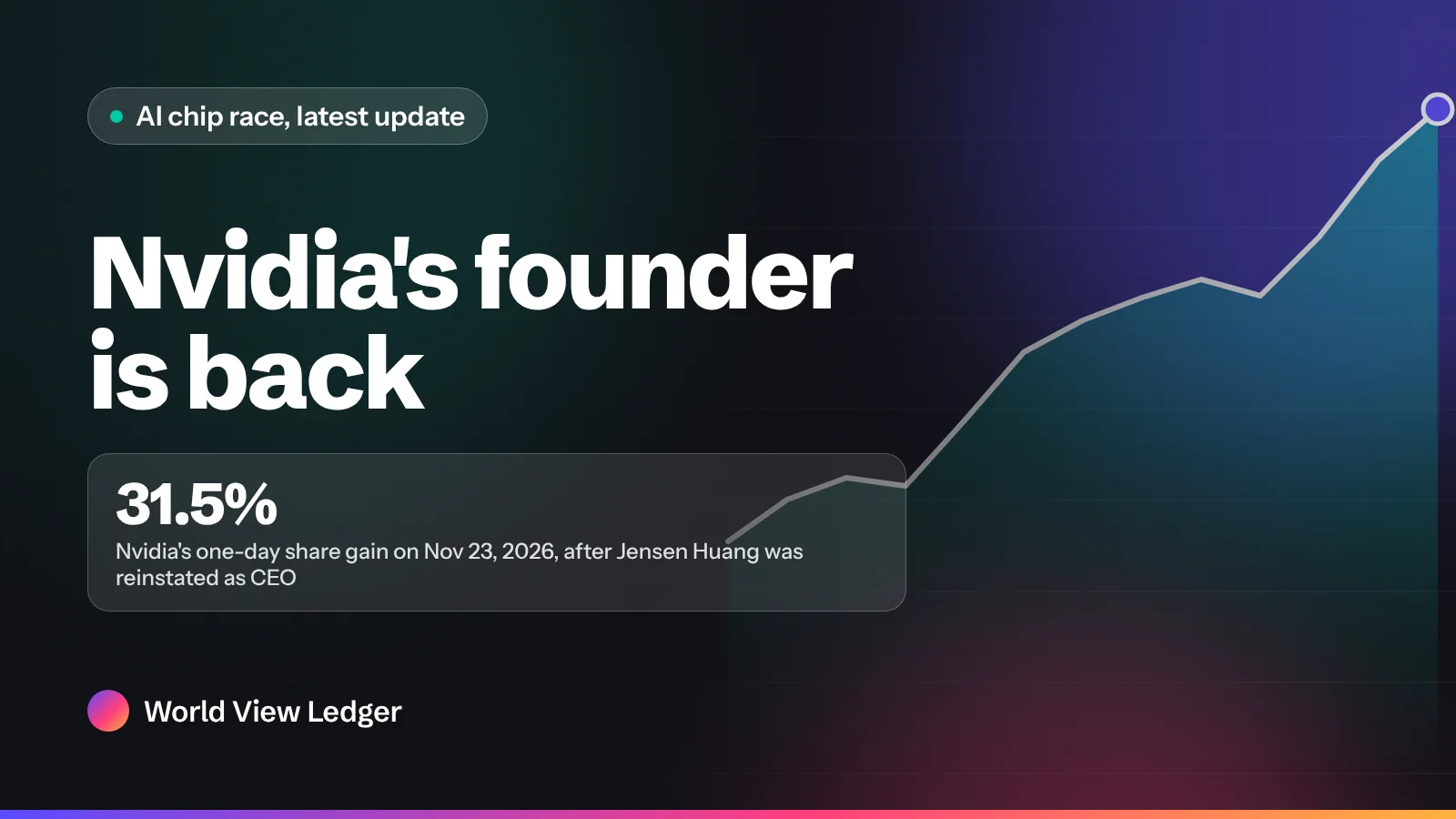
- Nvidia shares closed up 31.5% at $165.05 that day, their best day since 2003. MarketWatch put the gain at about $950 billion in market value, a one-day record for a US stock.
- The rally faded: shares fell on November 24 and dropped 3.9% to $149.30 on November 25 as hot inflation data, new tariff plans and doubts about AI spending weighed on tech.
- Nvidia's third-quarter revenue hit $115.8 billion, up 103% from a year earlier, and it guided to $130 billion this quarter with no data center sales to China assumed.
- AMD completed its purchases of World Labs and Taalas, and Elon Musk said Tesla's new AI5 chip will go to its Optimus robot while cars stay on AI4.
Nvidia shares closed at $149.30 on Wednesday, November 25, down 3.9% on the day and well below Monday's peak, as hot inflation data and new tariff plans hit technology stocks. The stock is still up about 19% from its November 20 close, before Jensen Huang was reinstated as chief executive. US stock markets are closed today for Thanksgiving and reopen for a shortened session on Friday.
The biggest Nvidia AI news today is that the world's most important AI chipmaker has its founder back. Nvidia's board reinstated Jensen Huang as CEO on November 23, 11 days after he resigned, and the stock had its best day in more than two decades before giving back part of the gain.
Below: what happened at Nvidia, what its record quarter showed, how the stock has swung, what AMD and Tesla did in the same fortnight, and the dates to watch.
What happened: Huang's exit and return
On November 12 Nvidia announced that Huang had resigned as president and CEO and left the board, effective immediately, after 33 years. Chief financial officer Colette Kress became interim CEO. Nvidia gave no reason. News reports linked the resignation to scrutiny of Huang's personal relationships, including one with a woman whom US officials reportedly suspected of ties to Chinese intelligence, Al Jazeera and other outlets reported. Those reports have not been confirmed by Nvidia.
On Monday, November 23, the board voted unanimously to bring him back as president, CEO and director, effective immediately. In its statement, Nvidia said it had received input from senior levels of the US government and was confident his return "poses no national security risk." It also said:
- The investigation by a committee of independent directors, with outside counsel, will continue to its conclusion, and Huang supports it.
- A new National Security and Export Control Committee of independent directors is hiring national security counsel.
- Nvidia is searching for a new chief compliance officer.
- Harvey Jones stays as board chair, and Kress returns to her role as CFO.
Huang said he was "honored to return." President Trump wrote on Truth Social that the board had made "the correct and proper decision," according to Al Jazeera. Not everyone in Washington agreed: Senator Elizabeth Warren said Huang and Nvidia "still owe Congress answers."
The stock: a record day, then a pullback
Investors had punished Huang's departure. Nvidia shares fell 23% in the week after he resigned, their worst week since 2008, as we reported in our stock market crash analysis. His return reversed much of that in one session.
MarketWatch estimated the move added about $950 billion to Nvidia's value, the largest one-day gain in market value for any US stock, StockAnalysis reported. Other outlets, using different measures, put it at close to $900 billion. Either way, it was more than double Microsoft's $450 billion one-day gain in July. The PHLX Semiconductor Index rose 14% and the Nasdaq 100 6.9%.
The euphoria did not last. Shares fell on Tuesday and then lost another 3.9% on Wednesday, closing at $149.30 with a market value of about $3.74 trillion, according to The Motley Fool via Yahoo Finance. The triggers were wider than Nvidia: the October PCE price index showed inflation at 3.8%, nearly twice the Federal Reserve's 2% goal, the US unveiled new tariff proposals, and worries about debt-funded AI spending resurfaced. AMD fell 1.75% the same day.
| Date (2026) | Event | Nvidia close |
|---|---|---|
| Nov 12 | Huang resigns, Kress named interim CEO | Selloff begins |
| Nov 17 | Record Q3 results under interim CEO | Up nearly 4% after hours |
| Nov 20 | Worst week since 2008 ends | About $125.53 |
| Nov 23 | Board reinstates Huang | $165.05 (+31.5%) |
| Nov 25 | Inflation and tariff worries | $149.30 (-3.9%) |
The November 20 close is derived from Monday's reported close and gain.
Nvidia's record quarter
The leadership drama overshadowed a very strong business. For the quarter to October 25, Nvidia reported revenue of $115.8 billion, up 103% from a year earlier and 20% from the previous quarter. Data center sales, mostly AI chips and systems, were $107.6 billion, up 110%. Wall Street had expected about $109.1 billion in total revenue, according to LSEG data cited by IBTimes.
| Measure | Q3 fiscal 2027 | Change from a year ago |
|---|---|---|
| Revenue | $115.8 billion | +103% |
| Data center revenue | $107.6 billion | +110% |
| Edge computing revenue | $8.2 billion | +42% |
| GAAP net income | $65.3 billion | +105% |
| GAAP gross margin | 74.8% | Up from 73.4% |
Kress said the new Vera Rubin NVL72 rack systems had shipped and called it "the fastest product ramp in the company's history." Nvidia guided to revenue of $130 billion, plus or minus 3%, for the current quarter, ahead of the roughly $125 billion analysts expected. Two caveats: the quarter has an extra week, and the forecast assumes no data center compute revenue from China, where US export controls have blocked sales of its most advanced chips. Our US-China news tracker covers the latest chip rules.
AMD: two acquisitions and a rack-scale push
Nvidia's closest GPU rival has been busy. On November 3 AMD reported a record third quarter, with data center revenue up 97% from a year earlier. According to the AMD newsroom, in the past two weeks it has:
- Nov 12: shared updates on its Instinct MI400 series, including measured inference results for the MI455X and a new MI450X, both on its Helios rack-scale system.
- Nov 16: completed its acquisition of World Labs, which builds AI models that create and simulate interactive 3D worlds. Co-founder Fei-Fei Li joins AMD as executive vice president and chief scientist, reporting to CEO Lisa Su, IT Brief reported.
- Nov 17: completed its purchase of Taalas, a Toronto start-up that designs specialized chips for AI inference, a deal first announced in August.
- Nov 23: said Microsoft is running workload validation of Helios for AI inference on Azure.
AMD did not disclose terms for either deal in the materials we reviewed. The strategy is clear, though: AMD is trying to sell complete AI systems, not just chips, and to win more of the fast-growing inference market, where trained models answer users' requests.
Tesla: AI5 goes to robots, not cars
Tesla designs its own AI chips, and its plans shifted this week. In a November 22 post on X, Elon Musk said of the new AI5 chip: "It's going to Optimus. Cars will remain at AI4," Teslarati and GSMGoTech reported. That means Tesla's Optimus humanoid robot and its training clusters get the new chip first, while vehicles keep the current hardware.
AI5 reached tape-out, the final design stage before manufacturing, in April, with TSMC and Samsung both named by Musk as production partners. Tesla is targeting volume production in 2027. Musk has argued AI4 is already enough for its Full Self-Driving software to be far safer than human drivers; that is his claim, not an independent finding.
What it means for investors and the AI race
- Concentration risk: Nvidia is one of the largest companies in the world, so its swings move index funds and pension savings in the US, UK, Australia and beyond, not just tech investors.
- Key-person risk is real: the stock's fall and rebound show how much of Nvidia's value investors tie to one founder, even while its sales were doubling.
- Demand is not the problem yet: the latest results show AI spending is still rising. The worries are about whether buyers can keep funding it, especially as interest rates stay high.
- Competition is broadening: AMD's deals and Tesla's in-house chips are part of a wider push to reduce dependence on Nvidia.
This article is general information, not financial advice. See our disclaimer.
What happens next: key dates
- November 27: US markets reopen for a shortened post-Thanksgiving session.
- December 8 to 9: the Federal Reserve's final rate meeting of 2026. Another hike would add pressure on richly valued tech stocks; see our inflation news tracker for the backdrop.
- Coming weeks: Nvidia's independent board investigation continues, and any findings, or action by Congress or regulators, could move the stock again.
- January 10, 2027: the current US-China trade truce expires unless extended, with chip export rules still a flashpoint.
- 2027: Tesla's target for AI5 volume production, and the next test of whether Vera Rubin demand holds up.
Follow our technology coverage for updates to this page.
Frequently asked questions
Is Jensen Huang still the CEO of Nvidia?
Yes. Huang resigned on November 12, 2026, but Nvidia's board voted unanimously to reinstate him as president, CEO and board director on November 23, effective immediately. Colette Kress, who was interim CEO, remains chief financial officer. An independent board investigation is continuing.
Why did Nvidia stock go up so much on November 23?
Investors cheered Huang's return after the stock fell sharply during his absence. Shares closed up 31.5% at $165.05, their best day since 2003, and MarketWatch estimated the gain at about $950 billion in market value, the largest one-day increase for any US stock.
Why is Nvidia stock going down this week?
After the November 23 surge, shares fell on November 24 and dropped 3.9% on November 25. Reports linked the slide to October inflation running at 3.8%, which raises the chance of another Fed rate hike, new US tariff proposals and renewed worries about how much companies are spending on AI.
How much revenue did Nvidia make last quarter?
Nvidia reported revenue of $115.8 billion for the quarter that ended October 25, 2026, up 103% from a year earlier. Data center sales were $107.6 billion. It expects about $130 billion, plus or minus 3%, in the current quarter, which includes an extra week.
- NVIDIA Announces Financial Results for Third Quarter Fiscal 2027, NVIDIA, 17 Nov 2026
- Nvidia record revenue, $130 billion outlook, China, International Business Times, 17 Nov 2026
- NVIDIA Board Reinstates Jensen Huang as President, CEO and Board Director, NVIDIA, 23 Nov 2026
- Nvidia board reinstates Jensen Huang as CEO, Al Jazeera, 23 Nov 2026
- Nvidia adds a record $950B in market value in one day on Huang's return, StockAnalysis, 23 Nov 2026
- Stock Market Today, Nov. 25: Nvidia Slides 3.9%, The Motley Fool via Yahoo Finance, 25 Nov 2026
- AMD buys World Labs and Taalas to boost AI strategy, IT Brief UK, 18 Nov 2026
- AMD Newsroom: All News, AMD, Nov 2026
- Tesla finalizes AI5 chip design, Elon Musk makes bold claim on capability, Teslarati, 24 Nov 2026
- Tesla AI5 Chip Reserved for Optimus as Cars Stick With AI4, GSMGoTech, 25 Nov 2026