Inflation News: Where Prices Are Heading and Why
US consumer prices are still rising faster than the Fed wants, and nearly all its officials now expect another rate hike in December. Falling gas prices offer some relief, but the minutes show the Fed worries inflation is spreading.
Key points
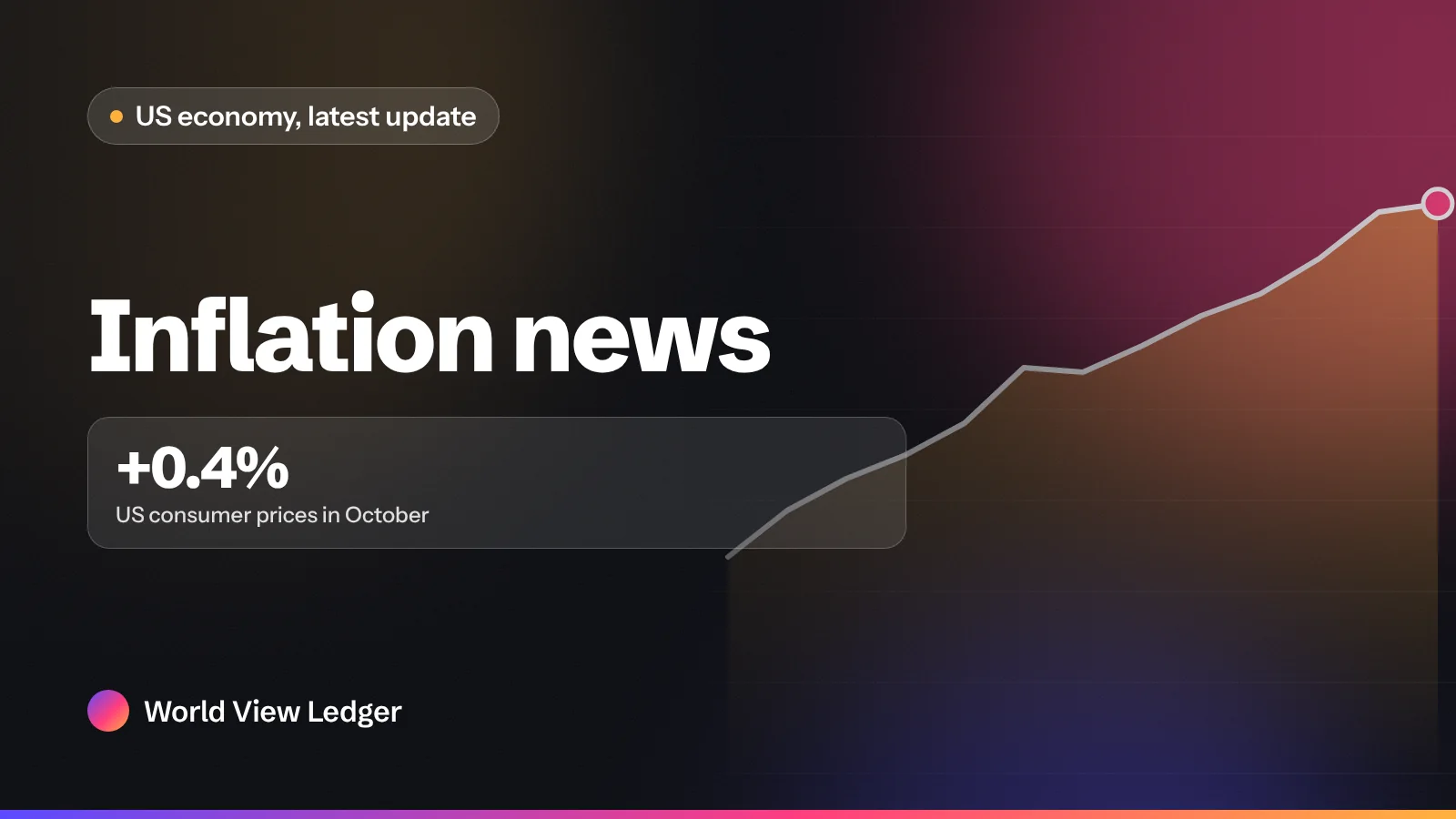
- US consumer prices rose 0.4% in October after 0.6% in September, and core prices rose 0.3% for a third straight month, according to the BLS.
- The BLS could not publish an annual CPI rate for October because the 2025 shutdown stopped data collection a year earlier. The Fed's preferred gauge, PCE, was 3.6% in September.
- Minutes released on November 18 show nearly all Fed officials expect a quarter-point hike at the December 8 to 9 meeting, with some floating a half-point.
- Gas prices are falling fast: AAA put the national average at $3.72 on November 19, down from $4.30 a month earlier, but still above $3.09 a year ago.
- Inflation is also elevated abroad: 3.6% in the UK and 4.0% in the euro area in October, driven by energy.
Minutes of the Federal Reserve's October meeting, released on November 18, show nearly all officials expect to raise interest rates again at the December 8 to 9 meeting, and two floated a half-point move. Gas prices, the biggest driver of this year's inflation, have been falling for about four weeks. The next key reading, October PCE inflation, is due on November 25.
Inflation news: US inflation is still running well above the Federal Reserve's 2% target. Consumer prices rose 0.4% in October after a 0.6% jump in September, and the Fed's preferred measure was 3.6% higher than a year earlier in September. With price increases spreading beyond gasoline, the Fed is preparing to raise rates for the second time this year, even as prices at the pump fall.
This page covers the latest numbers, why prices are rising, what the Fed is likely to do next, how the US compares with the UK and Europe, and the dates to watch. We will update it as new data arrives.
The latest US inflation numbers
The Bureau of Labor Statistics released the October Consumer Price Index on November 10. The headline index rose 0.4% on a seasonally adjusted basis. Core prices, which strip out volatile food and energy, rose 0.3%, the same pace as in August and September.
| Category (CPI, seasonally adjusted) | September 2026 | October 2026 |
|---|---|---|
| All items | +0.6% | +0.4% |
| Core (excluding food and energy) | +0.3% | +0.3% |
| Energy | +5.2% | +0.7% |
| Gasoline | +9.1% | +1.0% |
| Food | 0.0% | +0.5% |
| Shelter | +0.4% | +0.3% |
| Used cars and trucks | +0.7% | -1.2% |
Shelter accounted for more than 30% of October's increase. Other notable rises included hospital services (0.8%), electricity (0.9%), recreation (0.8%) and motor vehicle insurance (0.7%). Groceries rose 0.4% and restaurant meals 0.5%.
For an annual rate, the best current guide is the Personal Consumption Expenditures price index from the Bureau of Economic Analysis. In September it rose 0.5% on the month and 3.6% on the year. Core PCE was up 3.1% on the year. PBS NewsHour, reporting on the October CPI, said the country appears headed for annual inflation of about 4% this year.
Why is inflation so high?
Three forces stand out in the data.
1. An energy shock
The conflict involving Iran pushed oil and fuel prices sharply higher this year. Gasoline rose 9.1% in September alone. Energy feeds into almost everything, from delivery costs to airfares, so a large fuel shock tends to lift other prices with a lag.
2. Sticky services and housing
Rent, owners' equivalent rent, insurance and medical care are rising steadily. These costs change slowly and are hard for interest rates to move quickly, which is why core inflation has stayed at 0.3% a month, roughly a 3.6% annual pace if sustained.
3. Inflation is broadening
According to the Associated Press, the Fed's minutes said price increases have spread beyond the industries hit directly by higher oil prices or tariffs. A vast majority of officials worried that inflation could persist even if gas prices keep falling and the effects of tariffs and the AI data center buildout fade.
That combination of high prices and a strong-but-uncertain economy is why some economists have raised the risk of stagflation, although US growth has so far held up.
What the Fed is doing about it
The Fed raised its benchmark rate by a quarter point on September 16, to a range of 3.75% to 4.00%, in a 12-0 vote. It was the first increase in three years. At its October 27 to 28 meeting it held rates steady, but two policymakers, Cleveland Fed President Beth Hammack and Governor Lisa Cook, dissented in favor of another hike, according to J.P. Morgan Asset Management.
The minutes of that meeting, published on November 18, point clearly toward December:
- Nearly all officials expect a quarter-point increase at the December meeting, the AP reported. Bloomberg likewise reported that almost all expect more hikes.
- Two officials floated a half-point move in December. Governor Christopher Waller has publicly backed a half-point increase.
- Markets agree: futures pricing put the odds of a December hike at nearly 95% on November 18, according to the AP.
Not everyone wants to move fast. New York Fed President John Williams has opposed a half-point step. The size of the December move is the main open question, and the October PCE data on November 25 could tip it.
Our view: a quarter-point hike looks like the baseline. A half-point move would likely need another hot reading on core prices, not just energy.
Gas prices: the one piece of good news
Pump prices are falling quickly as crude oil has eased. On November 19, AAA put the national average for regular gasoline at $3.72 a gallon, down 18 cents in a week. US benchmark crude (WTI) settled at $83.26 a barrel on November 18.
| AAA national average, regular | Price per gallon |
|---|---|
| November 19, 2026 | $3.72 |
| One week earlier | $3.91 |
| One month earlier | $4.30 |
| One year earlier | $3.09 |
What it means for your wallet: filling a 15-gallon tank at $3.72 costs about $55.80. A month ago it cost about $64.43, so drivers are saving roughly $8.60 a fill. But the same tank cost about $46.40 a year ago, so fuel is still about $9.40 a fill more expensive than in late 2025.
Cheaper gas should pull November's headline CPI down. The Fed's concern is that core inflation, which excludes energy, has not slowed.
How US inflation compares with the UK and Europe
The energy shock is global, and so is the inflation problem.
| Economy | Latest annual inflation | Main driver |
|---|---|---|
| United States | 3.6% (PCE, September) | Gasoline, shelter, services |
| United Kingdom | 3.6% (CPI, October), up from 3.5% | Motor fuels, up 33.2% in a year |
| Euro area | 4.0% (HICP, October) | Energy, up 21% in a year |
In Britain, the Office for National Statistics said diesel averaged 199.5p a litre in October, the highest since its records began in 1996. UK core inflation, at 2.8%, is lower than in the US, suggesting the British problem is more concentrated in energy.
In the euro area, Eurostat confirmed on November 18 that inflation rose to 4.0% in October. Eunews reported energy inflation of 21% and services at 3.3%, with Italy jumping to 5.6%.
Why inflation is bad, and who it hurts most
Moderate, predictable inflation is normal. The damage comes when it runs high for long. Wages that do not keep up mean lower real incomes. Savers lose purchasing power. Lower-income households feel it most, because a bigger share of their budget goes on fuel, food and rent, the very items rising fastest now.
The cure has costs too. Higher interest rates raise mortgage, credit card and car loan payments, and if pushed too far can tip the economy into a downturn. Our guide to recession vs depression explains the warning signs. This article is general information, not financial advice; see our disclaimer.
What to watch next
- November 25: October PCE inflation from the BEA, the last major inflation reading before the Fed meets.
- December 8 to 9: Federal Reserve meeting, with a decision and press conference on December 9, according to the Fed's calendar.
- December 10: November CPI from the BLS. Lower gas prices should help the headline number.
- December 11: federal funding deadline. A shutdown could delay future data releases.
- December 16: UK CPI for November.
Follow our economy coverage for updates as each report lands.
Frequently asked questions
What is the current US inflation rate?
The latest annual figure is 3.6% for the PCE price index in September 2026, the measure the Fed targets. The BLS could not publish a 12-month CPI rate for October 2026 because no prices were collected in October 2025, during the government shutdown. Monthly CPI rose 0.4% in October.
Why is inflation so high right now?
Energy is the biggest single driver. Gasoline prices were 37.4% higher in October than a year earlier, according to the BLS. Food, shelter, insurance and medical services are also rising, and Fed officials say price increases are spreading beyond the sectors hit directly by oil and tariffs.
Will the Fed raise interest rates in December?
It looks likely but is not decided. Minutes of the October meeting show nearly all officials expect a quarter-point hike at the December 8 to 9 meeting, and futures markets put the odds near 95% as of November 18. New PCE and jobs data before the meeting could still change the size of the move.
When is the next inflation report?
October PCE inflation is due on November 25, 2026. The November CPI report is scheduled for December 10, 2026, the day after the Fed's decision.
- Consumer Price Index Summary, October 2026, U.S. Bureau of Labor Statistics, 10 Nov 2026
- Personal Income and Outlays, September 2026, U.S. Bureau of Economic Analysis, 29 Oct 2026
- Federal Reserve issues FOMC statement, Federal Reserve Board, 16 Sep 2026
- Monetary policy: meeting calendar and minutes, Federal Reserve Board, 18 Nov 2026
- FOMC statement: October 2026, J.P. Morgan Asset Management, 28 Oct 2026
- Fed minutes: Higher interest rates needed in December as inflation worries mount, Associated Press via ABC News, 18 Nov 2026
- Fed officials signal more rate hikes likely after October meeting minutes, Bloomberg, 18 Nov 2026
- Gas prices keep dropping as Thanksgiving approaches, AAA, 19 Nov 2026
- U.S. inflation report highlights strain of rising food, energy and housing costs, PBS NewsHour, 16 Nov 2026
- Consumer price inflation, UK: October 2026, Office for National Statistics, 18 Nov 2026
- Annual inflation up to 4.0% in the euro area, Eurostat, 18 Nov 2026
- Eurozone inflation confirmed at 4 per cent in October, Eunews, 18 Nov 2026