Key points
- A command economy is one where the government, not the market, decides what is produced, how much, at what price and who gets it.
- A market economy leaves those decisions to buyers and sellers; a traditional economy follows custom and family; a mixed economy combines markets with significant government.
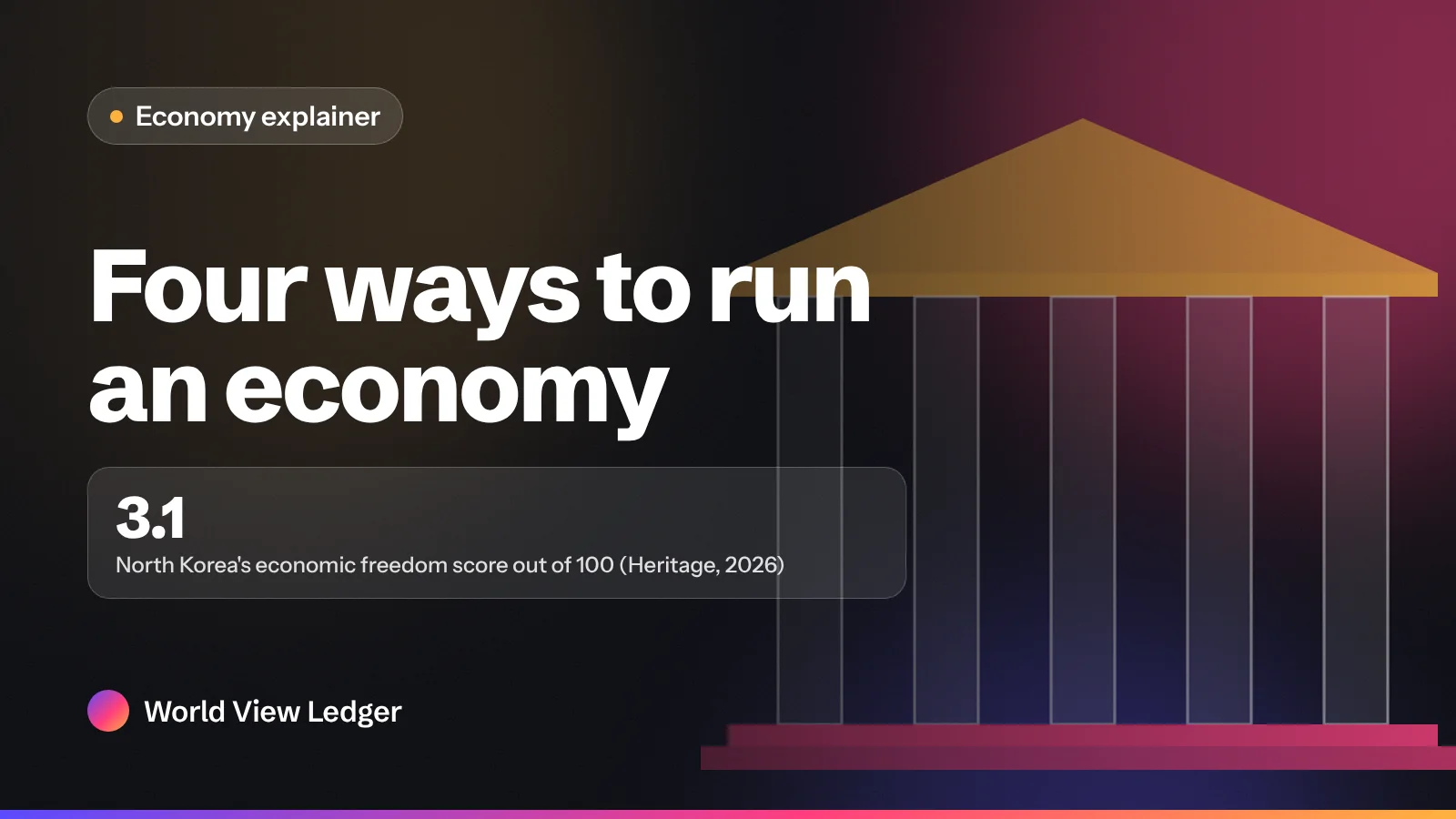
- North Korea is the purest command economy left: the Heritage Foundation's 2026 index scores it 3.1 out of 100, last of 176 countries. Cuba is second to last at 25.2.
- Cuba is loosening control: private small and medium firms grew from 262 in 2021 to 10,568 by September 2026, according to official data.
- The US, UK, Australia and UAE are all mixed economies. They differ in how much the state owns, spends and regulates, not in kind.
What is a command economy? A command economy is an economic system in which the government, rather than the market, decides what goods are produced, how much of each, at what price, and who receives them. Planners set targets, state-owned enterprises carry them out, and prices are fixed by officials instead of by supply and demand. North Korea is the clearest example still operating today.
A command economy is one of four classic economic systems that economists use to describe how societies organize production. The others are the market economy, the traditional economy and the mixed economy, which is what almost every country actually has. This guide explains each in plain English, shows how they work in real countries, and answers the questions students and curious readers most often ask about them.
First, what does "economy" mean?
An economy is the system a society uses to produce goods and services and to share them out. Because land, labor, time and materials are limited, every society has to answer three basic questions:
- What to produce? Bread or tanks, smartphones or steel.
- How to produce it? With which workers, machines and methods.
- For whom? Who gets the output, and on what terms.
The four economic systems are really four different ways of answering those questions. In a traditional economy, custom answers them. In a command economy, the government does. In a market economy, millions of buyers and sellers do, through prices. A mixed economy splits the job between markets and the state.
The four types of economies at a glance
| Traditional | Command | Market | Mixed | |
|---|---|---|---|---|
| Who decides what to produce? | Custom, family and community | Government planners | Consumers and businesses, through prices | Mostly markets, with government shaping key areas |
| Who owns land and businesses? | Families, clans or the community | Mainly the state | Mainly private owners | Mostly private, some public |
| How are prices set? | Barter, sharing or custom | Fixed by the state | Supply and demand | Mostly supply and demand, with some controls |
| Main strength | Stability, sustainability, strong community ties | Can mobilize resources fast for a single goal | Efficiency, choice and innovation | Balances growth with a safety net |
| Main weakness | Low productivity, vulnerable to shocks | Shortages, waste, weak incentives, little freedom | Inequality, booms and busts, neglect of public goods | Constant argument over the right balance |
| Real-world example | Subsistence farming and herding communities | North Korea, the former Soviet Union | None purely; Singapore and Switzerland come closest | US, UK, Australia, UAE and most countries |
What is a command economy?
In a command economy, also called a planned or centrally planned economy, a central authority draws up a plan for the whole economy and issues orders, or "commands," to the enterprises that must carry it out. The plan sets how many tons of steel to make, how many pairs of shoes, how much grain, and where each input should go.
Characteristics of a command economy
- State ownership. The government owns most factories, farms, banks and natural resources.
- Central planning. A planning agency sets output targets, often in multi-year plans.
- Fixed prices and wages. Officials, not markets, decide what things cost and what jobs pay.
- Allocation by plan. Raw materials and workers are directed to where planners want them.
- Few private businesses. Private trade is banned, restricted or tolerated only at the edges.
How it worked in the Soviet Union
The Soviet Union built the model that most command economies later copied. According to Encyclopaedia Britannica, the State Planning Committee, Gosplan, was created in 1921, and the first Five-Year Plan (1928 to 1932) poured investment into heavy industry, aiming to more than double steel output. Planners balanced expected supply and demand for key materials on paper, then handed each enterprise its quota.
The results showed both the strength and the weakness of the system. The Soviet Union industrialized at remarkable speed, but consumer goods were sacrificed to protect heavy-industry targets. Because managers were judged on hitting quantity targets, quality suffered: a target set in tons rewarded heavy products, and a target set in rubles rewarded expensive materials. Managers also hid spare capacity to get easier quotas, and fear of shortages encouraged hoarding. Britannica notes that Soviet critics themselves pointed to the "rigidity of prices, which did not reflect supply-demand conditions."
Command economy examples today
Very few command economies remain. The Heritage Foundation's 2026 Index of Economic Freedom, which ranks 176 countries on property rights, regulation, trade and government size, puts the two purest examples at the very bottom.
North Korea
North Korea is the closest thing to a pure command economy left on Earth. Heritage's 2026 country profile says state-owned industries account for nearly 100% of GDP and that the state sets production levels for most products.
Yet even North Korea has had to bend. When the state distribution system collapsed during the food shortages of the 1990s, markets known as jangmadang were permitted so people could get necessities. A 2022 analysis by the Korea Institute for National Unification counted 414 official markets, as summarized by 38 North. In recent years, the government has tightened control again: inspectors check permits, seize unlicensed and foreign goods, and the authorities keep trying to replace markets with expanded state stores, which tend to carry limited or poor-quality stock.
Cuba
Cuba has been state-run since the revolution, and Heritage's 2026 profile of Cuba describes price controls and firm state control of banking. But Cuba is moving, slowly, toward a mixed model. Private small and medium-sized enterprises, known as mipymes, were legalized in 2021. According to figures from Cuba's national statistics office reported by Directorio Cubano, their number rose from 262 in 2021 to 10,568 by September 2026.
In June 2026, Prime Minister Manuel Marrero told the National Assembly that private firms would be allowed to employ more than 100 people, that stock companies would be authorized and that agriculture would be opened to private enterprise, CiberCuba reported. The reforms come amid a deep economic crisis of blackouts and shortages.
How does the economy of Cuba differ from the economy of North Korea?
Both are run by communist parties and both rank last for economic freedom, but they differ in four important ways:
- Private business: Cuba has more than 10,000 legal private firms. In North Korea, private trading exists mainly in tolerated markets, not as legally recognized companies.
- Openness: Cuba depends heavily on tourism, remittances from Cubans abroad and some foreign investment. North Korea is one of the most isolated economies in the world and is under heavy international sanctions.
- Direction of travel: Cuba announced further liberalization in 2026. North Korea has been pushing to restore state control over markets.
- Measured freedom: Cuba scores 25.2 on the Heritage index, against North Korea's 3.1.
What about China and the former Soviet bloc?
China, Vietnam and Laos are ruled by communist parties, but they abandoned strict central planning decades ago and now rely heavily on private firms and market prices, while the state keeps control of strategic sectors. The Soviet Union and the Eastern Bloc dismantled their planning systems after 1989 to 1991. We cover how these labels overlap in our guide to socialism vs communism vs capitalism.
How a command economy affects ordinary citizens
Life in a command economy has some features that people value and many that they do not.
- Limited choice. Because the plan decides what gets made, shops may stock one brand or none. Consumer goods are usually a low priority compared with heavy industry and the military.
- Shortages and queues. Fixed prices that are too low create more demand than supply. The result is waiting lists, queues and rationing. Cuba has used a ration book for basic foods since 1962.
- Job security, but less freedom. Unemployment is officially low, and jobs, housing, education and health care are typically guaranteed or subsidized. But people may be assigned work rather than choosing it, and changing jobs or moving can require permission.
- A parallel economy. When the official system cannot deliver, people turn to informal or black markets, as North Koreans did with the jangmadang.
- Less political freedom. Historically, command economies have been run by one-party states, because controlling the whole economy requires controlling much of daily life.
What is a traditional economy?
A traditional economy is one in which decisions about production and distribution are guided by custom, religion, family roles and long-standing practice. People typically farm, herd, hunt, fish or gather, often producing mostly for themselves and their community, and trade by barter or sharing rather than money.
Traditional economies survive today in many rural and Indigenous communities: subsistence farmers in parts of sub-Saharan Africa and South Asia, nomadic herders, and communities in the Arctic and the Amazon that combine customary hunting and fishing with some cash income. They tend to be highly sustainable and socially cohesive, but productivity is low and a single drought or flood can be devastating.
Small family farming is still how much of the world feeds itself. The UN Food and Agriculture Organization estimated in 2021 that there are more than 608 million family farms, producing around 80% of the world's food by value, and that five out of six farms worldwide are smaller than two hectares (about five acres).
As incomes rise, people move off the land. A World Bank analysis found that in low-income Mozambique and Niger, 88% and 92% of the poorest 40% of households work in agriculture, while the share drops dramatically in high-income countries. That shift from traditional, farm-based work to industry and services is one of the most reliable patterns in economic development.
What is a market economy?
A market economy, often called a free-market or capitalist economy, is one in which private individuals and businesses own most property and decide what to produce, and prices are set by supply and demand. If people want more of something, its price rises, which signals producers to make more of it. If demand falls, prices drop and resources move elsewhere. Adam Smith called this coordination the "invisible hand."
The strengths are efficiency, consumer choice and innovation: competition pushes firms to cut costs and improve products. The weaknesses are inequality, boom-and-bust cycles such as recessions and depressions, and the tendency to underprovide things everyone benefits from but no one can easily charge for, such as clean air, basic research and national defense.
Examples of a market economy
No country has a pure market economy; every government at least enforces contracts and collects taxes. But some come much closer than others. In the 2026 Heritage index, the most market-oriented economies were Singapore (84.4), Switzerland (83.7), Ireland (83.3), Australia (80.1) and Taiwan (79.8). The US is also widely cited as an example of a market economy, ranking 22nd with a score of 72.8.
What is a mixed economy?
A mixed economy combines private markets with significant government involvement. Most businesses are privately owned and most prices are set by markets, but the government also regulates, taxes, redistributes income and provides services such as schools, roads, pensions and health care. Some industries may be publicly owned.
Almost every country today is a mixed economy. The real debate in democracies is not whether to have markets or government, but how much of each, and where.
How the mix looks in four countries
| Country | Heritage 2026 rank (score) | Market side | Government side |
|---|---|---|---|
| Australia | 4th (80.1) | Open, highly competitive private sector; strong property rights | Public health system (Medicare), compulsory employer-funded retirement savings (superannuation) |
| United States | 22nd (72.8) | Large private sector, deep capital markets, mostly private health care | Social Security, Medicare and Medicaid, public schools, extensive regulation |
| United Arab Emirates | 23rd (71.9) | No personal income tax, free zones with full foreign ownership | Large state-owned companies in energy, aviation and finance, and big sovereign wealth funds |
| United Kingdom | 29th (70.4) | Mostly private firms, a major global financial center | The NHS, publicly funded and largely free at the point of use; a broad welfare state |
The UAE is an interesting case for this comparison. It scores close to the US on economic freedom and has no personal income tax, yet the state plays a large role as an owner of major companies and investor of oil wealth. Freedom for private business and a big state footprint can exist side by side.
How a mixed economy can reduce unemployment
When unemployment rises, governments in mixed economies have tools that neither a pure market nor a command economy would use in the same way:
- Fiscal policy: extra government spending, for example on infrastructure, or tax cuts that put money in people's pockets and boost demand for workers.
- Monetary policy: central banks can lower interest rates to encourage borrowing and hiring. In the US, Congress has given the Federal Reserve a dual mandate of maximum employment and stable prices.
- Job training and placement: programs that help workers gain the skills employers need.
- Unemployment benefits: payments that support people between jobs and keep spending going during downturns.
These tools can pull in opposite directions when inflation and unemployment rise together, the problem explained in our guide to stagflation.
Command economy vs market economy: which works better?
The historical record is fairly clear on growth. Command economies have proven capable of rapid industrialization and of mobilizing resources for a single goal, such as war or space programs. Over the long run, though, they have struggled with shortages, poor quality, waste and stagnation, which is why most of them were abandoned or reformed. China's fastest growth came after it began allowing private enterprise and market prices from the late 1970s.
Pure markets have problems of their own, from financial crises to inequality and pollution, which is why no rich country runs one. The mixed economy became the global norm because it tries to keep the efficiency of markets while using government to handle what markets do badly. Where to draw that line is the central argument of modern politics, explored further on our economy page.
The bottom line
A command economy puts the government in charge of what is produced, how, and for whom. It can concentrate resources quickly but tends to deliver shortages and little choice, which is why only North Korea, and to a shrinking degree Cuba, still run close to the model. Traditional economies run on custom, market economies run on prices, and nearly every country, including the US, UK, Australia and the UAE, runs a mixed economy somewhere in between. When you hear a country's economy described with a single label, the more useful question is always: how much does the state own, plan, spend and regulate?
Frequently asked questions
What is one characteristic of a command economy?
The defining characteristic is central planning: a government body sets production targets, allocates resources such as steel, fuel and labor, and fixes prices, instead of letting supply and demand do it. Most large enterprises are owned by the state.
What is one way a command economy affects the lives of private citizens?
Citizens usually have little choice over what they can buy, because the state decides what is produced. Shortages, queues and rationing are common, as with Cuba's ration book. On the other side, jobs, housing and basic goods are often guaranteed or heavily subsidized, and many people are assigned to jobs rather than choosing them.
When compared to a mixed-market economy, a command economy typically has what?
A command economy typically has more state ownership of businesses, more government control over prices and production, fewer private firms, less consumer choice and less competition. A mixed economy lets markets set most prices while the government regulates, taxes and provides public services.
How does the economy of Cuba differ from the economy of North Korea?
Both are state-run, but Cuba now permits legal private businesses (more than 10,000 small and medium firms as of September 2026), relies on tourism and remittances, and has announced further reforms in 2026. North Korea's state industries account for nearly all of its GDP according to the Heritage Foundation, and its markets are tolerated rather than formally embraced, with periodic crackdowns.
In a mixed market economy, what is a typical way the government can reduce unemployment?
Governments typically use fiscal policy, such as extra spending on infrastructure and public projects or tax cuts that boost demand, along with job training programs. Central banks can also cut interest rates; in the US, the Federal Reserve's mandate from Congress includes maximum employment.
What is an example of a market economy?
There is no pure market economy, but Singapore, Switzerland and Ireland rank as the most market-oriented in the Heritage Foundation's 2026 Index of Economic Freedom. The US is also a classic example: most businesses are privately owned and most prices are set by markets.
- 2026 Index of Economic Freedom: Highlights, The Heritage Foundation, 2026
- 2026 Index of Economic Freedom: North Korea, The Heritage Foundation, 2026
- 2026 Index of Economic Freedom: Cuba, The Heritage Foundation, 2026
- Economic planning in communist countries, Encyclopaedia Britannica
- Beyond State Control: The Struggle Over North Korea's Markets, 38 North, Sep 2025
- Las mipymes en Cuba llegan a 10 568, según el balance de septiembre, Directorio Cubano (citing ONEI), 4 Nov 2026
- More companies, fewer limits: The new rules for the private sector in Cuba, CiberCuba, 19 Jun 2026
- Small family farmers produce a third of the world's food, FAO, 23 Apr 2021
- As incomes rise, farm employment drops, World Bank Data Blog, 5 Aug 2019
- What economic goals does the Federal Reserve seek to achieve through its monetary policy?, Federal Reserve Board, Aug 2025