- Home
- Technology
- Healthcare AI news
AI in Healthcare News: Diagnostics, Imaging and Regulation
The NHS has started recruiting women into EDITH, a trial of AI in breast screening with a planned 660,000 to 700,000 participants. Radiology's biggest meeting opens in Chicago on Sunday, and comments on a US Senate draft bill for health AI are due on Tuesday. Here is what happened in diagnostics, imaging and regulation, and what to watch next.
Key points
- The NHS has begun recruiting for EDITH, described as the world's largest trial of AI in breast cancer screening, starting at Cambridge University Hospitals, the first of about 30 UK sites.
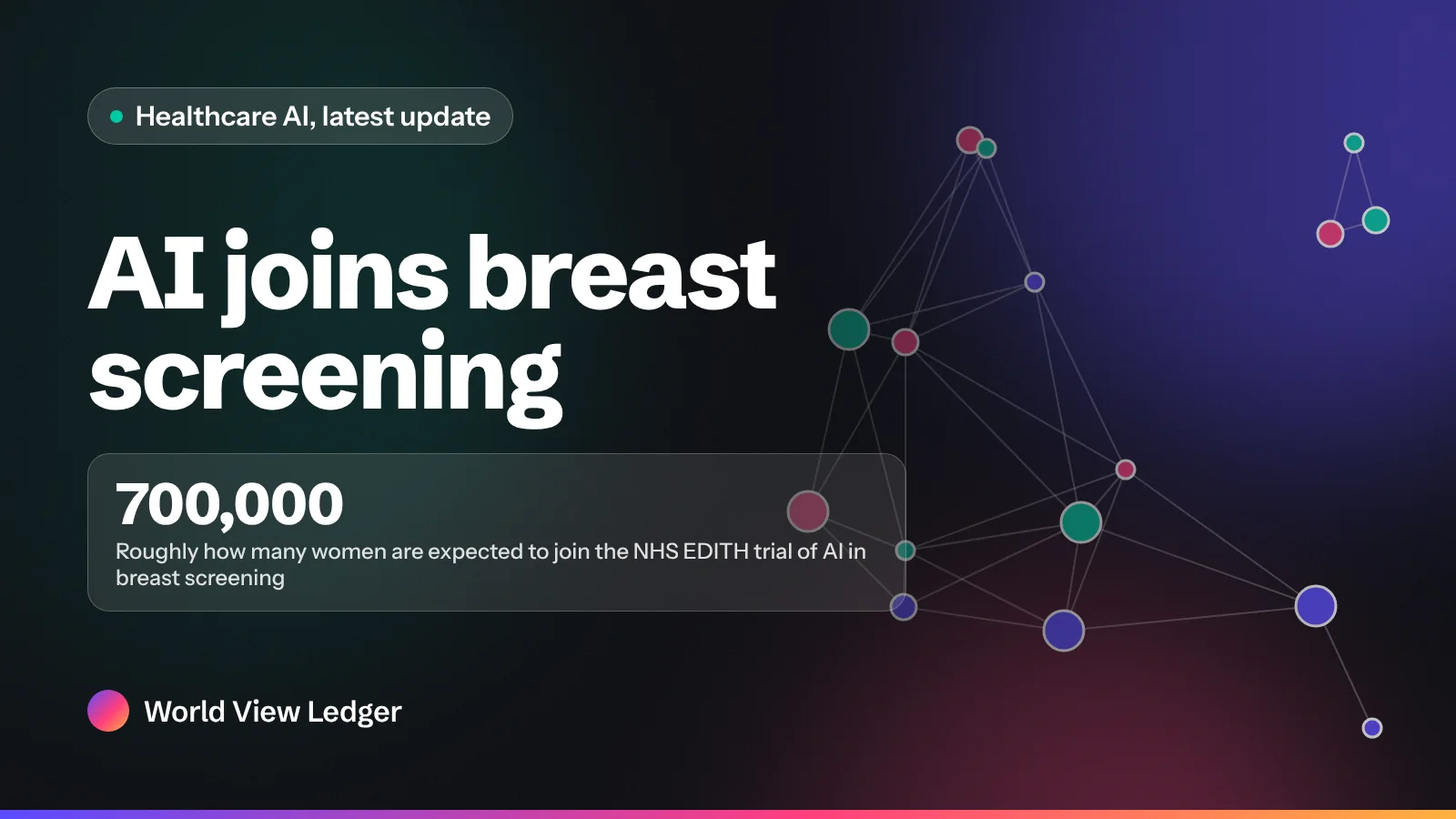
- Nearly 700,000 women are expected to take part (the trial's own page plans 660,000). It is funded by the NIHR, with reported funding of £10 million to £11 million.
- Every mammogram in the trial is still read by at least one human expert. The main measures are how many cancers are found and how many women are recalled.
- RSNA 2026, radiology's largest meeting, runs November 29 to December 3 in Chicago, with more than 100 companies planning to demonstrate AI tools.
- In the US, comments on Senator Bill Cassidy's draft PATIENT AI Act are due December 1. The draft would change FDA software review and test Medicare payment for autonomous AI.
The NHS EDITH trial of AI in breast screening is now recruiting at Cambridge University Hospitals, with about 30 UK sites to follow. RSNA 2026 opens in Chicago on Sunday, November 29, and comments on the US Senate's draft PATIENT AI Act close on Tuesday, December 1.
The biggest healthcare AI news today is that the NHS has started recruiting for EDITH, described as the world's largest trial of artificial intelligence in breast cancer screening. Nearly 700,000 women are expected to take part, and every scan will still be read by a human expert.
Below: what the trial tests and why, the imaging AI on show at radiology's biggest meeting, where US and European rules for health AI stand, and the dates to watch.
What happened: the NHS opens its AI breast screening trial
Recruitment for EDITH (Early Detection using Information Technology in Health) has begun at Cambridge University Hospitals, the first of 30 sites across the UK, the BBC reported on November 23. Women in Cambridgeshire are the first to join, according to the Cambridge Independent. Health and Social Care Secretary Yvette Cooper said: "This is the biggest AI breast cancer trial in the world."
The key facts, and where the sources differ:
- Size: nearly 700,000 women, according to the BBC, the Cambridge Independent and the government. The trial's own page at Warwick Clinical Trials Unit plans 660,000.
- Money: funded by the National Institute for Health and Care Research (NIHR). The Cambridge Independent reports £10 million; the BBC reports £11 million.
- Length: the BBC says around three years. The Warwick page gives a planned four years, with cancer follow-up for four more.
- Leaders: co-chief investigators Professor Sian Taylor-Phillips (University of Warwick) and Professor Fiona Gilbert (University of Cambridge), working with NHS England.
- Who is screened: NHS breast screening invites women aged 50 to 71 every three years. Women are told about the trial in their invitation letter and can opt out.
How the trial works
Today, two NHS experts read each set of mammograms. EDITH compares that standard with AI-assisted reading. In one arm, AI grades images before they reach experts, flagging low and high risk. In another, it reviews images after the experts have read them, to catch cancers they might have missed. The BBC says one of the two human readers will be replaced by AI in the trial, and dpa reports that low-risk scans in the AI groups get one expert read while high-risk scans get two.
The trial's two main measures are the cancer detection rate and the recall rate (how many women are called back for more tests). It will also weigh costs and benefits. Four AI systems were tested for accuracy beforehand, but the companies involved have not been named in reporting so far.
The trial runs on AIR-SP, a platform NHS England built with nearly £6 million of government funding to plug AI tools into screening, according to GOV.UK.
Why it matters: a radiologist shortage and promising early data
The NHS needs more reading capacity. Gilbert told the BBC there is a "huge shortfall" of radiologists while imaging examinations rise 8% a year. Our explainer on what National Insurance pays for shows how much payroll tax money goes to the NHS.
The early evidence is encouraging but limited. In a study of 10,889 women screened by NHS Grampian, published in Nature Cancer in March, AI used as an extra reader increased breast cancer detection by 10.4%, according to the University of Glasgow. The researchers said it could cut reading workload by more than 30% and reduced the time to notify women from 14 days to 3.
A single-region study cannot show whether the benefit holds across the UK, or whether extra cancers found are ones that would have caused harm. That is the gap EDITH is designed to fill.
Medical imaging AI: what to watch at RSNA 2026
RSNA 2026, the Radiological Society of North America's 112th annual meeting, runs November 29 to December 3 at McCormick Place in Chicago, according to RSNA and Choose Chicago. More than 700 companies have registered to exhibit, and more than 100 plan to demonstrate AI and machine learning products, many in a 52,000-square-foot AI Showcase.
Scheduled presentations listed by RSNA include a study of deep learning MRI acceleration across 598,833 exams, reporting 20% higher throughput without extra staff; a prospective multicenter comparison of AI as a reading aid versus triage in breast screening; and two-year results from a trial of AI-augmented prostate biopsy. These are presentation titles; the full results will come out at the meeting. Winners of RSNA's Knee Abnormality Detection AI Challenge are due on December 2.
Vendors are already positioning. Subtle Medical said on November 25 that its FDA-cleared software makes MRI sequences up to 80% faster and runs on more than 1,500 scanners. Those are company claims, not independent findings.
Regulation: the US, UK and Europe take different routes
In Washington, Senate HELP Committee chairman Bill Cassidy released a discussion draft of the PATIENT AI Act on October 29, with comments due December 1, Akin Gump reported. It would add a risk-based FDA review route for software, allow certified third-party reviewers and run a voluntary post-market monitoring pilot. It would also have CMS test a five-year payment model for AI that performs clinical tasks "autonomously," though the draft does not define that word or set payment rates, according to Medical Daily. It is a draft, not an introduced bill, and Cassidy leaves the Senate when his term ends in January.
The FDA, meanwhile, has been consulting on generative AI devices. About 540 stakeholders commented on its discussion paper before the October 19 deadline, according to law firm Mintz. On November 4 the agency published a new device classification for a digital cervical cytology slide imaging system that uses an AI algorithm.
In Europe, all 53 member states of the WHO European Region adopted the region's first roadmap for AI in health on October 29, according to WHO Europe. Its survey found nearly two in three countries already use AI for diagnosis, but only 8% have a health-specific AI strategy. "AI is already in our clinics and hospitals," said Dr Natasha Azzopardi-Muscat of WHO Europe.
| Where | Latest move | Next milestone |
|---|---|---|
| United Kingdom | NHS EDITH trial begins recruiting (Nov 2026) | Rollout to about 30 screening sites |
| United States | PATIENT AI Act discussion draft (Oct 29); FDA generative AI consultation | Draft comments due Dec 1, 2026 |
| WHO European Region | 53 countries adopt AI in health roadmap (Oct 29) | Midterm progress report in 2029 |
What it means for patients
- In the UK: if you are invited for breast screening near a trial site, your letter will explain EDITH and how to opt out. Your appointment itself does not change.
- In the US: AI is already used in many imaging centers, but payment and liability rules are unsettled. The Cassidy draft shows one direction Congress is considering.
- Everywhere: the question has shifted from whether AI can read scans to whether it improves outcomes at scale. Large trials like EDITH are how that gets answered.
For the chips and companies powering medical AI, see our AI industry news tracker, and for more coverage visit our technology section.
This is general information, not medical advice; see our disclaimer and talk to your doctor about your own screening.
What's next: key dates
- Nov 29: RSNA 2026 opens in Chicago; exhibits and the AI Showcase run to Dec 2.
- Dec 1: comments due on the PATIENT AI Act discussion draft.
- Dec 2: RSNA announces its Knee Abnormality Detection AI Challenge winners.
- Dec 3: RSNA 2026 closes.
- January 2027: Cassidy's Senate term ends.
- 2027 onward: EDITH expands across UK screening sites; results come after the women screened have been followed up.
Frequently asked questions
What is the EDITH trial?
EDITH (Early Detection using Information Technology in Health) is an NHS trial testing whether AI helps experts find breast cancer in routine mammograms. Recruitment began in November 2026 at Cambridge University Hospitals, the first of about 30 sites, and nearly 700,000 women are expected to take part. It is funded by the National Institute for Health and Care Research.
Will AI replace radiologists in breast screening?
Not in this trial. Every mammogram will still be read by at least one human expert, and clinical decisions stay with NHS staff. In the AI arms, the software either sorts images by risk before experts read them or checks them afterwards, which could mean some scans need one human reader instead of the usual two.
When is RSNA 2026?
RSNA 2026, the Radiological Society of North America's 112th annual meeting, runs from November 29 to December 3, 2026, at McCormick Place in Chicago. The exhibit halls open November 29 to December 2, including an AI Showcase.
Is AI in healthcare regulated in the US?
Partly. The FDA reviews AI software that counts as a medical device, and it has been consulting on generative AI devices. Many other uses, such as administrative tools, fall outside that review. Senator Bill Cassidy's draft PATIENT AI Act, open for comments until December 1, 2026, proposes changes but is not yet a bill.
- Can AI spot breast cancer earlier? NHS launches world's largest trial to find out, BBC News, 23 Nov 2026
- World's largest trial of AI to aid breast cancer screening begins in Cambridge, Cambridge Independent, 24 Nov 2026
- Can AI diagnose breast cancer faster? A major trial aims to find out, dpa via Yahoo News, 26 Nov 2026
- EDITH trial, Warwick Clinical Trials Unit, University of Warwick, 19 Jan 2026
- Pioneering study finds AI increases cancer detection by more than 10 percent, University of Glasgow, 13 Mar 2026
- AI to be trialled at unprecedented scale across NHS screening, GOV.UK, 22 Sep 2025
- RSNA 2026 Technical Exhibits Spotlight Medical Imaging Innovation, RSNA, 6 Oct 2026
- RSNA 2026 Highlights Advances in Medical Imaging, RSNA, 2 Nov 2026
- RSNA 2026, Choose Chicago, 2026
- Sen. Cassidy Unveils PATIENT AI Act Discussion Draft on Health Care AI, Akin Gump, 29 Oct 2026
- Medicare Could Test Paying for AI That Performs Clinical Tasks on Its Own Under Cassidy's Senate Draft, Medical Daily, 1 Nov 2026
- FDA in Flux: November 2026 Newsletter, Mintz, 19 Nov 2026
- CDRH New: News and Updates, US Food and Drug Administration, 25 Nov 2026
- 53 Member States of the WHO European Region adopt new plans on healthy ageing and AI in health, UNRIC / WHO Europe, 30 Oct 2026